
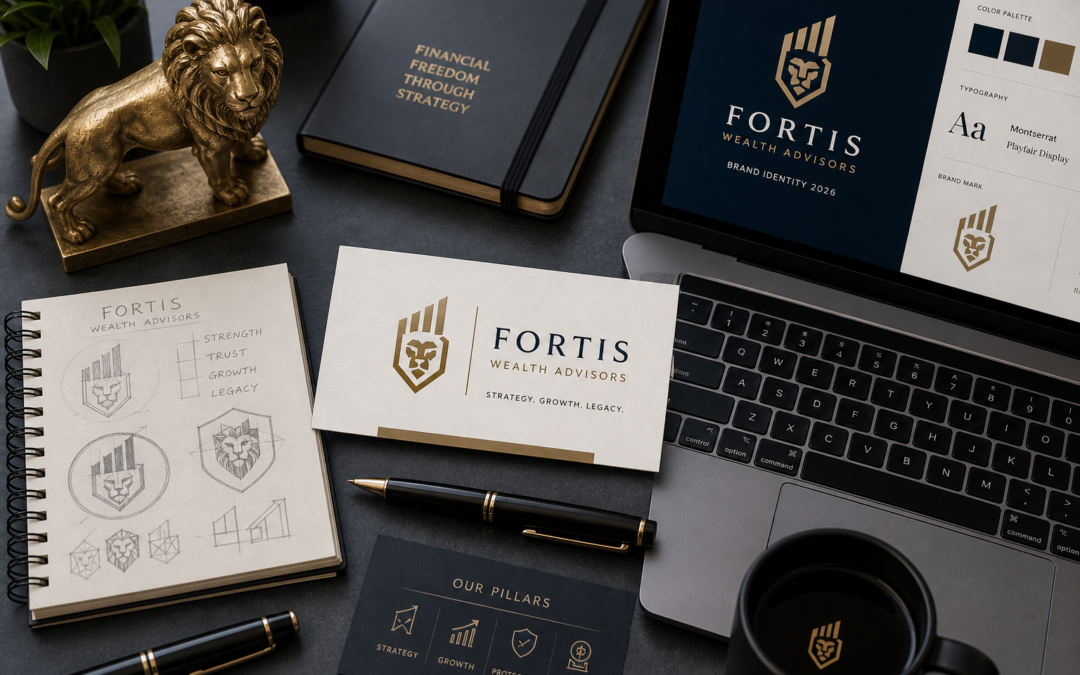
Brand identity and logo design for financial advisors go well beyond having a polished look—they help create trust, communicate expertise, and make your firm memorable in a field where credibility is essential. If branding is treated as an afterthought, advisors risk missing out on growth opportunities. Taking a thoughtful, research-informed approach to brand identity can be the difference between standing out as a trusted leader and blending into the crowd. In this guide, you’ll find a plain-language breakdown of what effective brand identity means for financial advisors, actionable tips based on industry research, and a step-by-step framework you can actually use.
Key Takeaways
- Brand identity and logo design for financial advisors are practical tools that shape trust, client perception, and business growth—not just cosmetic upgrades.
- Elements like color, typography, and consistency have a real impact on credibility and recall. For example, research shows that color choices and logo quality can influence client decisions (Capital One Shopping).
- Defining a focused niche and aligning your brand with that audience is crucial—generic branding makes it difficult to establish authority or stand out.
- It’s easy to undermine your brand with do-it-yourself design or by neglecting physical assets like business cards. A professional, compliance-aware process is key.
- Following a clear, step-by-step branding process that’s backed by research and consistently applied is much more effective than chasing trends or using off-the-shelf templates.
Defining ‘Logo Design for Financial Advisors’—What Does It Really Mean?
Logo design for financial advisors isn’t just about picking a symbol or color scheme—it involves creating a visual identity system that signals trust, expertise, and a clear sense of who your ideal client is. This system includes the logo itself, color palettes, fonts, and guidelines for how your brand appears everywhere from your website to your business cards. The goal is to build recognition and trust from the first impression.
Why Brand Identity Matters More for Financial Advisors Than Most Professionals Think
Financial advisors work in a field where trust is central. Clients are making weighty decisions about their financial future, so they pick up on any cues of professionalism and reliability—often before they ever speak to you. Too many advisors assume branding is a luxury or just about aesthetics, but relying on word of mouth alone often limits growth.
Visuals matter more than many realize. According to Advisor Guidance, 75% of consumers recognize a brand by its logo, and 60% will avoid a company with an unattractive or unprofessional logo—even if it has strong reviews. This means that a sharp, consistent brand identity and logo set expectations from the first website visit or handshake.
And it’s not only about visuals: research from Smead highlights that consistent branding across materials helps reinforce a firm’s credibility, while the Color Matters project notes that color psychology can play a role in immediate trust judgments. In short, brand identity is less about your personal taste and more about shaping the signals that clients rely on when choosing an advisor.
The key is to approach branding as a decision-making tool for clients. If your logo or brand materials look generic or inconsistent, they may subtly undermine your expertise, regardless of your track record.
What Actually Goes Into a Standout Brand Identity for Financial Advisors?
A true brand identity package is more than a logo and some colors. For financial advisors, it’s a full system that enables instant recognition, trust, and alignment with your ideal client. The essentials include a professionally designed logo, clear color and typography systems, usage guidelines, business card designs tailored for financial services, and templates for digital and print materials. But the strategic side is just as important: you need a clear brand message, a unique value proposition, and a well-defined position in your market.
Most advisors run into trouble when they jump straight to visuals without first defining their ideal client. The best branding efforts start with niche clarity—whether your audience is retirees, business owners, physicians, or another specialized group. According to Aryze Design, top-earning advisors often have a well-defined niche, and consistent branding can contribute to long-term revenue growth. Without that focus, even the best-looking logo might not resonate with your audience.
Consistency across all brand elements isn’t just a nice-to-have. As Capital One Shopping notes, using a consistent color palette improves brand recognition. Every touchpoint—from your website to your LinkedIn banner—should use the same colors, fonts, and tone. For a breakdown of what a full identity package should include and how much you might budget, see Brand Identity & Logo Design Costs in 2026: Real Pricing.
If you’re looking for additional outside perspectives, the Financial Planning magazine explores why a strong brand is essential in building trust with clients, while Forbes Finance Council discusses how strategic branding impacts client acquisition and retention in financial services.
Logo Design Tips for Financial Advisors: What Actually Works (and What to Avoid)
Many logo design tips online miss the specific psychological needs of the financial sector. The most common pitfall is copying the look of big banks or using tired symbols like dollar signs, bar graphs, or shields. These choices tend to make you blend in instead of standing out. The best logos for financial advisors are usually simple, restrained, and built around your core values and what you promise clients.
Color choices are more than just a matter of preference—they signal trust. Blue, for example, is strongly tied to reliability and is a popular choice in finance: 54% of shoppers are more likely to trust a brand that uses blue (Capital One Shopping). But using only blue, or pairing it poorly, can make your brand fade into the background. Advisors with a specific niche often benefit from a more distinctive palette, such as warm neutrals or a sophisticated accent color.
Logo structure matters, too. According to Capital One Shopping, most brands have symmetrical logos, but people tend to view asymmetrical logos as more dynamic and interesting. If your target clients are younger or entrepreneurial, a slightly asymmetrical logo—balanced with clear, professional typography—can suggest innovation.
For further expert advice on effective logo strategies, the Smashing Magazine Logo Design Guidelines provide broader industry context on what makes logos memorable and effective.
Case Example: Building Authority Through Brand Identity—A Niche Advisor’s Journey
Consider a solo advisor whose focus is financial planning for tech founders. She started out with a generic logo and a vague “wealth management” tagline. Despite strong credentials, her business plateaued. After a rebrand, she adopted a geometric, slightly asymmetrical logo in deep blue and silver, and shifted her messaging to emphasize “futureproofing liquidity events.” Her business cards were updated to premium stock with embossed details, and her website was redesigned to match.
Soon after, prospects started mentioning her tech focus and describing her as “tech-forward.” While not every new client can be credited directly to a new logo, the rebrand created a clear, consistent impression that aligned with her audience’s expectations. This example shows how strategy-driven brand identity and logo design for financial advisors can raise your profile and relevance in a competitive market.
For a look at how branding strategy works in other fields, How Top Restaurants Use Brand Identity to Win More Customers breaks down the same principles—matching every detail of your visual and verbal branding to what your audience cares about most.
DIY, Freelancer, or Agency: Which Branding Route Fits Financial Advisors?
Not all branding solutions are equal. Financial advisors can try doing it themselves, hire a freelance designer, or work with an agency that understands financial compliance. Each route has its trade-offs, especially given the regulatory requirements in finance. Here’s a practical comparison:
| Option | Pros | Cons | Best For |
|---|---|---|---|
| DIY Tools (e.g., Canva, Looka) | Lowest upfront cost, quick results, full control | Template-based, can look amateur, lacks strategic or compliance input | Early-stage advisors with minimal budget or testing ideas |
| Freelance Designer (via Upwork, Dribbble) | Custom design, moderate cost, flexible collaboration | Quality and process can vary, may not know financial regulations, limited strategic input | Advisors with focused needs and time to manage the project |
| Branding Agency (with financial sector experience) | Research-based strategy, full identity suite, compliance-ready assets | Higher investment, takes longer, requires more involvement | Established firms seeking lasting positioning and differentiation |
A key detail: many advisors underestimate the value of strategic direction and compliance knowledge. A logo that works for a tech startup or fitness studio might not suit a financial advisor if it feels unstable or lacks the seriousness clients expect. For a detailed look at typical costs and deliverables for each approach, see Brand Identity & Logo Design Costs in 2026: Real Pricing.
For more on what to ask when hiring a designer or agency, the Entrepreneur Guide to Hiring a Branding Agency can help you vet your options.
The S.T.A.B.L.E. Framework for Financial Advisor Branding
To avoid common pitfalls and create a brand that lasts, use the S.T.A.B.L.E. Framework—a practical, step-by-step guide for financial advisors. Here’s how to put each stage into action:
- Specialization: Get clear on your niche and ideal client. Use your CRM, client interviews, and even competitor websites to map out who you serve best and what they care about. Try listing your top five clients and noting what they have in common—their profession, life stage, or financial goals. This shapes every other branding decision.
- Trust Signals: Identify the colors, icons, and tone of voice that make clients feel secure. While blue and muted tones are common for a reason, don’t just copy competitors—look at your audience’s preferences. For example, if you work with physicians, softer blues and greens might resonate. Research from Color Matters shows that color choices influence first impressions, so choose your palette intentionally.
- Authenticity: Build your story around real strengths and differentiators, not industry clichés. Draft a short positioning statement that explains why you’re different, then test it with a few trusted clients or colleagues. Ask them if it feels specific and genuine, or if it could apply to any advisor. Revise until your message feels true and unique.
- Bespoke Design: Work with a designer or agency who understands financial regulations (such as SEC or FINRA guidelines). Request several logo concepts and review each for originality and clarity, not just visual appeal. Compare your shortlist to local competitors’ logos to avoid accidental similarities.
- Lasting Consistency: Create detailed brand guidelines covering logo usage, color codes, font choices, and simple “do’s and don’ts” for imagery. Use these guidelines across your website, social media profiles, business cards, and print materials. Set a quarterly reminder to review all assets for consistency—many firms lose ground here without realizing it.
- Engagement Assets: Go beyond the basics. Invest in business cards, folders, and presentation templates that reinforce your brand. For example, a custom onboarding kit or a premium-feel folder for client reports can make a lasting impression in meetings and networking events.
Treat these steps as a working checklist—print them out or share them with your team. For advisors adding digital assets, resources on Logo & Business Card Design and Website Development & Management can help ensure your identity is consistent everywhere clients interact with you.
If you want to see how a framework-driven process can help you avoid branding pitfalls, the article Branding Agency Processes: What Actually Works in 2026 offers a comparison of methodologies and real-world case studies.
Branding Beyond the Logo: Why Business Cards and Print Collateral Still Matter
With so much focus on digital marketing, it’s easy to overlook the value of physical branding assets. But for financial advisors, business card design and print materials still play a big role in networking, onboarding, and client referrals. A well-designed card—printed on quality stock, with a distinctive logo and consistent branding—can be the first tangible reminder a prospect has of your firm.
Physical quality makes a difference. Premium card stock, subtle embossing, or a unique cut can make your brand more memorable than a flimsy, mass-produced card. The same goes for print collateral—folders, reports, and flyers that use your brand colors and fonts help reinforce professionalism at each step of the client journey.
To connect print and digital, you can add QR codes or NFC chips to business cards, making it easy for clients to visit your website or book a call immediately. For creative ideas and typical cost ranges, see Print Marketing & Flyer Design Costs in 2026: Real Pricing Insights.
For more insight into the role of print in modern branding, the Printing News analysis explores why physical business cards remain relevant, even in a digital-first world.
Common Mistakes in Financial Advisor Branding (And How to Avoid Them)
Obvious mistakes—like blurry logos, mismatched colors, or generic stock images—are easy to spot. But subtler errors can be even more damaging. One frequent misstep is failing to update brand assets after a merger, business pivot, or service expansion, which can leave clients unsure about what you actually do.
Another trap is inconsistency: using one set of colors and logos on your website, and another on your print materials or social profiles. This kind of drift can erode trust and make your firm look less established. The remedy is a living brand guidelines document, backed by regular audits to keep everything on track.
For industry-specific lessons on what not to do, 7 Logo Design Mistakes Costing Cosmetic Clinics Leads offers cautionary tales that apply to financial advisors as well—especially the risks of quick DIY fixes.
To further deepen your understanding of branding pitfalls, the Investopedia guide to branding mistakes in finance covers common errors and how to avoid them.
Integrating Brand Identity with Modern Financial Services Marketing
A strong brand identity only works if it’s carried through across every digital touchpoint. Prospects will Google you, check your LinkedIn, and scan reviews—so your logo, color palette, and messaging need to match everywhere. This means investing in high-resolution logos, branded social media templates, and consistent messaging in all content.
Top firms often use tools like Canva for quick graphic creation, Figma for collaborative design, and CRM platforms like HubSpot or Salesforce to maintain brand consistency in communications. Many advisors now use AI-powered content tools and AI social media management to keep their message on-brand at scale. For video, make sure your visual identity is present in intros, outros, and overlays—see video creation for practical ways to keep your brand consistent in motion.
When you layer in analytics, a clear identity simplifies tracking and segmentation, helping you see what works and where to improve. For a practical overview of how brand consistency supports paid marketing, check Best AI Advertising Management for Financial Advisors in 2026.
For more detail on integrating branding with digital marketing, Advisor Perspectives provides a look at how branding and digital marketing work together for financial advisors.
What to Expect: Honest Trade-Offs in Rebranding for Financial Advisors
Rebranding isn’t a quick fix. It takes time, investment, and a willingness to let go of familiar assets. The trade-off is often between some short-term confusion for existing clients and long-term gains in positioning, visibility, and growth.
High-quality brand identity and logo design for financial advisors is a real investment. Many established practices budget somewhere in the low-to-mid four figures for a full rebrand, though costs vary depending on the depth of strategy, number of collateral pieces, and level of research involved. Agencies with financial sector experience may cost more, but often deliver assets that hold up under compliance scrutiny and client expectations.
For those comparing costs and value, Brand Identity & Logo Design Costs in 2026: Real Pricing shares realistic, scenario-based examples. If you’re considering AI-powered creative or analytics, working with a specialist—such as Lion Click Media—can help you avoid common pitfalls and scale your brand identity effectively.
For a deeper look at the process of rebranding, the McKinsey report on branding in financial services offers industry-wide insights and case studies.
Building a Timeless Brand Identity: Your Next Best Steps
Brand identity and logo design for financial advisors are core investments in a profession built on trust, memorability, and clear differentiation. The firms that stand out in the years ahead will be the ones who treat branding as a strategic advantage—starting with clarity about their audience, investing in professional design, and enforcing consistency at every client touchpoint.
Remember: branding isn’t a one-and-done project. Your identity should adapt as your practice, niche, and client expectations change. Whether you’re refining your message, updating your business card design, or adding new digital tools, a framework-driven approach helps you avoid missteps and build steady growth.
To move forward, review your current identity assets, use the S.T.A.B.L.E. Framework to plan your next steps, and focus on investments that earn trust and recognition for the long term.
Frequently Asked Questions
How long does it typically take to design a logo for a financial advisor?
Designing a logo usually takes between two to six weeks, depending on research, revisions, and final approvals.
Can I use bright colors in my financial advisor logo?
While bright colors can attract attention, financial advisors should use them sparingly since clients expect trust and stability, often conveyed by blues and neutrals.
Is a business card still important for financial advisors in 2026?
Yes, business cards provide a tangible, professional impression that digital channels alone can’t replicate, especially at networking events.
What software tools do agencies use for financial advisor logo design?
Professional designers often use Adobe Illustrator and Figma for precise vector-based logo creation, ensuring scalability and quality across formats.
Should financial advisors update their logos regularly?
Logos should evolve carefully; frequent changes can confuse clients. Updates every several years to modernize without losing recognition are best.
How can AI help with branding for financial advisors?
AI can streamline content creation, social media management, and data analytics, helping advisors maintain consistent messaging and measure brand performance.
What common mistakes should financial advisors avoid in brand identity?
Avoid overly complex logos, inconsistent visuals, and ignoring client expectations for professionalism and trustworthiness.
Get Your Free AI Marketing Audit
See exactly where you are leaving leads on the table and how Lion Click Media can help you rank higher, capture more customers, and Make Your Brand ROAR. No cost, no obligation.
Claim My Free Audit →Or chat with our 24/7 AI assistant (bottom-right) for instant answers.