
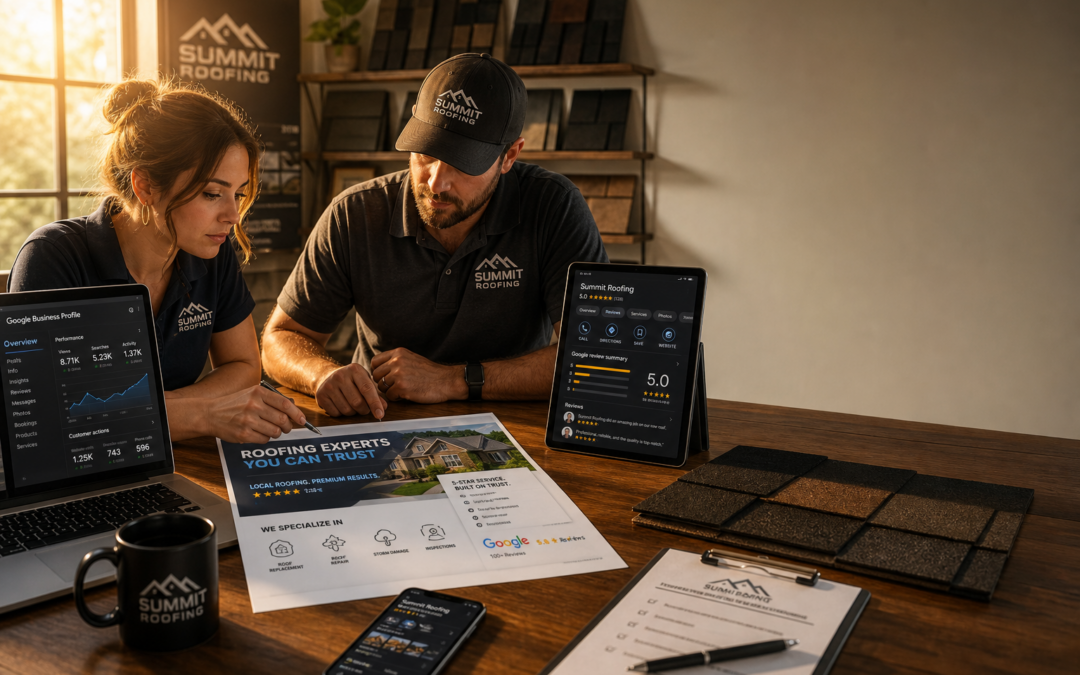
Most roofing companies fall short on Google Business Profile optimization because they treat it as a one-off administrative task, overlooking the fact that ongoing, customer-focused updates are what truly drive local search visibility. Instead of routinely refining categories, updating service details, and actively managing reviews with the homeowner’s urgent needs in mind, many businesses settle for a basic, static listing. This passive approach means your competitors could be capturing leads that should come to you. The contrast between a neglected profile and one that’s maintained with regular, meaningful updates is often the difference between being overlooked online and consistently appearing in your local map results.
Key Takeaways
- Choosing and maintaining the correct primary Google Business Profile category (“Roofing Contractor”) is essential—mislabeling significantly reduces your local search visibility.
- Ongoing updates—photos, business hours, and detailed service descriptions—are critical for attracting and converting local leads.
- Consistent, complete business information (name, address, phone) and proactive review management are minimum requirements for ranking and building customer trust.
- Your profile should reflect how real customers search—not just the services you want to highlight.
- Neglecting basics like accurate hours, defined service areas, and review replies can quickly lead to a noticeable decline in calls and map visibility, as supported by industry case studies.
Why Do Most Roofing Companies Struggle with Google Business Profile Optimization?
A common pitfall is viewing Google Business Profile optimization as a simple checklist to complete once, then ignore. This “set-and-forget” approach misses how Google’s local algorithm prioritizes businesses that signal ongoing accuracy, engagement, and relevance. For roofers, this is especially costly since most customers search in urgent situations (“roof leak near me,” “emergency roof repair open now”). If you’re not actively refreshing hours, services, and reviews, you’ll be invisible when it matters most. Google’s own official documentation emphasizes the importance of accurate, updated information for search performance, and industry resources like the TruLata Blog echo these findings for service businesses.
Another frequent mistake is focusing on company history or technical details that matter more to the business than to customers. Many roofing companies fill their profile with internal jargon or outdated company milestones, but omit the practical details homeowners search for—such as specific roofing services, accurate service areas, and current business hours. Audits of real-world profiles have shown that incomplete information, inconsistent listings across directories, and incorrect primary category choices are especially common among roofers and directly hurt map rankings (SEO Roofing).
The takeaway: treating your Google Business Profile as a static listing is a quick way to lose leads. Only companies that take a dynamic, customer-driven approach—adapting to both Google’s evolving standards and real-world search patterns—consistently perform well in local search.
What Actually Moves the Needle in Local SEO for Roofers?
Much of the advice given to local roofers about SEO is either too generic (“get reviews”) or overly technical without real-world context. What matters most is aligning your Google Business Profile with how local homeowners actually search and choose a service. According to Strategyc, the vast majority of Google Business Profile views come from category-based searches—not from people entering your business name directly. This means relevance to searcher intent is far more important than brand awareness alone.
- Primary Category: Choose “Roofing Contractor” as your main category. Using broader titles like “Contractor” or “Home Improvement” will sharply reduce your profile’s relevance for roofing searches.
- Service Listing: Clearly list every service you offer—such as “roof replacement,” “emergency tarping,” or “storm damage repair”—in everyday language that matches what customers actually type into Google.
- Consistency: Ensure your business name, address, phone, and hours are identical everywhere online—on your website, in directories, and in your Google profile. This matching data, known as NAP consistency, is a key trust signal for both Google and homeowners.
- Media: Add real, high-quality photos regularly (think before/after shots, your branded vehicles, your team at work). Avoid using only stock photos, which can reduce trust and signal inauthenticity.
These steps are more than just minor adjustments. For example, in a case study tracking service businesses over time, consistent Google Business Profile optimization was linked to dramatic improvements in profile engagement and lead flow (Rankit99). While your own results will vary, most companies see a clear increase in visibility and incoming calls when they maintain their profile actively.
To get practical, listen closely to what customers ask when they call or email. What exact words do they use? Which services do they mention? Incorporate those terms directly in your profile fields—don’t just copy boilerplate from your website. Roofers who do this see their profile resonate better with both search engines and real homeowners.
What Is the Cost of “Set-and-Forget” Optimization?
A passive Google Business Profile doesn’t just limit your growth—it can actively cost you leads. Google’s local search algorithm prioritizes businesses with complete, current, and recently-updated profiles, as outlined in Google’s own resources and supported by industry experts such as the TruLata Blog. Outdated hours or vague service lists will knock your listing out of the “emergency” and “open now” search results that often deliver the most urgent, high-value leads.
Imagine a sudden storm in your area. Dozens of homeowners might search for “emergency roof repair near me.” If your profile doesn’t reflect extended hours or mention urgent services, you simply won’t appear in the results—while a competitor who keeps their information fresh will win those calls. Failing to respond to reviews, whether positive or negative, signals a lack of engagement and can reduce trust quickly.
The impact is clear: fewer calls, fewer requests for directions, and less presence in your own neighborhood. Meanwhile, a nearby competitor who regularly adds project photos, updates hours, and responds to every review will gradually attract and convert more local leads.
The R.A.F.T. Framework: A Reliable Process for Roofing Business Google Profile Optimization
To avoid the most common missteps, roofing companies can use the R.A.F.T. Framework—a practical, four-step approach specifically for local service businesses. Here’s how to take this framework beyond a checklist, with hands-on examples and tools for each step:
-
Real-World Category Selection
- Audit the top-ranking roofers in your city by searching “roofing contractor near me.” Note their primary category—nearly all successful profiles use “Roofing Contractor.”
- Check Google’s official category list to confirm the most up-to-date options.
- If you offer additional services (like gutter cleaning), add these as secondary categories only if you genuinely provide them—don’t overstuff with irrelevant categories.
- Example: If you’re a roofing company that also installs solar panels, add “Solar Energy Contractor” as a secondary category, but never as your primary unless roofing is a minor part of your business.
-
Accurate, Consistent Information
- Use tools such as Whitespark or Moz Local to scan for NAP (Name, Address, Phone) inconsistencies across the web.
- Keep a master spreadsheet of your business info and have someone double-check it quarterly—typos or mismatches between your website, directories, and Google profile can suppress your rankings.
- When listing service areas, be specific—list every neighborhood, town, and zip code you serve, not just your main city. For example: “Serving Costa Mesa, Newport Beach, Huntington Beach, and all of Orange County.”
- During busy seasons or after major storms, update your hours and service area to reflect real-time availability.
-
Fresh Content & Photos
- Set a calendar reminder to upload 3–5 new project photos each month. Include before/after shots, your crew in action, and branded vehicles parked in recognizable local neighborhoods.
- Try short video clips—such as a quick walkthrough after a completed job or answering a common roofing question.
- Use Google Posts to share updates: recent projects, seasonal services, special offers, or weather alerts.
- During holiday periods or extreme weather, review and update your hours so you show up for “open now” and “emergency” searches.
- Tip: Use your smartphone’s photo location settings or a free geo-tagging tool to add local relevance to your photos, which can help with local search signals.
-
Trust-Building Engagement
- Respond to every review, positive or negative. Thank happy customers and address complaints with specific, helpful replies.
- After each completed job, send a follow-up text or email with a direct link to your Google review page. Use a simple script: “If you’re satisfied with our roof repair, could you leave us a Google review mentioning the service and your neighborhood?”
- Use Google’s Q&A feature to answer common questions—like “Do you work with insurance claims?” or “How quickly can you respond to emergencies?”
- Consider setting up automated review monitoring (many CRM and reputation management tools offer this), but always write your replies yourself to keep them personal and genuine.
- Track engagement by noting which types of replies or posts get follow-up questions or more calls—adjust your outreach accordingly.
Each step in the R.A.F.T. Framework builds on the next: selecting the right category helps you appear in relevant searches, accurate info builds trust, regular content signals you’re active and open, and genuine engagement demonstrates credibility to both Google and potential customers. For a deeper dive into local search tactics and common pitfalls, see Google Business Profile Optimization Advice That’s Bad in 2026.
Comparison Table: DIY vs. Outsourced vs. Hybrid Google Business Profile Optimization
| Approach | Pros | Cons | Best For |
|---|---|---|---|
| DIY (Do It Yourself) | Lowest cost; full control; immediate access for updates | Time-consuming; risk of missing key details; usually lacks ongoing attention | Small roofing companies with tight budgets and some digital know-how |
| Outsourced (Agency/Expert) | Current expertise; proactive management; owner’s time freed up | Recurring cost; requires trust and clear communication | Established roofers aiming to scale or dominate map rankings |
| Hybrid (Owner + Consultant) | Mix of local knowledge and expert direction; shared effort | Needs coordination; may still miss technical nuances if not diligent | Growing businesses seeking balance of control and results |
When choosing your approach, consider how much time you can dedicate, your comfort with digital tools, and how reliant your business is on local search for new leads. For a practical breakdown of these models, you can compare perspectives in Google Business Profile Optimization vs. DIY. For impartial background on outsourcing, see Google’s own guidance on working with third parties.
What Role Do Reviews and Ongoing Engagement Play?
Review management is often the deciding factor in local search for service businesses. Many roofing companies collect a handful of reviews, but then let months go by without new feedback or replies. Google, however, considers the timing, frequency, and content of reviews—along with your responses—when deciding which profiles to show in map results. Profiles with consistent, recent reviews and active engagement appear more prominently and build more trust with searchers.
It’s not just the number of reviews that matters. A sudden surge of reviews followed by silence looks unnatural, while steady, authentic reviews that mention specific services and local areas are much more credible. As noted by Builder Growth Engine, incomplete profiles or a lack of new reviews can weaken your ranking power considerably.
Make review requests part of your project wrap-up. Use a simple, consistent script so every happy customer knows how and what to write. For step-by-step automation tips and more advanced engagement strategies, see choosing an AI social media management agency for roofing companies. For general review management best practices, check Google’s review guidelines.
How Does Google Choose Which Roofing Company Profiles to Show?
Google’s local search results are based on three main factors: relevance (how well your profile matches the search intent), distance (your proximity to the searcher), and prominence (your business’s reputation and activity online). The area you can control most is relevance. The primary category you choose is the main trigger for relevant searches. According to Strategyc, most profile impressions come from users searching by category, not by business name.
If you select the wrong primary category (for example, “General Contractor” instead of “Roofing Contractor”), you’re signaling to Google that you may not be the best match for roofing-specific searches. While adding secondary categories helps, the primary category is the main filter Google uses for local rankings.
Profile completeness and recent activity also matter. Google rewards businesses that look “active and open”—with regular updates, new photos, and responses to Q&A. Incomplete or dormant profiles tend to get buried, regardless of how strong your website or advertising might be. For further reading on new trends in content and ranking, see AI Content Creation and Google’s own recommendations.
What Are the Most Common Mistakes (and How Can You Avoid Them)?
Roofing contractors often stumble into the same costly mistakes, even after reading “best practices” guides:
- Incomplete Profiles: Skipping detailed service descriptions, omitting business hours, or failing to add photos all weaken your profile’s relevance and ranking potential (Builder Growth Engine).
- Incorrect Category Selection: Using a broad or unrelated primary category (like “General Contractor”) is a silent killer for map visibility (Strategyc).
- Inconsistent Information: Mismatched name, address, or phone details across your website, directories, and Google profile erode trust with both Google and potential customers (SEO Roofing).
To fix these, create a quarterly audit checklist that includes verifying all business information, uploading new project photos, and reviewing service descriptions. Assign responsibility for regular review management and document every update in a shared tool or spreadsheet. For a look at outdated advice and what to avoid in the future, see Google Business Profile Optimization Advice That’s Bad in 2026.
How Can Roofing Companies Use AI and Automation Without Losing the Human Touch?
AI and automation can be valuable for monitoring reviews, scheduling posts, and tracking trends—but they should support, not replace, genuine human interaction. For example, AI-driven review monitoring can quickly alert you to new feedback, but always reply with personalized, thoughtful messages rather than generic templates. This balance is key for building real trust.
Content scheduling tools (like Buffer or Later) can help you maintain a steady flow of fresh photos and updates, even during busy periods. Some platforms also analyze customer questions, allowing you to update your Q&A or service descriptions based on actual search trends. Just remember: nothing replaces the impact of authentic before/after project photos or timely updates about local weather events. For more on using AI wisely, see AI Marketing Analytics for Roofing Companies and Mastering AI Content Creation: Navigate Google’s 2026 Update.
Real-World Scenarios: What Great (and Poor) Optimization Looks Like
Consider two roofing companies operating in the same city:
- Company A has a fully completed profile with “Roofing Contractor” as the primary category, detailed service listings, a gallery of recent project photos (with geo-tags), updated hours for storm season, and reviews that mention “emergency roof repair” in specific neighborhoods. Every review receives a prompt, thoughtful reply, and Google Posts are used to showcase recent work and urgent weather alerts.
- Company B claimed their profile years ago, left the primary category as “General Contractor,” lists only “roofing” as a service, and hasn’t uploaded any new photos or updated hours in months. Reviews are left unanswered.
Company A is much more likely to appear in local searches and win urgent leads, while Company B’s lack of updates and incomplete profile keep them largely invisible—regardless of their technical skill or years in business.
This pattern isn’t unique to one market. Across the industry, companies that treat their Google Business Profile as a living, evolving tool consistently outperform those who see it as an afterthought. For tips on using video and visuals to stand out in crowded markets, see why Newport Beach companies are switching to video creation.
Checklist for Ongoing Roofing Company Local Search Success
Google Business Profile optimization is never a one-and-done project. Use this monthly checklist to keep your local presence sharp:
- Audit your primary and secondary categories—are they still the best fit for your business?
- Update business hours for seasonality, holidays, or local emergencies.
- Upload 3–5 new project photos (before/after, geo-tagged if possible).
- Review and refresh service descriptions to match what customers are actually searching for.
- Request reviews after every job, and respond to all new feedback promptly and personally.
- Post at least one update or special offer using Google Posts each month.
- Verify NAP consistency (Name, Address, Phone) across your website, directories, and profile.
- Monitor competitors’ profiles for category, review, or content changes that might impact your ranking.
Assign each task to a team member or automate reminders using a shared calendar or project management tool. To streamline these processes, consider platforms like AI Social Media Management and AI Data Analytics for automated performance tracking.
Final Perspective: Why Roofing Business Google Profile Optimization Is an Ongoing Competitive Advantage
Ultimately, Google Business Profile optimization for roofing companies isn’t just another digital box to check. It’s an ongoing process that demonstrates to both homeowners and Google that you’re responsive and reliable—especially during urgent moments. Roofers who treat their profile as a living, customer-first resource consistently earn more local leads, calls, and trust. Those who neglect it, no matter their technical skill, risk being left behind in local search.
Prioritize your profile from the homeowner’s perspective. Make sure every detail aligns with what searchers actually want and need. That mindset—focused on real user experience and transparency—is what separates top performers in local search from the rest. While a digital partner such as Lion Click Media (Orange County, CA) can help with expertise and efficiency, the greatest advantage comes from your ongoing commitment to thoughtful, customer-focused optimization.
Frequently Asked Questions about Google Business Profile for Roofing Companies
- How often should roofing companies update their Google Business Profile?
Google recommends updating your profile any time your business details change and at least monthly to add new photos or posts. Frequent updates keep your profile active and relevant in local search (Google Business Profile Help). - Can I use the same Google Business Profile for multiple roofing locations?
Each distinct physical location should have its own profile. This ensures accurate service area targeting and better local search performance (Google Documentation). - What kind of photos perform best on a roofing company’s Google Business Profile?
Real photos of your completed projects, before/after shots, your team at work, and branded vehicles in recognizable local areas tend to get the best engagement and build trust. - Will printing flyers really help my Google profile’s ranking?
Offline tactics like flyers don’t directly impact ranking but can drive more branded searches, which may indirectly support profile visibility. Focus on digital updates and reviews for direct SEO impact. - Is it worth paying for Google ads if I optimize my Business Profile well?
A well-optimized profile improves organic visibility, but Google Ads can still drive additional calls, especially in competitive markets or for urgent/emergency keywords. - How can I encourage more customers to leave reviews?
Request reviews after every job using a simple script and a direct link. The more specific and timely your request, the better the response rate (see “Trust-Building Engagement” above). - What’s the biggest mistake roofing companies make in Google Business Profile descriptions?
The most common error is failing to mention specific services and local areas, or using technical language that doesn’t match how customers search (see “What Actually Moves the Needle in Local SEO for Roofers?” above).
Frequently Asked Questions
How often should roofing companies update their Google Business Profile?
Roofing companies should aim to post new content and respond to reviews at least every two weeks to maintain profile freshness and engagement.
Can I use the same Google Business Profile for multiple roofing locations?
No, each roofing location should have its own verified Google Business Profile with unique address and phone number to maximize local SEO effectiveness.
What kind of photos perform best on a roofing company’s Google Business Profile?
Before-and-after project photos, team shots, and pictures of branded vehicles or equipment help build trust and showcase your expertise.
Will printing flyers really help my Google profile’s ranking?
While flyers don’t directly affect Google’s algorithm, they drive offline engagement and direct calls that increase genuine activity and signals on your profile.
Is it worth paying for Google ads if I optimize my Business Profile well?
Yes, Google ads complement organic optimization by targeting high-intent searches and can accelerate lead generation when managed alongside your profile.
How can I encourage more customers to leave reviews?
Make review requests simple by following up after service with personalized messages and links to your Google Business Profile review form.
What’s the biggest mistake roofing companies make in Google Business Profile descriptions?
Overstuffing keywords or using generic, vague descriptions instead of clear, unique value propositions that speak to local customers’ needs.
Get Your Free AI Marketing Audit
See exactly where you are leaving leads on the table and how Lion Click Media can help you rank higher, capture more customers, and Make Your Brand ROAR. No cost, no obligation.
Claim My Free Audit →Or chat with our 24/7 AI assistant (bottom-right) for instant answers.