
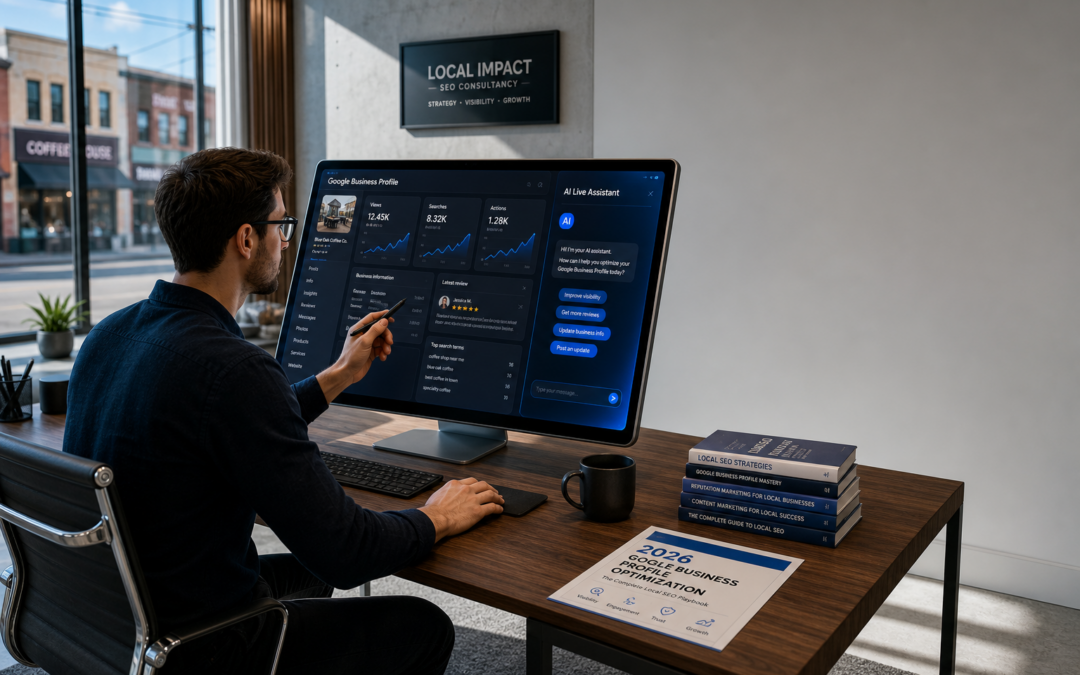
Most “Google Business Profile optimization advice” in 2026 is not just obsolete—it’s actively harmful. Tactics that once nudged your listing up the map pack now risk penalties, and advice columns stuck in 2022 ignore the AI and user behavior shifts that truly drive results. To stand out in local SEO 2026, business owners need to cut through myths, adopt features that genuinely build engagement, and focus on actions that foster real customer trust—not just run through outdated checklists. Understanding what truly impacts Google Maps ranking today is key to sustainable success.
Key Takeaways
- Following outdated or generic Google Business Profile optimization advice can tank your local SEO performance in 2026—and may even trigger penalties.
- User-driven signals—like real engagement, messaging, and lead capture—now outweigh minor profile tweaks or keyword stuffing for Google Maps ranking.
- Shortcuts such as fake reviews, aggressive category switching, or over-reliance on AI spam can invite ranking drops and account suspensions.
- Modern GBP optimization requires ongoing, practical efforts anchored in user experience, not static, once-and-done edits or jargon-heavy tactics.
- The REFLECT Framework delivers a concrete, stepwise process for sustainable, up-to-date Google Business Profile growth, with actionable examples.
Why Most Google Business Profile Optimization Advice in 2026 Is Actively Dangerous
Local SEO is evolving at breakneck speed, and most popular advice hasn’t caught up. In 2026, your Google Business Profile (GBP) is more than a simple map listing—it’s the core data source for Google’s AI Overviews and the primary driver of map pack rankings for local queries, according to Caliber Web Studio. Yet, a quick scan of SEO blogs reveals many “best practices” have become liabilities.
For example, adding extra keywords to your business name, constantly switching categories, or buying reviews seemed effective once—until Google’s ranking systems became advanced enough to penalize these behaviors. Google’s AI now detects manipulation and low-quality signals with increasing speed and accuracy. Even semi-manipulative tactics—such as spinning AI-generated Q&A content or bulk-posting generic offers—can get your listing flagged or suppressed, as Search Engine Land has reported.
What most owners miss: Google’s AI now weighs actual user engagement and real-world signals above all. If a tip doesn’t measurably improve customer experience or help searchers take action, it’s not just ineffective—it’s a risk you can’t afford. Treat your Google Business Profile like a living, interactive storefront, not a static brochure to “optimize and forget.” These shifts are echoed in both Search Engine Journal and Google’s own documentation on representing your business online.
Common GBP Optimization Myths That Still Circulate—And Why They Fail
Some myths persist because they sound simple or promise easy wins. But clinging to these outdated tactics in 2026 will do more harm than good:
- “Add keywords to your business name for a ranking boost.” This advice still circulates, but it’s a fast track to suspension—Google’s filters are strict about mismatches between your real-world signage and your online profile. Google’s official guidelines make this clear.
- “Switch your primary category often for an edge.” Some “experts” claim toggling categories helps you ride trends. In reality, frequent changes confuse both the algorithm and users, eroding trust signals and potentially lowering your Google Maps ranking.
- “Post every day for better rankings.” Quality and user relevance matter much more than post volume. Daily posting of generic content just trains Google’s AI to ignore you—something confirmed by Moz, which found that engagement drops off when posts aren’t relevant to user needs.
- “All reviews are good reviews—get as many as you can, any way you can.” Chasing review quantity with fake or incentivized feedback is a recipe for algorithmic demotion. Google’s AI is increasingly capable of spotting unnatural review patterns, as detailed by Search Engine Land.
The reality: In 2026, Google’s ranking system weighs trust, authentic engagement, and AI-detected quality far more than surface-level profile edits. According to Baldwin Digital, 84% of GBP views come from “discovery searches”—not branded queries—which means you’re competing for attention among people who don’t know you. Sophisticated competitors win by prioritizing legitimate reviews, real-time messaging, and content that solves searchers’ needs. Businesses stuck on myths are invisible to new customers.
AI and User Behavior Now Drive Google Maps Rankings—Not Just Profile Tweaks
The single biggest blind spot in most GBP optimization advice: ignoring the shift from data entry to AI-evaluated, user-driven engagement. In 2026, Google’s AI doesn’t just index your profile—it monitors how searchers interact: clicks, calls, chats, bookings, and especially how users engage with lead intake assistants and messaging features.
For context, Caliber Web Studio confirms GBP is the main driver of map pack visibility and fuels AI Overviews for local queries. Meanwhile, Baldwin Digital reports that 84% of GBP views are “discovery” traffic—meaning your listing shows up for people searching for what you offer, not your name. The businesses that win are those whose profiles prompt real actions, not those that just tick every field.
Bottom line: optimizing for 2026 means designing your profile for engagement. That means making it easy for users to get answers, request quotes, or book instantly—especially through AI chat features. If your optimization plan doesn’t account for user behavior and AI-powered signals, it’s irrelevant. For readers seeking a hands-on guide to tying these actions to meaningful results, see our conversion rate optimization guide for small businesses.
Scenario: Why “Set-and-Forget” GBP Optimization Fails in 2026
Picture this: a fitness studio fills out its GBP, uploads a few stock photos, writes a keyword-stuffed description, and posts a weekly generic update. Then they stop paying attention, assuming the basics are covered.
Months later, a competitor with fewer reviews but more engagement is dominating the map pack. What’s the difference? That competitor actively responds to reviews, uses an AI lead intake assistant to answer questions and capture leads, and regularly adds real photos from classes and events. These actions spark more clicks, chats, and bookings from discovery searchers—signals Google’s AI rewards with higher rankings. This scenario is common in local SEO 2026, as engagement consistently outpaces static completeness alone.
The lesson: “set-and-forget” optimization leaves your profile looking stale, both to users and to Google. Staying hands-on—experimenting with AI chatbots, updating real photos, and tracking user actions—is now the baseline for visibility in the map pack. For more on the risks of static optimization and how to avoid them, check out the side-by-side of professional vs. DIY GBP optimization.
The REFLECT Framework: A Stepwise Process for Modern GBP Optimization
To separate real impact from outdated tactics, the REFLECT Framework offers a practical, up-to-date process for ongoing Google Business Profile success in 2026. Each step below is expanded with real-world examples and actionable tools:
- Review: Audit your profile monthly. Double-check that your business name matches real-world signage (as required by Google’s guidelines), verify categories, location, and services. For example, a dentist might discover their listed category is “cosmetic dentist” but most leads are for family dentistry—adjust accordingly. Use GBP Insights to spot engagement drop-offs, then cross-check with Google Analytics or tools like BrightLocal for deeper analysis. A local bakery could look for a sudden drop in ‘direction requests’ and investigate if hours or photos are outdated.
- Enhance Visuals: Add new, authentic photos and short videos at least twice a month. Real images of staff, customers, and day-to-day operations outperform stock shots. For example, a home services company might upload before-and-after photos of projects, while a café shares pictures of daily specials. Use tools like Canva for basic edits, but avoid heavy filtering—users and Google trust authenticity.
- Facilitate Conversations: Turn on Google’s messaging feature and, if possible, integrate an AI lead intake assistant. According to Chatsy, 73.8% of chats were handled by AI in 2025, so fast response is now expected. Test the messaging experience yourself on desktop and mobile. For example, a medical clinic could set up automated appointment booking via chat, but periodically review chat logs to ensure accuracy and empathy.
- Listen to Reviews: Respond to every review—positive and negative—within 48 hours when possible. Use AI tools to flag sentiment trends, but always personalize responses. For instance, a restaurant owner could use AI to summarize feedback themes (like “slow service” or “great ambiance”), then address these points directly in replies or operational changes. Never incentivize or fake reviews; focus on authentic feedback and continuous improvement. For guidance on handling negative comments constructively, see AI content creation advice.
- Engage With Q&A: Actively seed your Q&A section with real, helpful questions customers actually ask. For example, a pet grooming business could add “Do you accept walk-ins?” or “What’s your cancellation policy?”—then provide clear, updated answers. Avoid copying generic FAQs. Use insights from in-person or phone questions to keep this section relevant. If your services, policies, or hours change, update the Q&A accordingly.
- Connect With Offers and Posts: Post with intent, not just frequency. Highlight time-limited offers, events, and customer stories. For example, a fitness studio might promote an upcoming class with a post, while a law office could share a recent case success story (with client permission). Use Google’s booking or order features if available, and track which post types drive actual actions—calls, bookings—using GBP Insights or UTM-tagged links.
- Track What Works: Set aside time monthly to review GBP Insights, lead counts, and chat logs. For example, compare the number of quote requests before and after adding an AI chat feature. Adjust your approach based on what’s actually generating engagement. Tie GBP data into your broader analytics stack—such as Google Analytics or CRM software—for a full-funnel view. Consider using a spreadsheet or dashboard to monitor trends over time, helping you spot what’s working and what needs change.
Most businesses drop off after the first couple of steps, but the real gains go to those who cycle through every stage, using both data and direct user feedback to refine their profile every month. For deeper insights on connecting GBP activity to real-world conversions, see our guide on conversion rate optimization.
Comparison Table: AI Lead Intake Assistant Options for GBP in 2026
| Platform | Strengths | Weaknesses | Best For |
|---|---|---|---|
| Google Business Messages AI | Native to GBP, quick setup, integrates directly with Google’s messaging features. Example: A dental clinic uses this for basic appointment requests and quick questions. |
Limited customization, basic lead routing. | Businesses wanting a simple, reliable first step. |
| 3rd-Party AI Chat (e.g., Drift, Intercom) | Advanced automation, CRM integrations, analytics dashboards. Example: A multi-location HVAC company routes chats to the correct branch and tracks source in their CRM. |
Requires setup, higher learning curve, potential for higher cost. | Multi-location, service-based businesses with larger teams. |
| Industry-Specific AI Assistants | Pre-built workflows for bookings, quotes, or intake. Example: A law firm uses a legal-specific chatbot to pre-qualify cases before connecting to an attorney. |
Less flexible for niche use cases, sometimes generic responses. | Medical, legal, home services, fitness studios. |
| DIY Chatbot Builders | Customizable, affordable, fast deployment. Example: An independent gym owner uses a no-code builder to create a custom chat flow for class sign-ups. |
Requires technical skill, limits of AI learning. | Tech-savvy owners or those with unique workflows. |
Selecting the right lead intake assistant depends on your team size, sales process, and technical comfort. For an in-depth breakdown, see this comparison of AI live chat & lead intake assistant alternatives for 2026.
What Actually Moves the Needle for Local SEO in 2026?
AI-driven local search has changed the game. Completing every profile field is just the starting line—true map pack visibility and customer acquisition come from what actually drives engagement and trust:
- Profile completeness and accuracy: Businesses with complete, accurate Google Business Profiles are much more likely to attract location visits, according to DG Agency.
- Review quality and authenticity: It’s not just about star ratings—review content, recency, and owner responses all matter. Avoid templates and focus on specifics. For tips, see AI content creation advice.
- Real user engagement: Actions like clicks for directions, calls, bookings, and especially AI-powered chat interactions are now heavily weighted. AI live chat responsiveness is a major differentiator in 2026.
- Use of AI and messaging features: With users expecting instant answers, integrating AI chat is increasingly standard practice. According to Chatsy, 73.8% of chats were handled by AI in 2025, and LiveChat data puts average first response for live chat at 35 seconds.
- Consistency and timeliness: Regularly updating posts, responding quickly to reviews and messages, and keeping all info current reinforce trust with both users and Google’s AI. For more on content update cadence and avoiding pitfalls, see our guide to AI content creation.
What’s often missed: the interplay between these factors. For example, a business with moderate reviews but rapid AI chat response and personalized messaging might outperform a competitor with more reviews but less engagement. Sophisticated operators focus on conversions—calls, bookings, foot traffic—and tie GBP activity to revenue. For practical steps on tracking these outcomes, see the conversion rate optimization guide for small businesses.
Case Example: Responding to Negative Reviews with AI—What Works and What Backfires
Consider a dental clinic that receives a negative review about wait times. The owner, pressed for time, configures an AI tool to auto-respond with the same generic apology for every review. Over time, potential patients notice the repetition, engagement drops, and Google’s AI picks up on “template spam”—weakening the listing’s trust signals.
Contrast that with a competitor who uses AI to draft personalized responses, but always reviews and customizes them before posting. Their replies specifically reference the reviewer’s experience and outline steps taken to resolve the issue. This approach reassures customers and signals to Google that the business is genuinely attentive—a clear ranking advantage. For a step-by-step approach to managing AI in your review process, explore our guide to AI content creation advice.
The takeaway: AI can streamline review management, but over-automation strips away authenticity. The winning move is blending AI efficiency with human oversight—using AI for suggestions, but never letting it speak for you unchecked. This principle also applies to content creation and live chat. For more examples of what works and what backfires, see common AI live chat mistakes clinics make.
How to Avoid Over-Optimization Penalties and Algorithmic Demotions
One of the costliest mistakes in local SEO is over-optimizing your GBP based on bad advice. This includes keyword-stuffing, aggressive review solicitation, or spamming posts with irrelevant offers. Google’s 2026 algorithms are built to spot inauthentic patterns and manipulation—penalizing offenders with visibility drops or even suspension, as highlighted in Search Engine Land.
Red flags to avoid:
- Business name includes locations or services not on legal signage (in violation of Google’s guidelines).
- Sudden spikes in review volume, especially clustered on the same day.
- Posts with repetitive, off-topic, or keyword-stuffed content.
- Using AI tools to mass-generate unfiltered responses or Q&A entries.
- Frequent category switching to chase rankings.
Depending on your market’s competitiveness, Google’s AI may penalize these behaviors almost instantly. For a nuanced comparison of professional versus DIY optimization (and how to avoid compliance pitfalls), see this side-by-side of professional vs. DIY GBP optimization.
Realistic Trade-Offs: What You Lose by Chasing Shortcuts
Shortcut tactics—like spammy reviews, AI-generated content, or relentless posting—can create an illusion of progress, but usually backfire. For instance, a business might see a fleeting spike in GBP impressions after pumping out keyword-rich posts, but if those posts don’t trigger real engagement, Google’s AI discounts them quickly.
Likewise, using a generic, low-cost AI chatbot might save time initially, but poor lead handling and robotic responses erode trust and kill conversions. The most successful businesses invest in quality: personalized replies, real images, and well-configured AI tools that are monitored and refined—not just set loose. For an honest breakdown of costs and benefits, see the AI live chat & lead capture pricing guide for 2026.
The bottom line: Every shortcut comes with a hidden cost—lower visibility, lost customer trust, or wasted marketing spend. Sustainable local SEO means prioritizing user experience and real conversion over vanity metrics. For more on optimizing for outcomes, not shortcuts, see our conversion rate optimization guide.
AI’s Role in GBP Optimization—And Where Human Oversight Still Matters
AI is now essential for scaling Google Business Profile management, but it’s not a substitute for human judgment. In 2026, AI tools can handle the bulk of live chat (as Chatsy reports, nearly three-quarters of chats were AI-handled in 2025), monitor reviews for sentiment, and suggest content. But AI can’t understand nuanced local context or deliver the authenticity that builds trust.
Top-performing businesses use AI as a force multiplier, not a crutch: deploying AI to provide instant answers, reviewing chat logs for missed leads, drafting posts but editing for voice, and always customizing review responses. For a breakdown of when to hand off to AI versus when to keep the human touch, see common AI live chat mistakes clinics make and consider cross-referencing with Google’s official business profile help center for compliance.
Ultimately, the winners in local SEO blend automation with human oversight—using AI to eliminate bottlenecks but never outsourcing the heart of their customer relationships. If you’re unsure where to draw the line, reviewing your GBP alongside your wider website management strategy can help clarify which tasks should stay human-led and which can be safely automated.
Summary: The Path to Sustainable Google Business Profile Success in 2026
To outperform in local SEO, filter every piece of Google Business Profile optimization advice through a hard reality check: Does this tactic improve real user experience? Does it align with the way Google’s AI now weighs engagement and trust? Is it sustainable and evidence-based, not just a risky shortcut? The quick-fix era is over; what matters now is ongoing, user-focused, AI-assisted work.
For owners ready to invest in lasting local marketing results, frameworks like REFLECT offer a roadmap that survives every algorithm update and keeps your presence both visible and valuable. Orange County-based firms such as Lion Click Media specialize in modern, compliance-first approaches, but any business can apply these principles with the right mindset and a commitment to data-driven action. The key: stay vigilant, put users first, and let real evidence—not rumors—guide every optimization move.
Frequently Asked Questions
Is it still important to have a lot of reviews on my Google Business Profile?
While the number of reviews matters, Google in 2026 emphasizes review recency, quality, and owner engagement more. Focus on getting recent, detailed reviews and responding promptly.
Can I use AI chatbots to respond to Google Business Profile messages automatically?
Yes, AI chatbots can integrate with Google messaging to provide instant, automated responses that qualify leads and improve customer experience.
What should I avoid when naming my Google Business Profile in 2026?
Avoid keyword stuffing or adding terms not part of your official business name. Use your legal or commonly recognized name only to prevent penalties.
How often should I update my Google Business Profile categories?
Review and adjust categories whenever you launch new services or shift focus, typically every few months, to stay relevant to search intent.
Does adding more photos always improve my profile’s ranking?
Not necessarily. Google rewards authentic, high-quality photos that showcase your real business environment rather than generic or stock images.
What are the benefits of Google’s automated Q&A feature?
Automated Q&A surfaces common questions and answers directly on your profile, improving user experience and reducing repetitive inquiries.
Is DIY optimization enough for competitive local markets in 2026?
DIY can work for some, but competitive markets benefit from AI-powered agencies that combine data analytics, live chat, and continuous optimization for faster, better results.
Get Your Free AI Marketing Audit
See exactly where you are leaving leads on the table and how Lion Click Media can help you rank higher, capture more customers, and Make Your Brand ROAR. No cost, no obligation.
Claim My Free Audit →Or chat with our 24/7 AI assistant (bottom-right) for instant answers.