
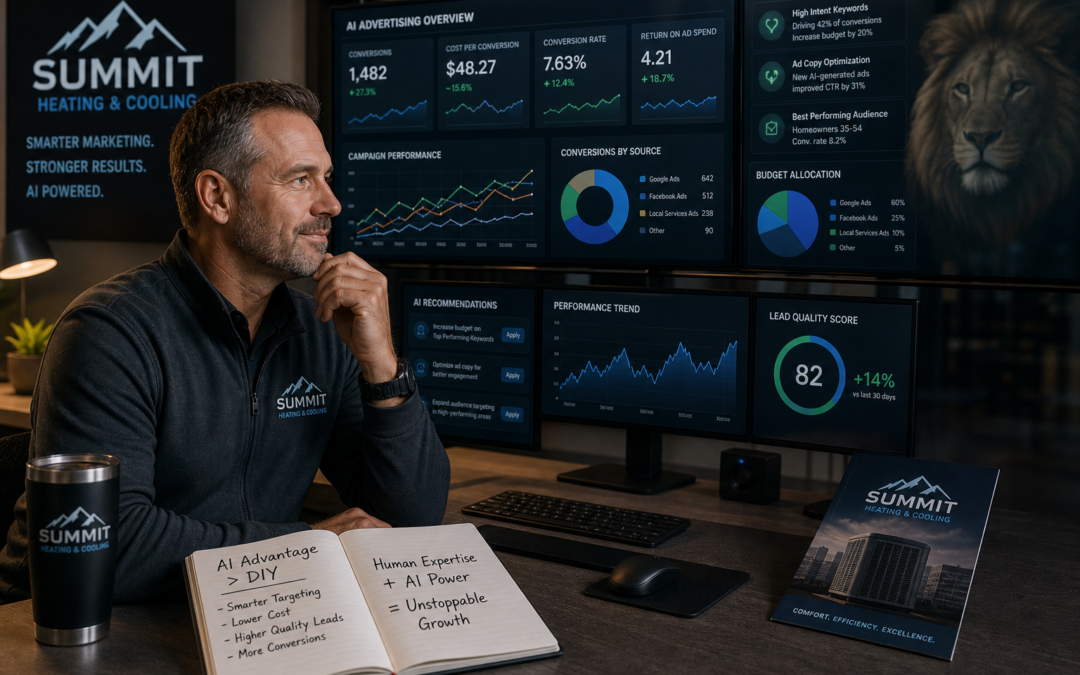
AI advertising PPC management typically produces better results than DIY campaigns for HVAC companies—especially when guided by someone who understands both the technology and the specific quirks of local HVAC demand. The main advantage isn’t just automating bids or keywords; it’s about knowing which signals to prioritize, what to filter out, and how to keep campaigns agile as seasons, neighborhoods, and competitors change. Most HVAC business owners tend to underestimate the detail needed to turn paid clicks into real, booked jobs. While AI can help you act faster and spot trends, it’s most valuable when paired with genuine expertise and regular, hands-on campaign adjustments. For HVAC, smart PPC management is less about “set and forget” and more about ongoing, visible improvement.
Key Takeaways
- AI advertising PPC management, guided by HVAC-specific expertise, reliably outperforms DIY advertising—especially for campaigns that need to adapt to local, seasonal, and emergency-driven swings in demand. Search Engine Land notes that industry knowledge remains key even with automation.
- DIY PPC typically falls short due to missed negative keywords, thin or poorly tracked conversion data, and over-reliance on default platform recommendations—issues highlighted by WordStream’s PPC mistake analysis.
- AI tools only deliver meaningful ROI when a human expert configures, monitors, and adjusts for local realities and business goals—automation by itself often misses market shifts or urgent needs.
- The most profitable approach is a hybrid: AI analyzes and reacts quickly, but humans shape strategy, creative, and local adaptation.
- Control, transparency, and cost can vary widely—understanding these trade-offs (beyond just up-front price) is essential before picking a path.
Is AI Advertising PPC Management Actually Better for HVAC—or Just Different?
Switching to AI-powered PPC management won’t automatically rescue a weak campaign. The main misconception among HVAC business owners is that any AI platform will “magically” improve results. In practice, AI is only as effective as the signals, business context, and rules you give it. For instance, Google’s Performance Max or Smart Bidding can optimize for conversions, but they don’t know your service boundaries or that you want to prioritize after-hours emergency calls during a heatwave unless you set those parameters.
Imagine an HVAC company enabling automated bidding and letting the platform run. Their ads start showing up for broad searches like “AC repair” or “heater not working.” Calls come in, but many are from outside the service area or from people looking for DIY advice. Here, the AI is just maximizing clicks, not qualified leads. Without human input—like detailed negative keyword lists, geo-fencing, and custom conversion tracking—the automation just speeds up poor outcomes. If your keywords, ad copy, or landing pages are misaligned, AI simply accelerates spend on what’s not working.
What really matters is combining AI’s ability to spot patterns with oversight tailored to local HVAC realities. For example, someone has to notice when a spike in “heat pump rebate” searches happens in your region, or when a competitor launches a big campaign on your branded terms. That’s the kind of hands-on adjustment that turns AI from a blunt tool into a real business asset.
For additional context on how AI impacts paid media, see Search Engine Land’s guide on AI in PPC.
What Do Most DIY PPC Campaigns for HVAC Get Wrong?
DIY PPC appeals to HVAC owners who want to save money or micromanage their spend. But even diligent owners often fall into the same traps: setting up a campaign, choosing some keywords, and letting it run for months without meaningful optimization. The likely result? Budgets drain on irrelevant searches, lead quality drops, and it becomes hard to track which clicks actually turn into jobs.
For example, an HVAC shop might target broad keywords like “furnace repair” and then wonder why they get calls from outside their service area or from people looking for parts, not repairs. Without negative keywords like “manual,” “DIY,” or “parts only,” and without strict geo-targeting, much of the ad spend is wasted. Very few DIYers set up call tracking to sort out real booked jobs from tire-kickers, and even fewer adjust ad schedules to catch after-hours emergencies (which are often higher value). Relying on Google’s default “smart” settings means missing the local, seasonal, and urgency-driven nuances that drive true ROI in HVAC PPC. As WordStream’s PPC mistakes overview confirms, these are among the most common (and costly) errors.
- Not building and updating negative keyword lists—wasting budget on irrelevant searches.
- Skipping ad extensions (like callouts or location extensions) and failing to adjust messaging to local needs.
- Not connecting PPC campaigns to call tracking or CRM tools—so they can’t trace which keywords drive actual jobs.
- Using default bidding strategies that ignore HVAC’s urgency cycles (not raising bids during heat waves or cold snaps).
- Letting ad creative go stale, leading to ad fatigue and falling click-through rates.
For a deeper dive into how these missteps undermine campaigns in both PPC and live chat, see AI Live Chat & Lead Capture vs DIY: What Gets Results.
AI PPC Optimization for HVAC: What Actually Moves the Needle?
The real advantage of AI PPC isn’t just letting software set your bids—it’s using automation to spot hyper-local trends and react faster than any person could on their own. In HVAC, this means tracking search demand at the ZIP code level, adjusting budgets during sudden weather changes, and testing new ad copy or offers in real time.
Suppose an AI system flags a spike in “emergency AC repair” searches in several neighborhoods after a heatwave. A smart marketer could then shift budget to those ZIP codes, update ad copy to highlight 24/7 service, and tweak landing pages to promote immediate booking. Here, AI handles the detection and budget shift, but a human makes the creative and strategic adjustments that turn leads into customers. This hybrid workflow consistently drives better results than DIY or set-and-forget automation.
To achieve this, you need:
- Granular conversion tracking (using tools like CallRail, WhatConverts, or ServiceTitan).
- Flexible Google Ads campaign structures that allow for rapid testing and quick shifts in spend.
- A steady cadence of A/B testing—on headlines, landing pages, offers, and even call tracking numbers.
For more on how these approaches apply across home services, see AI Advertising Management vs DIY: What Gets HVAC Results and the industry-wide perspective in PPC Hero’s AI in Home Services PPC.
Comparing AI PPC Platforms, DIY, and Hybrid Models: What Are Your Real Choices?
HVAC business owners have more than just “AI” or “DIY”—the real landscape includes pure DIY, self-serve AI tools, hybrid “AI + human” models, and traditional agencies. Each model comes with its own strengths and drawbacks for control, transparency, and cost. Here’s a side-by-side look:
| Option | Who It Fits Best | Pros | Cons |
|---|---|---|---|
| DIY PPC (Manual) | Owners with time and digital marketing skills | Full control; potentially lower cost; direct access to all campaign data and settings | Steep learning curve; time-consuming; easy to make costly mistakes; rarely scales well; risks missing out on advanced optimization features |
| Self-Serve AI PPC Platforms | Owners wanting some automation and oversight | Faster optimizations; reduces repetitive manual work; easy to launch; can quickly respond to market changes | Often uses generic algorithms; limited customization for HVAC needs; can feel like a “black box” with little transparency into decisions (Search Engine Journal) |
| Hybrid AI + Human Expert | Growth-focused HVAC businesses | Best blend of data-driven AI and local, strategic human input; can adapt quickly to local events, weather, or competitor moves; typically delivers more consistent job bookings | Usually higher investment; requires careful partner selection; trust and communication are critical |
| Traditional Agency (Manual) | Companies wanting white-glove, done-for-you service | Personalized management; detailed, tailored reporting; direct communication with a human team | Can be slow to adapt to rapid shifts; may miss algorithm-driven trends; less efficient at scale; sometimes higher fees |
Many HVAC owners default to the cheapest or simplest option, but that can be a false economy. Most find a hybrid approach—AI for speed and scale, humans for local nuance and ongoing oversight—delivers the strongest, most sustainable results.
The HVAC R.A.P.I.D. Framework for Profitable PPC Campaigns
To bring order to the process, use the R.A.P.I.D. Framework for HVAC PPC: Research, Automate, Personalize, Iterate, Diagnose. Here’s a step-by-step guide with practical tools and examples:
- Research: Go beyond Google’s Keyword Planner. Listen to call recordings to find out what real customers ask about (“thermostat not working,” “energy rebate,” etc.). Scan CRM notes and customer reviews for language that matches what people actually search. For local timing, check weather forecasts and city event calendars—planning a campaign around an upcoming heatwave or local rebate can be a game-changer. Moz offers a practical guide to keyword research.
- Automate: Set up AI-driven bidding (like Google’s Smart Bidding) for tasks that benefit from scale, but add your own rules using scripts or platform automations. For example, use scripts to pause underperforming ads, or rules that automatically boost bids in ZIP codes where your call tracking shows high-value jobs. Tools like Optmyzr offer user-friendly automations compatible with HVAC PPC needs.
- Personalize: Avoid running generic, AI-generated ad copy. Edit ads to use local terms (“swamp cooler” instead of “evaporative cooler” if that’s what your customers say), highlight urgent and after-hours service, and call out current rebates or seasonal offers. Use dynamic keyword insertion only where it fits—otherwise, ads can sound robotic.
- Iterate: Run A/B tests on more than just headlines. For instance, test landing page offers (“$0 service call” vs. “same-day install”), try new call tracking numbers, or even swap before-and-after job photos. Schedule campaign reviews at least weekly during peak season to catch market shifts—tools like Google Ads Experiments and Unbounce make this easier.
- Diagnose: Look deeper than headline metrics. Use attribution tools (such as CallRail, WhatConverts, or a CRM like ServiceTitan) to spot drops in call volume, upticks in no-shows, or changes in lead quality. Correlate these shifts with weather, local events, or competitor promos. This step—regular diagnosis and course correction—is where most HVAC businesses fall short, according to WordStream.
A common gap: many business owners stop after Automate and Personalize, but skip Diagnose—missing the real-time corrections that set high-ROI campaigns apart.
Why Local Nuance and Human Judgment Still Beat Automation Alone
One of the biggest misconceptions in AI advertising PPC management is that “machine learning” will figure out all the local details for you. In reality, most AI tools are built on broad data sets and overlook the quirks that drive actual demand in your market. For example, Google’s Smart Bidding might start spending more on “furnace repair” after a cold snap, but it won’t know that a local utility just launched a new rebate for heat pump installs—unless someone tells it.
Picture two HVAC companies in neighboring suburbs. Both run AI-optimized campaigns. One gets steady booked jobs because the owner regularly checks search terms, adds negative keywords like “DIY” and “parts only,” and tweaks ads to fit local language. The other leaves everything to automation—and ends up with irrelevant leads and wasted spend. Human insight, especially around local events and customer lingo, remains the single most important lever for PPC profitability.
For a broader playbook on using AI across your marketing—beyond PPC—see AI Social Media Management for HVAC in Orange County: 2026 Guide.
Control, Transparency, and Cost: The Real Trade-Offs in AI vs DIY PPC
There’s no one-size-fits-all “best” answer—just trade-offs. If you want full control and have the time to deeply learn Google Ads, DIY might be for you. But expect a steep learning curve and wasted spend while you get up to speed. Self-serve AI platforms make things easier, but most HVAC owners still end up stepping in to stop wasted clicks and steer toward better leads.
Hybrid AI plus expert oversight usually produces the best outcomes for growing HVAC businesses: you get the speed and data depth of automation, plus the strategic pivots and local adjustments only a human can manage. Many service businesses budget somewhere in the low-to-mid four figures per month for this model, though it varies widely by market and competition. The real question isn’t just cost, but whether you’re consistently getting booked jobs at a lead cost you can live with.
Transparency is another sticking point. DIYers see every detail and can adjust on the fly, but may struggle to interpret the data. Some AI platforms operate as “black boxes”—you can’t always see why they made certain choices. The best partners (human or tech) provide clear reporting, direct access to campaign data, and candid conversations about what’s working and what isn’t. For more on these trade-offs in other service niches, see AI Live Chat & Lead Capture vs DIY: What Gets Results.
What Ongoing Optimization Looks Like in HVAC PPC (and Why Most Fail)
PPC optimization isn’t glamorous, but it’s where most ROI is won or lost. AI can surface patterns, but in HVAC, the real edge comes from relentless weekly (or even daily) review and adjustment. This means checking search queries for new negative keywords, tweaking ad schedules to catch after-hours surges, and rotating creative to fight ad fatigue.
A practical workflow includes:
- Reviewing search terms and adding at least five new negative keywords per week during busy seasons.
- Refreshing ad copy and testing new offers every month—track which ones actually drive booked calls, not just clicks.
- Using call tracking to connect ad spend to revenue, not just form submissions.
- Updating geo-targeting as neighborhoods grow or competitors shift (for example, when a new development opens or a major competitor enters your area).
- Watching out for “budget traps”—periods when your campaign runs out of funds early in the day and you miss high-intent evening or weekend leads.
These are the details that keep HVAC PPC campaigns profitable—and they’re often neglected when you over-rely on automation or set-and-forget DIY approaches. For a look at how AI-driven advertising is reshaping other industries, see Best AI Advertising Management for Financial Advisors in 2026 and The 2026 AI Advertising Playbook for Chiropractors.
Tools, Integrations, and Why Attribution Still Trips Up Most HVAC PPC Campaigns
Both AI-driven and DIY PPC efforts frequently stumble on attribution—accurately connecting ad spend to real, booked jobs. Many HVAC businesses track clicks or call counts, but don’t separate out price-shoppers, repeat customers, or high-value emergencies. According to BrightLocal’s Local Consumer Review Survey, tracking true outcomes is a common challenge for local service providers.
A solid PPC setup integrates Google Ads with call tracking (like CallRail), a CRM (such as ServiceTitan or Housecall Pro), and scheduling tools. For instance, using unique call tracking numbers for each campaign helps you see which keywords drive after-hours emergencies versus routine tune-ups. AI analytics platforms can then surface which campaigns bring in your most valuable leads, not just the cheapest ones. This level of clarity is rare with DIY, but it’s essential to make your budget count.
To strengthen your marketing stack, consider integrating AI-powered content tools (AI Content Creation), video for landing pages (Video Creation), and local website management (Website Development & Management) to support your full customer journey. More on attribution challenges can be found in PPC Hero’s guide to attribution for local businesses.
Final Thoughts: Choosing the Right PPC Management Path for Your HVAC Business
The bottom line: success in HVAC PPC isn’t about chasing the latest AI tool or pinching pennies with DIY. It’s about building a process where automation supports smart strategy, not replaces it. Demand transparency, real attribution, and regular strategy reviews from any provider. If you go DIY, invest the time to learn and track what matters to your business—or expect to learn from trial and error.
Whichever path you take, remember: your campaign’s actual booked jobs matter more than generic benchmarks or platform promises. AI magnifies both good and bad strategies. The HVAC businesses that win will be those who balance rapid, AI-driven optimization with hands-on, real-world adjustment—not just one or the other.
Lion Click Media, based in Orange County, CA, is one of many agencies offering AI-enabled marketing strategies for home services, but regardless of partner or platform, these principles will help you see through the hype and get real results.
Frequently Asked Questions
Can small HVAC businesses benefit from AI PPC management?
Yes, but the benefits increase with budget and campaign complexity. Small HVAC shops might find DIY sufficient initially, but AI PPC management usually delivers more consistent leads and better ROI once scaled.
How does AI improve HVAC PPC ad targeting?
AI analyzes user behavior, search patterns, and conversion data in real time to adjust bids and audiences dynamically, ensuring ads reach the most qualified HVAC prospects at the right moment.
Is AI PPC management compatible with local HVAC marketing needs?
Absolutely. AI platforms can hyper-target ads by zip code, time of day, and service type, which is critical for local HVAC businesses aiming to capture nearby emergency or seasonal demand.
What platforms does AI PPC management cover for HVAC ads?
AI PPC management typically spans Google Ads, Meta (Facebook/Instagram), LinkedIn, TikTok, and YouTube, allowing HVAC businesses to run coordinated multi-channel campaigns.
How do I track if AI PPC campaigns are actually generating HVAC leads?
Integrating conversion tracking with CRM systems and call tracking tools is essential. This data feeds AI models and provides transparent insight into actual booked appointments versus just clicks.
Can AI PPC management reduce the cost per lead for HVAC companies?
While results vary, AI PPC management often lowers wasted ad spend by shifting budget to high-converting keywords and ads, which tends to reduce overall cost per qualified lead.
Do I still need human experts if I use AI PPC management?
Yes. Human oversight ensures strategy alignment, creative quality, and proper data setup—AI optimizes within these parameters but doesn’t replace expert judgment.
Get Your Free AI Marketing Audit
See exactly where you are leaving leads on the table and how Lion Click Media can help you rank higher, capture more customers, and Make Your Brand ROAR. No cost, no obligation.
Claim My Free Audit →Or chat with our 24/7 AI assistant (bottom-right) for instant answers.