
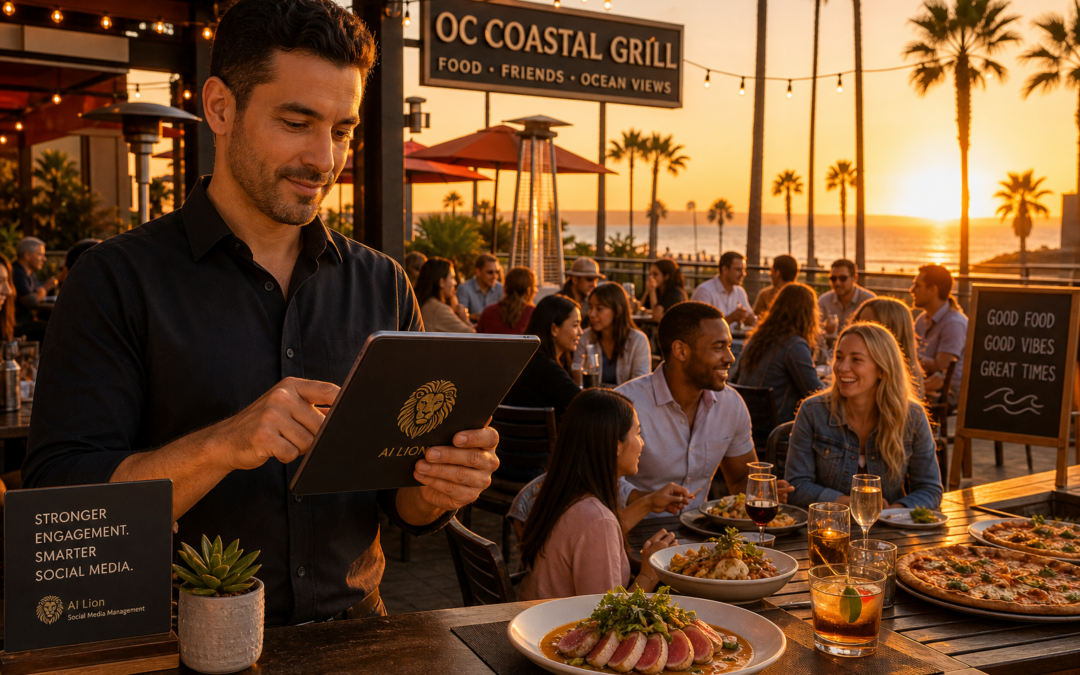
AI social media management is no longer a futuristic add-on for restaurants—it’s the lever that separates brands stuck in the daily grind from those scaling engagement and loyalty without burning out their teams. By 2026, the ability to blend automation with strategic human guidance will define the winners in restaurant social marketing. But the real edge comes from knowing where AI excels, where it stumbles, and how to build a feedback loop that protects your brand’s voice while multiplying output.
Key Takeaways
- AI social media management lets restaurants dramatically boost content output and engagement without increasing staff, but only if paired with clear brand oversight and smart tool selection.
- Automation can streamline workflows, but without active human management and a living style guide, brand voice and authenticity quickly erode.
- The best AI tools for restaurants offer advanced localization, review management, and actionable analytics, but not every platform fits every operation—choose based on workflow, not buzzwords.
- AI frees up hours each week for higher-value creative work, but the true gains come when teams reinvest that time into relationship-building and experimentation.
- The A.I.M. (Audit, Integrate, Monitor) Method gives restaurant operators a repeatable, practical framework to integrate and oversee AI in social media for sustainable, measurable results.
Why AI Social Media Management Is Now Mission-Critical for Restaurants
For restaurant operators, social media has shifted from a sporadic marketing channel to a core part of daily operations. The sheer volume of reviews, DMs, and local content required outpaces what most teams can handle by hand. AI social media management fills this gap—going far beyond simple post scheduling. For example, a 50-location restaurant chain leveraged an AI social media agent to quadruple content output, localize posts for each market, and respond to reviews, all without hiring additional staff, according to Agentmelt. This level of efficiency is impossible with manual workflows alone.
But here’s where many stumble: treating AI as a ‘set-and-forget’ shortcut. Operators who see real results use AI to scale what works locally—then maintain close oversight to prevent off-brand or tone-deaf content. It’s not about replacing people, but about freeing them to focus on storytelling, customer connection, and creative experimentation. Those who succeed view AI as an accelerator, not an autopilot.
What Changes—and What Doesn’t—When You Automate Restaurant Social Media?
Introducing AI-driven management transforms more than just speed. Sure, you can publish more posts, reply to reviews in near real-time, and keep up with trends across multiple platforms. But the real shift is in the rhythm and flexibility of your presence. Imagine a single marketer scheduling unique daily posts for each location, responding to Instagram comments, and deploying timely offers—all within the same workday. This is not hypothetical: social media managers using AI tools reported saving over five hours per week on routine tasks like caption writing and scheduling in 2025, according to the Sprout Social Index 2025.
Yet, more output doesn’t automatically mean more meaningful engagement. Automation can easily default to bland templates or mismatched hashtags, making feeds feel lifeless. The best results come when AI handles repetitive mechanics—caption drafts, hashtag suggestions, bulk scheduling—while humans invest their reclaimed time in curating visuals, responding with personality, and telling stories unique to their brand. If your content strategy is weak to begin with, AI just amplifies the problem.
AI Social Media Management Tools: Real-World Comparison for Restaurants
The AI tool landscape is crowded and noisy. For restaurants, the best fit rarely comes from chasing the latest feature—it’s about finding a platform that matches actual workflow needs. Here’s a practical comparison of leading platforms for restaurants in 2026, focused on what genuinely matters:
| Platform | Best For | Strengths | Trade-Offs |
|---|---|---|---|
| Sprout Social | Multi-location restaurants | Advanced reporting, review management, workflow automations | Requires setup time; may be overkill for single-location shops |
| LatelyAI | Content repurposing | Generates many posts from one video/blog; solid content suggestions | Quality varies; human editing needed for voice |
| Agentmelt | Localized content at scale | Automates multi-location messaging, multi-platform scheduling, review replies | Learning curve for custom rules; less visual focus |
| Hootsuite | General automation | Broad integrations, simple interface, strong scheduling | Fewer AI features for content creation than specialist tools |
| Seenalyze AI | Engagement optimization | Analyzes content performance, suggests timing/topics | Limited direct publishing; works best alongside other tools |
Avoid the common trap of picking a platform for a single feature or the most buzzworthy AI pitch. The right tool fits your team’s workflow, integrates with your reservation or POS systems, and delivers localization, analytics, and review management you’ll actually use. For more on industry-specific platform selection, see choosing an AI social media management agency for roofing companies or auto repair shops—the questions translate well to restaurants.
The A.I.M. Method for Restaurant Social Media Automation
Too many restaurants automate without a plan, then scramble to fix off-brand posts or missed messages. The A.I.M. (Audit, Integrate, Monitor) Method gives operators a practical, repeatable framework for sustainable AI adoption:
- Audit: Map out your current social media workflow. Where do delays or mistakes happen—responding to reviews, creating visuals, writing local captions? Which content types (stories, menu updates, local offers) actually drive engagement? Audit your brand voice: is it consistent across locations and platforms, or does it drift? For extra depth, pull metrics like average review response time and engagement rate per post as a baseline.
- Integrate: Choose AI tools that directly address your pain points. For example, if slow review responses are the main headache, prioritize platforms with robust review automation and sentiment analysis. Integrate the tool with your scheduling and analytics systems (like Google My Business for reviews, Canva for visuals, or your POS for local offers) to avoid data silos. During onboarding, train your AI by supplying it with a library of your highest-performing posts and real customer interactions—not just generic prompts.
- Monitor: Set up regular (weekly and monthly) reviews of both quantitative data (reach, engagement, average response time) and qualitative output (brand voice, customer sentiment). Don’t rely on dashboards alone—have a human scan scheduled posts and automated replies, especially in the first 60-90 days. Use feedback from team members and customers to flag awkward phrasing, cultural missteps, or off-brand content for immediate correction.
This isn’t a one-time checklist. The restaurants that thrive treat the A.I.M. Method as an ongoing cycle, refining workflows as the business and customer expectations evolve. For a sector-specific spin, see the AI social media management guide for Orange County restaurants.
What Are the Real Productivity Gains—and Where Do Teams Go Wrong?
AI’s biggest promise is freeing up hours for higher-value work. In practice, it delivers: 82% of marketers said AI tools improved productivity in 2025, with more than a third seeing a significant boost, according to Emplifi. Meanwhile, AI adoption for social media content creation or scheduling shot up from 43% to 65% in just one year (Hootsuite Social Media Trends 2025).
But here’s the catch: time savings are squandered if teams don’t reinvest them. If AI drafts a week of Instagram posts in minutes, the smart move isn’t to sit back—it’s to double down on human-driven storytelling, produce behind-the-scenes videos, and jump into DMs with real personality. AI multiplies whatever foundation you have. If your visuals are generic or your brand voice is bland, automation just spreads that mediocrity faster. The best operators use AI to clear the grunt work, then channel freed-up time into content that builds real loyalty and buzz.
How Does Automated Social Media Drive Engagement—and Where Can It Fall Flat?
Used well, AI automation can send engagement soaring. A Budapest café saw a 65% jump in engagement and 180% follower growth in the first month of automated posting with SEENALYZE AI (SEENALYZE AI). But don’t confuse more posts with better results—the lift comes from relevance and timing, not just volume.
Restaurants that pair AI scheduling with hyper-local offers and quick, thoughtful replies to reviews or comments consistently outperform those who rely solely on generic, templated posts. The biggest pitfall: letting automation run unchecked, so you end up with mismatched hashtags, irrelevant holiday posts, or robotic customer replies. To keep engagement climbing, set up human review checkpoints and regularly experiment with content formats and topics. For more tactical guidance, see boosting engagement and authority with AI social media management.
What’s the True Cost—and ROI—of AI Social Media for Restaurants?
Budgeting for AI social media management means weighing more than just subscription fees. Many multi-location restaurants typically spend in the low-to-mid four figures per month, but that range varies by region, menu complexity, and content expectations. The true ROI comes not just from cost savings, but from new business unlocked: faster customer responses, broader reach, and stronger brand consistency. The global social media management market is projected to grow from $29.9 billion in 2025 to $171.6 billion by 2033, with a 24.8% CAGR, signaling that businesses see value well beyond cost reduction (Grand View Research).
The hidden risk: over-relying on automation creates a false sense of security. Without human oversight, subtle shifts in customer sentiment or negative trends can go unnoticed until they snowball into real problems. The most honest metric for ROI isn’t just cost per post, but the quality of customer interactions, repeat business, and word-of-mouth referrals. For frameworks to track these outcomes, see AI data analytics for marketing.
How to Preserve Brand Voice and Authenticity with AI
It’s easy for AI-generated posts to sound generic—especially if you feed it only standard prompts or mass-market hashtags. The fix: invest in a living brand style guide that AI tools can reference. This should include sample responses for common review scenarios (positive, negative, neutral), a library of approved visuals, and a list of on-brand phrases or emojis. Update these assets regularly to reflect seasonal menus, local events, or new brand campaigns.
Don’t just use AI to push out content—use it to monitor sentiment and flag outliers. If an automated reply gets a negative reaction, your team should be alerted to step in and resolve the issue personally. Integrating AI-driven review management with your broader customer service loop ensures automation never replaces genuine empathy. For related strategies, see AI live chat and lead capture for service businesses—many tactics translate directly to restaurant social media.
Checklist: Restaurant-Ready AI Social Media Setup in 2026
- Develop a living brand style guide with sample responses, approved visuals, and on-brand phrases.
- Audit your current content mix and workflow—identify gaps and top performers.
- Select an AI platform that supports multi-location scheduling, review automation, and actionable analytics.
- Train the AI with your high-performing real content, not just generic prompts.
- Institute a weekly human review process for all automated posts and replies.
- Integrate AI tools with your reservation, ordering, and customer feedback systems for a seamless experience.
- Track engagement, sentiment, and ROI monthly, and adapt your approach based on real results.
This checklist isn’t a one-and-done project. The restaurants thriving with AI in 2026 treat these steps as an ongoing process—regularly updating assets, retraining AI models, and tightening oversight as trends shift and customer expectations rise.
Case Example: AI in Action at Scale and Locally
Consider the 50-location chain highlighted by Agentmelt: by implementing an AI social media agent, they scaled up localized content output, automated scheduling, and improved review response times—all without expanding their marketing team. Local managers could focus more on direct guest experiences, while AI handled digital interactions. This isn’t limited to big brands—a regional group could see similar gains by combining AI scheduling with targeted local offers and automated review management.
Contrast this with Aroma Corner, a Budapest café. Using SEENALYZE AI, they saw a 65% engagement increase and 180% follower growth in the first month of automated posting, surfacing trending content ideas and responding quickly to customers (SEENALYZE AI). In both cases, the differentiators were a willingness to experiment, ongoing monitoring, and fast adaptation based on live customer feedback.
Final Thoughts: The Human-AI Partnership Defines the Future of Restaurant Social Media
AI social media management isn’t a magic bullet. The restaurants winning in 2026 are those that treat automation as a force multiplier for human creativity, empathy, and strategic thinking—not a replacement. As the market for AI-powered tools explodes, the advantage goes to brands that build feedback loops, invest in training both their people and their AI, and never lose sight of the customer’s experience. For hands-on next steps and deeper sector breakdowns, see the comprehensive guide to AI social media management for restaurants or explore AI social media management solutions for broader insights. Lion Click Media, based in Orange County, draws on national and international restaurant experience—proving that AI expertise is defined by adaptability and listening, not just technology.
Frequently Asked Questions
Can AI social media management replace a human social media manager for restaurants?
AI social media management can automate many tasks but does not fully replace human creativity and brand nuance. Restaurants benefit most from combining AI efficiency with human oversight.
How do I keep AI-generated social posts authentic for my restaurant brand?
Review and customize AI suggestions to match your restaurant’s voice, include local events or specials, and use real photos or videos to maintain authenticity.
What platforms are best for AI-driven social media scheduling in 2026?
Platforms like Lion Click Media's AI Social Media Management and Hootsuite Insights excel at combining AI analytics with scheduling tailored to audience behavior.
Is AI social media management suitable for small single-location restaurants?
Yes, but the investment and complexity should match the restaurant’s scale. Smaller restaurants may prefer simpler AI tools with manual input rather than full agency solutions.
How does AI help identify the best time to post for restaurant social media?
AI analyzes audience activity patterns and historical engagement data to recommend optimal posting windows, maximizing reach and interaction.
Can AI social media tools track competitor activity for restaurants?
Yes, many AI tools monitor competitor posts, hashtags, and trends to inform your content strategy and help you stay competitive.
What are the risks of relying too heavily on AI for restaurant social media?
Over-reliance can lead to generic, off-brand content that disengages followers. Human review and local insight are essential to maintain relevance and authenticity.
Get Your Free AI Marketing Audit
See exactly where you are leaving leads on the table and how Lion Click Media can help you rank higher, capture more customers, and Make Your Brand ROAR. No cost, no obligation.
Claim My Free Audit →Or chat with our 24/7 AI assistant (bottom-right) for instant answers.