
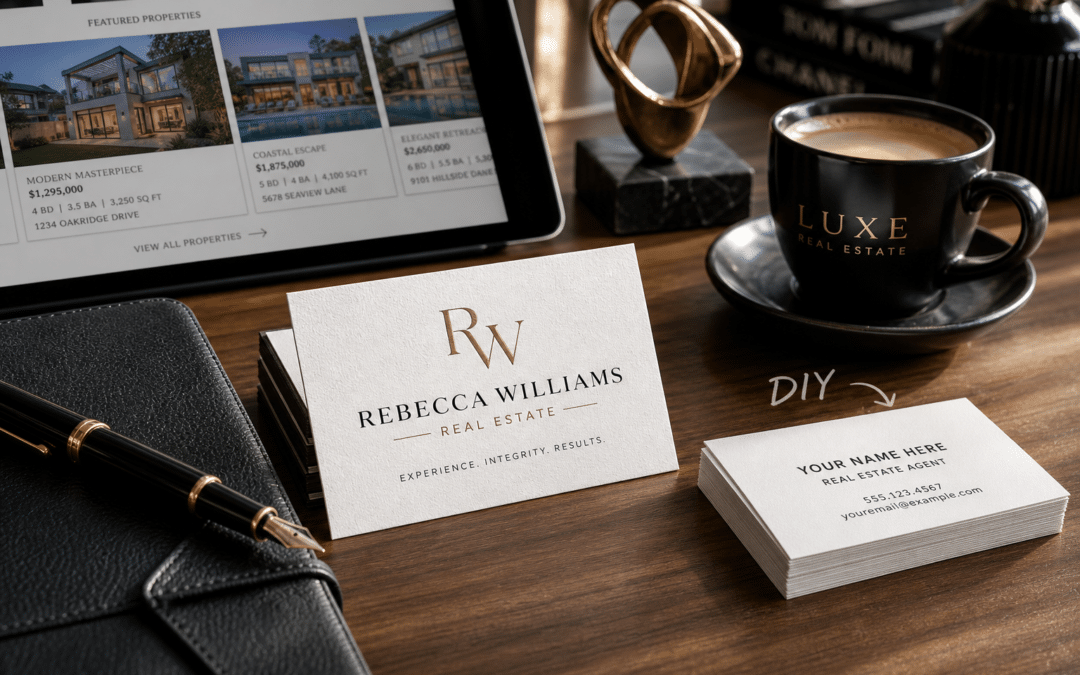
For real estate agents, the decision between professional brand identity and logo design vs DIY is not just about aesthetics—it’s a strategic business choice that affects recognition, trust, and long-term growth. While DIY options promise speed and savings, they often result in generic, inconsistent branding that erodes credibility and creates obstacles to scaling your reputation. In contrast, a thoughtfully crafted brand identity, anchored by expert design and strategic intent, directly drives revenue, client loyalty, and market leadership.
Key Takeaways
- Professional brand identity and logo design outperforms DIY with increased recognition, trust, and measurable revenue growth, as supported by industry research.
- DIY logos and template marketplaces often produce brands that lack originality, scalability, and consistency—undermining credibility and market positioning.
- Effective real estate branding is rooted in clear strategy, market positioning, and meticulous consistency across every client touchpoint.
- Research-backed frameworks, like the 5D Brand Architecture, help agents build identities that actually support business goals and adapt over time.
- Every element—from business card design to digital assets—plays a critical role in reinforcing a memorable, trusted brand presence.
Brand Identity & Logo Design vs DIY: What’s Actually at Stake?
Many real estate agents underestimate the true impact of their brand identity, assuming that a logo built with DIY tools or a template marketplace will suffice. This is a mistake that often leads to lost opportunities. The real value of a professional brand identity is strategic: it’s the sum of your visual language, messaging, personality, and values, all consistently woven through every client interaction. In an industry built on trust and first impressions, this depth is non-negotiable.
The misconception is that “looking professional” is all about polish. In reality, what matters is differentiation and memorability. Consistent branding can deliver up to 23% revenue growth and 80% greater recognition for real estate agents, according to RealScout. These are not minor perks—they’re strategic advantages in a crowded market.
Picture this: an agent relies on a free logo generator, resulting in a generic icon and inconsistent color use. Their business cards, yard signs, and social media graphics all look slightly different. Prospects see them as just another interchangeable agent, and referrals slip away to competitors with distinctive, unified branding.
How Professional Branding Actually Delivers Results for Real Estate Agents
The real edge of professional branding is not simply better visuals—it’s the alignment of every brand element with your unique selling proposition and market context. Seasoned designers begin by clarifying your position: are you the luxury condo expert, the relocation specialist, or the family neighborhood guide? From there, every asset, from logo to business cards, reinforces that positioning.
Scalability is a crucial but often ignored requirement. Modern real estate agents must ensure their brand assets look sharp on everything from yard signs to Instagram stories. The industry is moving away from generic house icons in favor of memorable, scalable identities that reflect local relevance and market positioning, as outlined by LogoOutlets.
Take the example of RE/MAX, which refreshed its brand identity and logo in 2025 to better connect with new generations and reinforce its digital leadership (RE/MAX Metropolitana). Even solo agents should emulate this level of strategic thinking—not just “looking nice,” but building a recognizable, future-proof platform for growth.
DIY Logo Pitfalls: Why Templates Rarely Cut It
DIY logo makers and free template marketplaces lure agents with promises of fast, affordable branding. But these methods almost always produce brands that blend into the background. DIY platforms recycle the same tired icons and fonts; prospects have seen these visuals before—sometimes associated with unrelated businesses. The result is a brand that feels generic and forgettable, not expert or trustworthy.
One of the biggest pitfalls is inconsistency. Agents may stretch, recolor, or crop logos for different uses, leading to a fragmented brand experience. This lack of cohesion is costly: agents with cohesive branding enjoy far greater recognition and revenue growth than those with mismatched assets, according to RealScout.
Imagine an agent whose logo appears in three different colors across their print and digital materials. Over time, clients struggle to recall their brand, and the agent misses out on referrals and repeat business. In a field where reliability and recognition drive transactions, this inconsistency is a silent killer.
The 5D Brand Architecture Framework for Real Estate Agents
To build a brand identity that actually supports business goals, agents need a structured framework. The 5D Brand Architecture Framework offers a practical stepwise approach:
- Define: Start by clarifying your core values, target audience, and unique selling proposition (USP). Tools like Brandfolder, Canva’s Brand Kit, or even a simple client survey can help pinpoint what truly sets you apart. This foundation directs every subsequent branding decision.
- Distill: Translate your positioning into a visual language. Choose a color palette, typography, and iconography that reflect your brand’s personality and your market. For example, a coastal specialist might use blue-green hues and wave motifs, while a downtown condo broker could opt for bold, modern fonts and geometric shapes.
- Design: Collaborate with a professional designer to create a logo and accompanying assets that are distinctive, scalable, and versatile. Commission multiple logo variations (horizontal, stacked, icon-only) for flexibility. Don’t overlook the value of three-dimensional (3D) logo effects—recent research shows that 3D logos can increase perceived trust and purchase likelihood by enhancing realism (Journal of Marketing Research).
- Deploy: Roll out your new branding consistently across every touchpoint—website, social media, signage, business cards, print materials, even email signatures and video intros. Use platforms like Lucidpress or Canva Pro to maintain asset consistency and make it easy to update materials as needed.
- Diagnose: Routinely assess your brand’s impact. Use feedback tools (like Google Forms surveys), social media analytics, and web engagement metrics to spot strengths and weaknesses. Adjust as needed, but always preserve core brand consistency to avoid confusing your audience.
Many agents are tempted to jump straight to the design phase—skipping the foundational work of defining their values and diagnosing performance. This shortcut leads to attractive visuals with no real strategic power. Use the full 5D process, and you’ll have a brand that grows with you, not just a logo file gathering dust.
Comparison Table: Professional vs DIY Branding for Real Estate Agents
| Criteria | Professional Brand Identity | DIY Logo/Branding | Template Marketplace |
|---|---|---|---|
| Originality | Custom, unique to agent/firm | Often generic, reused icons | Some variation, but still limited pool |
| Brand Consistency | High—guidelines and versions for all uses | Low—prone to mismatches and inconsistency | Moderate—templates can be adapted, but often misused |
| Market Positioning | Strategically aligned with target segments | Missing or accidental positioning | Some relevance, but lacks depth |
| Scalability | Designed for all formats (print, web, video, signage) | May not translate across platforms | Often limited to digital or basic print |
| Cost | Higher upfront, long-term ROI | Low upfront, higher risk of rebranding | Low-medium upfront, may require future updates |
| Trust & Perception | Signals professionalism and expertise | May undermine credibility | Neutral to slightly above DIY |
For a closer look at what to budget for professional branding and what to expect in terms of return, see Brand Identity & Logo Design Costs in 2026: Real Pricing.
Brand Consistency: Why It’s More Than a Buzzword
Brand consistency is about earning trust through reliable, repeated exposure—not about following rigid design rules. Real estate clients typically encounter your brand across multiple touchpoints before they remember and trust you. Every off-brand flyer, stretched logo, or mismatched Instagram post erodes that trust and makes your marketing less effective.
Consistent branding leads to dramatically higher revenue and recognition, as shown by RealScout. Yet, many agents focus on only the “big” assets (like websites and yard signs) and neglect the smaller ones—like open house flyers, email signatures, or social story templates. True brand consistency means every detail, no matter how small, reinforces your identity.
One actionable step: create a simple brand guideline document, even as a solo agent. Document your logo variations, official color codes, approved fonts, and sample layouts. This makes it easier to collaborate with printers, designers, or marketing partners and ensures your look is always on point. For guidance, see AI-driven approaches to social media management, which can help maintain consistency when marketing across many platforms.
What Modern Real Estate Branding Gets Right: Lessons from Industry Leaders
Top real estate brands understand that branding is about strategic positioning, not superficial decoration. According to a 2026 survey by Marq, professionals in the field rank brand positioning as the most important driver of company success, even above website or app user experience.
Today’s best real estate logos are moving away from overused visual clichés (like generic house icons) and toward symbols, monograms, or wordmarks that are both memorable and scalable (LogoOutlets). Winning brands often incorporate subtle cues—nods to local landmarks, clever use of negative space, or a sense of depth—to set themselves apart.
Consider two agents in the same city. Agent A invests in a scalable, minimalist logo and rolls out matching business cards, yard signs, and web graphics. Agent B sticks with a free template, updating only their website. Within a few months, Agent A’s brand is recognized at open houses and on social feeds, while Agent B remains an interchangeable face in the crowd. The difference? Strategic commitment to consistent brand identity.
Real-World Scenarios: When DIY Works (and When It Fails)
DIY branding isn’t always a mistake. For a brand-new agent or a short-term project, a quick DIY logo can serve as a stopgap. But as soon as you’re serious about building a reputation, DIY quickly becomes a liability. The most common scenario: an agent outgrows their DIY logo, is forced to rebrand, and faces costly asset updates and potential client confusion.
Imagine a new brokerage launching with a template logo, only to discover months later that a competitor uses nearly the same design. The result? The firm must rebrand, reprint all collateral, retrain clients to recognize the new look, and regain lost trust. What started as a cost-saving move turns into an expensive, distracting exercise.
DIY can help clarify your visual preferences and get early feedback, but the moment you begin investing in website development, paid advertising, or community sponsorships, it’s time for a professional, cohesive brand identity.
Business Card Design & Print: The Unseen Branding Battleground
Despite the rise of digital marketing, business cards remain a vital tool for real estate agents. They often serve as the first physical touchpoint with clients at open houses, networking events, or community gatherings. Yet many agents treat business card design as an afterthought, slapping a logo onto a generic template and calling it a day.
A well-designed business card is more than contact info—it’s a pocket-sized extension of your brand. Consider tactile finishes like spot gloss, embossing, or textured stock that reinforce your brand’s personality and make your card memorable in a sea of afterthoughts. For agents looking to elevate their print presence, explore specialized logo and business card design services or integrated flyer and printing options to keep every asset on brand.
For more on how other industries use print collateral as part of a unified brand identity, see how top restaurants build loyalty through brand identity.
Brand Identity in Practice: Beyond the Logo
A common mistake: thinking a logo alone constitutes a brand. In reality, your brand identity is a toolkit—logo, color palette, typography, messaging, photo style, and more. Success comes from activating these elements consistently across every touchpoint, from listing presentations to Instagram stories to branded video intros.
For example, a well-branded agent might use a custom video intro featuring their logo and colors, branded open house signage, and consistent social story templates. This unified approach amplifies every marketing investment and compounds brand recall over time. For an in-depth comparison, look at branding strategies of top financial advisors, who face similarly trust-driven markets.
Choosing the Right Path: Honest Trade-Offs and Decision Criteria
The choice between professional brand identity and logo design vs DIY is about intent and long-term vision, not just budget. If you’re building a real estate career—not a short-term side hustle—branding is a business asset, not a one-off expense. The upfront investment in professional branding pays off in recognition, trust, and fewer rebranding headaches down the line.
However, DIY is sometimes the only option when cash is tight. If you go this route, use the time to clarify your positioning and gather client feedback, with a clear plan to upgrade as soon as possible. When you’re ready to invest, choose a partner that understands real estate marketing, not just graphic design, and always ask for real estate-specific work samples and scalable brand guidelines.
Want to avoid common mistakes? Cautionary tales—like those detailed in logo design errors that cost clinics leads—highlight the hidden costs of poor branding and the value of getting it right the first time.
The Bottom Line: Strategic Branding Wins—DIY Leaves You Exposed
In real estate, your brand identity is foundational—it drives listings, referrals, and reputation. DIY branding may feel sufficient at first, but rarely survives real-world marketing demands. Distinctiveness, consistency, and a strategic approach to brand identity are essential for agents who want sustainable growth.
Whether you’re a solo agent or a growing brokerage, the evidence is clear: consistent, well-crafted branding leads to measurable improvements in recognition, trust, and business results (RealScout). That’s why top firms—from industry leaders like RE/MAX to ambitious independents—invest in evolving, cohesive identities that work across every channel. Even when working with an AI-driven marketing agency such as Lion Click Media, the process always starts with a real strategic commitment to brand identity, not shortcuts or templates. The market rewards those who treat branding as the business asset it truly is.
Frequently Asked Questions
Can I create a real estate logo myself and still get good results?
You can create a DIY logo, but it often lacks the strategic depth and consistency professional design provides, which are crucial for building client trust and standing out.
How important are business cards if I focus mostly on digital marketing?
Business cards remain a powerful offline tool for real estate agents, creating memorable impressions at events and face-to-face meetings, complementing your digital presence.
What should I look for when hiring a logo designer for my real estate business?
Look for designers who offer a strategic approach, understand real estate markets, provide multiple asset formats, and create cohesive brand identities beyond just the logo.
Is AI-powered logo design better than traditional methods?
AI-powered design combines data-driven insights with creative expertise, often speeding up the process and improving market fit, but it should be paired with human strategy for best results.
How often should I update my real estate brand identity?
Update your brand identity when your market changes, your business grows, or your current branding no longer reflects your value—typically every few years to stay relevant.
Can I maintain brand consistency if I hire multiple freelancers for my marketing materials?
Maintaining consistency is challenging with multiple freelancers unless you provide clear brand guidelines and centralized review to ensure all materials align.
What is the biggest mistake real estate agents make with DIY branding?
The biggest mistake is treating the logo as a standalone element rather than part of a cohesive brand identity, leading to inconsistent, forgettable marketing.
Get Your Free AI Marketing Audit
See exactly where you are leaving leads on the table and how Lion Click Media can help you rank higher, capture more customers, and Make Your Brand ROAR. No cost, no obligation.
Claim My Free Audit →Or chat with our 24/7 AI assistant (bottom-right) for instant answers.