
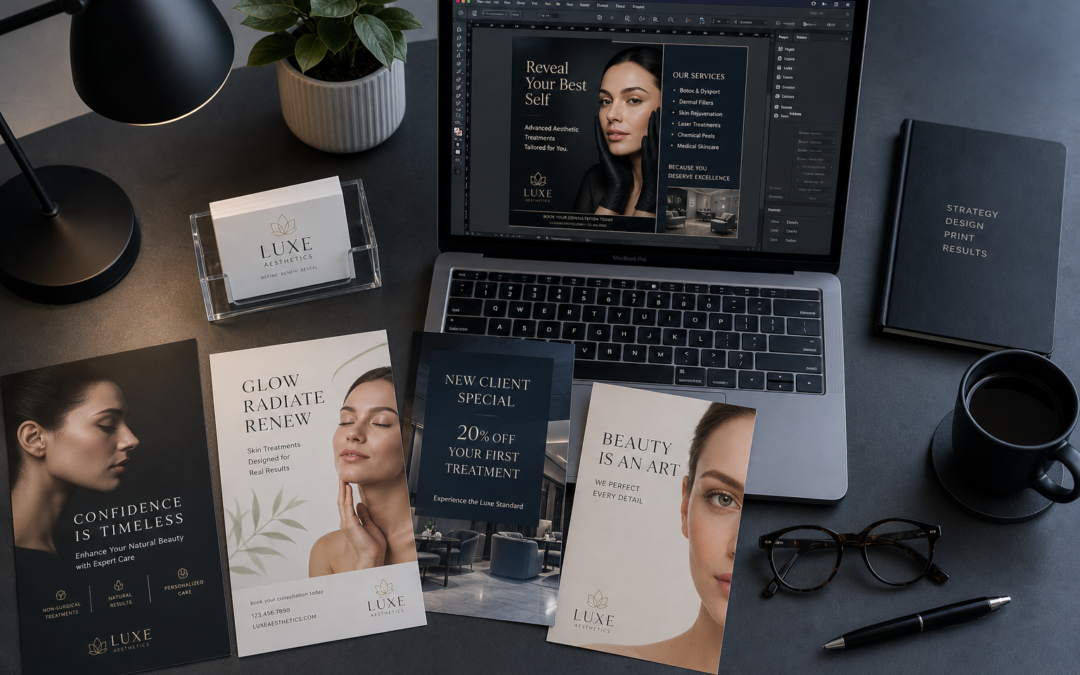
Choosing a print marketing and flyer design agency for your aesthetic clinic is about more than just good looks—it’s about ensuring compliance, building patient trust, and delivering measurable business results. The best agencies for clinics have hands-on experience working with regulated healthcare providers, understand advertising regulations like HIPAA and FTC guidelines, and can show real-world examples of how their print materials lead to more bookings or stronger brand reputation. Many clinics mistakenly view print as a simple commodity, which often leads to wasted spend and missed opportunities. To make the right choice, approach agency selection with a clear framework, ask for evidence of their process in real clinic scenarios, and require both compliance literacy and practical know-how from initial design to final distribution.
Key Takeaways
- Clinic-specific print marketing expertise is essential for compliance and credibility—generalist designers often miss key regulatory details and the nuances of patient trust.
- Print and direct mail continue to play a unique role in building trust and recall for beauty and wellness clinics. According to ContentMation citing MarketingSherpa, 82% of consumers trusted print ads when making a purchase decision in 2025.
- Effective agency vetting requires a step-by-step framework that covers aesthetics, legal compliance, and execution details, not just a portfolio review.
- Not all flyer printing services offer the same material quality, proofing rigor, or distribution support—these factors directly affect campaign ROI and brand perception.
- Strategic budgeting for print should focus on quality, targeting, and measurable outcomes—not just minimizing spend or maximizing print volume.
Why Print Still Matters for Aesthetic Clinics — And Where Most Clinics Get It Wrong
Despite the rise of digital channels, print marketing remains a uniquely powerful driver of trust for aesthetic clinics. Patients considering elective treatments often weigh risk and reputation—qualities that tactile, well-crafted print materials can reinforce more effectively than a fleeting social ad. According to ContentMation citing MarketingSherpa, 82% of consumers trusted print advertisements when making a purchase decision in 2025. This trust advantage is especially important in personal health and beauty sectors, where credibility and professionalism are essential.
The most common mistake: clinics treat print as an afterthought, delegating it to a generalist designer or defaulting to stock templates that fail to reflect their actual patient experience. For example, a clinic might print a batch of postcards featuring generic spa imagery and aggressive discounts—only to find these materials languishing unread, or worse, undermining the clinic’s medical credibility. In contrast, a flyer that uses real (consented) patient stories, premium paper stock, and carefully balanced copy—emphasizing both expertise and approachability—can prompt cautious patients to book consultations they might otherwise postpone.
The difference often comes down to details: typography that signals luxury, copy that avoids clinical coldness without crossing into unsubstantiated claims, and a physical feel that subtly reinforces the clinic’s quality standards. Clinics that invest in specialized print marketing and flyer design agencies—those with clear understanding of HIPAA (see U.S. Department of Health & Human Services: HIPAA Privacy Rule), before-and-after photo compliance, and the nuances of regulated advertising (see FTC Advertising & Marketing Guidance)—consistently see stronger patient response and brand loyalty.
What Sets a True Print Marketing & Flyer Design Agency Apart?
It’s a costly assumption to believe any marketing agency can handle print for aesthetic clinics. The reality: few agencies combine design excellence with the operational and regulatory expertise clinics require. A true print marketing and flyer design agency for clinics will not only design but also manage every step from compliance vetting to print run logistics and distribution timing.
One critical differentiator is an agency’s ability to bridge design and distribution. Many design shops deliver nice-looking PDFs but lack experience with real-world print production. For example, ‘variable data printing’ means customizing sections of each flyer—like personalizing a greeting or offer based on the recipient—rather than sending everyone the same message. Agencies experienced in postal regulations (such as size and weight limits for mailing) will help you avoid postage surcharges and delays. They’ll also explain the practical differences between methods like USPS Every Door Direct Mail (EDDM) for broad local reach and targeted house lists for reaching past patients, weighing compliance, cost, and campaign goals. Additionally, they’ll clarify how to track responses using unique QR codes or call tracking lines that integrate with your CRM (customer relationship management system), so you can see which print pieces actually drive calls or bookings.
Another sign of a genuine clinic partner is their process for integrating print with your broader marketing funnel. The best agencies ask about your patient journey, digital retargeting, and post-flyer follow-up—suggesting, for instance, how to sync a flyer drop with a social campaign or how to use QR codes for seamless digital handoff. For practical ways to blend print with digital, see Print Marketing & Flyer Design: 2026 Guide for Orange County Med Spas.
Clinic-Focused Print Design: What Most Agencies Miss
The difference between a generic flyer and a clinic-ready piece often comes down to psychological triggers and regulatory details most agencies overlook. For example, a flyer advertising injectables must feel high-end and reassuring—not coldly clinical, nor irresponsibly sensational. Common missteps include overpromising with before-and-after images or using language like “Look 10 Years Younger Instantly!”—which can trigger scrutiny from medical boards or the FTC (see FTC Advertising & Marketing Guidance).
An experienced print marketing and flyer design agency will insist on using real patient testimonials with proper consent, spotlighting credentials, and including compliance-mandated disclaimers (for instance, about treatment results varying). A real-world comparison: Clinic A mails out a glossy postcard featuring a stock model and deep discounts; Clinic B sends a tri-fold with a real patient story, a subtle introductory offer, and a note from the medical director. The latter approach, by connecting emotionally and signaling authenticity, is far more likely to prompt qualified inquiries and build lasting trust.
Even tactile quality is often overlooked. Patients notice the feel of a flyer—flimsy paper can subtly undermine perceptions of your clinic’s quality. A specialist agency will specify premium finishes, recommend formats (such as die-cuts or unique folds), and even suggest uncoated stocks for a more sophisticated feel. These choices are not cosmetic; they function as trust signals from the very first touch. For more on how tactile details influence brand perception, see this PIWorld breakdown on tactile marketing.
The A.C.E. Framework for Vetting Print Marketing & Flyer Design Agencies
Years of clinic projects reveal most agency vetting processes are too shallow. A more thorough approach is the A.C.E. framework—Aesthetics, Compliance, Execution—designed to surface the real differences between agencies and weed out those unfit for regulated clinic work. Here’s how to apply it, with concrete steps and examples for each stage:
- Aesthetics:
- Request physical print samples—not just digital PDFs—of clinic campaigns. For example, ask to see a real mailer they created for another regulated healthcare provider, and have them explain design decisions (such as color, paper, typography) that supported the clinic’s goals.
- Ask for a case study or a scenario where their materials led to tangible outcomes (such as increased appointment requests or positive patient feedback), even if the results are qualitative. Example: “Show me a flyer that was used to launch a new treatment and explain what changed in patient inquiries after its release.”
- Review their work for a blend of medical credibility and aspirational aesthetics. If their portfolio leans heavily spa-like or uses only generic beauty models, probe whether they understand medical branding and patient trust nuances.
- Compliance:
- Ask about their process for regulatory review. For example: “Can you walk me through how you ensure materials meet HIPAA requirements for patient privacy (U.S. HHS HIPAA Privacy Rule) and FTC rules on advertising claims (FTC Guidance)?”
- Request their compliance checklist. Ask if they verify consent for all testimonials and before-and-after images, and if they coordinate with your legal counsel before printing.
- Have them describe a time they caught a compliance issue pre-print (such as a missing disclaimer or an overpromising claim) and how they resolved it.
- Execution:
- Request a detailed breakdown of the agency’s print process: proofing, vendor selection, error correction, and distribution planning. For example, “Show me your step-by-step workflow from design approval to final delivery.”
- Ask if they have established relationships with printers experienced in healthcare mailings, and if they have handled direct mail fulfillment. For instance, “Explain how you would troubleshoot an issue if a print batch arrived with color or text errors right before an event.”
- Probe for specific examples, such as: “Describe a scenario where you had to resolve a print or delivery problem under a deadline. What steps did you take?”
Applying the A.C.E. framework in this step-by-step way will quickly reveal which agencies can truly deliver for your clinic and which are simply dabbling outside their depth.
Print vs. Digital: The Trust and Recall Advantage in Aesthetic Clinic Marketing
Digital marketing delivers speed and measurability, but print outperforms digital in trust and recall—two critical factors in elective healthcare decisions. A 2025 study found that print advertisements generate 20% higher recall than digital ads among the same audience. Patients often keep a flyer on hand for weeks, revisiting it before booking a consult—a behavior rarely observed with digital-only campaigns.
Direct mail, specifically, can produce much stronger response rates for clinics with well-maintained patient lists. According to the WifiTalents Report 2026, direct mail response rates for house lists were 5.1%, compared to just 0.6% for email. This underscores why print should be a central tactic—not a “nice to have”—within a clinic’s marketing mix. For a deeper dive into how flyers and print campaigns have worked for other industries—and how similar principles transfer—see Is Print Marketing & Flyer Design Worth It? Real ROI for HVAC.
Effective campaigns integrate print and digital, tracking offline-to-online conversions using QR codes, custom URLs, or redemption codes. For example, a clinic might include a QR code on a flyer that leads to a dedicated booking page, allowing for attribution and follow-up. For more strategies, see the linked article above as many principles apply to aesthetic medicine as well.
Comparison Table: Print Marketing & Flyer Design Agency Options for Clinics
| Agency Type | Strengths | Weaknesses | Best For |
|---|---|---|---|
| Generalist Design Firm | Low cost, fast turnaround, wide range of styles | Lacks clinic compliance, superficial understanding of patient psychology | Basic event flyers, non-medical promotions |
| Clinic-Specialized Print Agency | Deep compliance knowledge, luxury aesthetics, integrated print strategy | Higher fees, sometimes limited to healthcare sector | Regulated treatments, high-value patient acquisition |
| Online Print Marketplace | Template-driven, affordable, easy ordering | Generic designs, little customization, no compliance support | Seasonal promos, mass mailers on a budget |
| Hybrid Marketing Agency | Can unify print with digital, broad tactical expertise | Clinic experience varies, may outsource print fulfillment | Clinics wanting full-funnel campaigns |
Summary: For most clinics, a specialized agency with sector-specific regulatory knowledge and a track record in luxury aesthetics delivers the strongest return on investment—especially when print is part of an ongoing strategy, not just a one-off mailer. Generalist firms and online marketplaces may be appropriate for simple, unregulated promotions, but carry significant compliance and quality risks for medical campaigns.
The Print Design Checklist Every Clinic Should Use Before Approving a Flyer
Never rely on gut instinct or delegate final approval of your clinic’s flyer to one person. Use a systematic print design checklist to catch costly missteps before they go to print:
- Brand Consistency: Ensure your logo, color palette, and fonts match your clinic’s brand identity (see 7 Logo Design Mistakes Costing Cosmetic Clinics Leads for common pitfalls).
- Clear Offer: Spell out the patient incentive and double-check that it complies with advertising guidelines for medical services.
- Imagery: Use only authentic, properly consented before-and-after photos, or high-quality, relevant lifestyle imagery that reflects your real patient experience.
- Compliance Review: Run all claims, testimonials, and disclaimers past your legal or regulatory advisor before printing. For further regulatory details, see HIPAA Privacy Rule and FTC Advertising Guidance.
- Contact & Tracking: Include unique phone numbers, QR codes, or URLs to measure response—ensure these connect with your CRM or intake system (see AI Live Chat & Lead Intake Assistant for digital handoff strategies).
- Paper & Print Proof: Always approve a physical proof—never just a digital file. Assess tactile quality, color accuracy, and legibility of disclaimers.
- Distribution Plan: Clarify how, when, and to whom flyers will be distributed (e.g., in-clinic handouts, direct mail, event sampling).
Skipping any step risks wasted spend or compliance issues. Many clinics only spot errors when thousands of flawed flyers arrive—this checklist is your backstop against expensive reprints and brand damage. For more on optimizing your clinic’s brand assets, see Branding & Rebrand Timing for Cosmetic Clinics.
Budgeting and ROI: What Actually Drives Value in Print Marketing for Clinics?
Too many clinics approach print budgeting with a “what’s the minimum I can spend?” mindset. This almost always backfires. According to the RRD 2025 Print Marketing Report, 72% of consumers reported regularly reading or looking at advertisements received in the mail. But to capitalize, your materials must be compelling and actionable—not merely cheap.
Here’s what most clinics get wrong: treating design and printing as separate line items, or chasing the lowest per-unit cost by overordering. Instead, focus on targeted, high-quality print runs and a feedback loop for measuring results. For example, rather than blanketing your whole city, you might send a smaller batch of premium flyers to a curated patient list—perhaps those who haven’t visited in over a year or those who previously inquired about a specific treatment. Ask agencies for projected response scenarios tied to your actual goals (such as, “What’s the likely appointment lift from mailing to lapsed patients with a reactivation offer?”). Always insist on response tracking—unique URLs, call tracking, or redemption codes—so you can tie results to spend. For a breakdown of common cost factors and typical budget ranges, see Print Marketing & Flyer Design Costs in 2026: Real Pricing Insights.
Flyer Printing Services: Hidden Factors That Make or Break Campaigns
Not all flyer printing services are created equal—choosing the wrong vendor can erode perceived value, response rates, and even compliance. For example, clinics often discover after the fact that their final flyers have “off” colors, blurry images, or disclaimers that are too small to read. These issues usually trace back to poor proofing, mismatched color profiles (differences between how colors appear on screen and in print), or incompatible paper stocks.
To avoid expensive surprises, insist on a physical proof from your flyer printing service before authorizing a full print run. This step will catch the majority of quality issues in time to correct them. Also, clarify whether your print vendor offers direct mail fulfillment (printing, addressing, and mailing in one workflow) or if you’ll need to coordinate distribution separately. Some agencies handle design and print logistics under one roof (see Flyer & Printing Services), which can save time and reduce risk.
Ask for a written breakdown of print-to-mail timelines, error resolution protocols, and whether the printer guarantees delivery windows—especially if you’re timing a campaign around a product launch or event. For more on what to watch for in print quality and logistics, see PIWorld on print production best practices.
Real-World Scenario: Integrating Print Into a Modern Clinic Marketing Funnel
Imagine a mid-sized med spa launching a new injectable. Instead of relying on digital ads alone, the clinic partners with a specialized print marketing and flyer design agency to reach lapsed patients. They send a premium tri-fold mailer featuring a special consultation offer, a QR code linking to a booking page, and a real patient testimonial (with full consent). The print drop is timed to coincide with a retargeting email sequence and social ads, using unique codes to attribute conversions.
Within a few weeks, the clinic might notice a clear uptick in bookings tied directly to the flyers (thanks to tracked QR codes and dedicated phone lines). Many recipients mention the flyer’s luxurious feel as a key reason they reconsidered the clinic. In this scenario, success is driven not just by creative design, but by seamless integration of print and digital, careful compliance, and the choice of an agency that understands both technical and regulatory demands. For guidance on combining print with other channels, see AI Content Creation and AI Social Media Management.
This approach is repeatable: clinics that treat print as a core channel—backed by specialist partners and integrated with digital—tend to see higher engagement and stronger patient loyalty over time.
Final Insights: Choosing the Right Long-Term Print Partner
Selecting a print marketing and flyer design agency is a strategic decision for clinics—not a commodity purchase. The best partners combine sector-specific experience, fluency in compliance with regulations like HIPAA and FTC guidelines, and a willingness to challenge your assumptions about what works in print. Clinics that demand rigorous agency vetting (using frameworks like A.C.E.), invest in high-quality materials, and insist on measurable results consistently outperform those who treat print as an afterthought.
Don’t chase the lowest proposal or the flashiest mockup alone. Instead, prioritize agencies with a clinic-specific track record, a transparent collaborative process, and a plan for integrating print into your broader marketing funnel. While Lion Click Media is based in Orange County, the principles above apply universally: in aesthetic clinic marketing, every detail matters—and the right agency will treat your print campaigns with the same care and rigor you give your patients.
Frequently Asked Questions
- What makes a flyer design agency good for aesthetic clinics?
- Can I just use a local print shop without an agency?
- How long does it usually take to complete a flyer project?
- Should my flyers include digital elements like QR codes?
- Is it better to hire freelancers or a full-service agency for flyers?
- How can I measure the success of my print flyer campaigns?
- Are there legal considerations in print marketing for clinics?
Frequently Asked Questions
What makes a flyer design agency good for aesthetic clinics?
A good agency understands healthcare branding, compliance, and how to visually balance medical credibility with aspirational beauty to connect with your target clients.
Can I just use a local print shop without an agency?
While local print shops handle printing, they often lack design expertise and strategic marketing insight, which are crucial for creating flyers that truly convert in the aesthetic market.
How long does it usually take to complete a flyer project?
Typical flyer design and print projects take several weeks, including concept development, revisions, proofing, and printing; timelines vary based on complexity and print volume.
Should my flyers include digital elements like QR codes?
Yes, integrating QR codes or URLs that link to booking pages or social media enhances tracking and bridges print with digital, boosting lead capture effectiveness.
Is it better to hire freelancers or a full-service agency for flyers?
Freelancers can be cost-effective for simple projects, but full-service agencies offer strategic marketing, print quality control, and scalability that better suit growing aesthetic clinics.
How can I measure the success of my print flyer campaigns?
Track success by monitoring appointment spikes tied to flyer distribution, using unique promo codes, QR scans, or integrating print efforts with digital analytics platforms.
Are there legal considerations in print marketing for clinics?
Yes, clinics must ensure all claims comply with advertising regulations and HIPAA privacy rules, which a specialized agency familiar with healthcare marketing can help navigate.
Get Your Free AI Marketing Audit
See exactly where you are leaving leads on the table and how Lion Click Media can help you rank higher, capture more customers, and Make Your Brand ROAR. No cost, no obligation.
Claim My Free Audit →Or chat with our 24/7 AI assistant (bottom-right) for instant answers.