
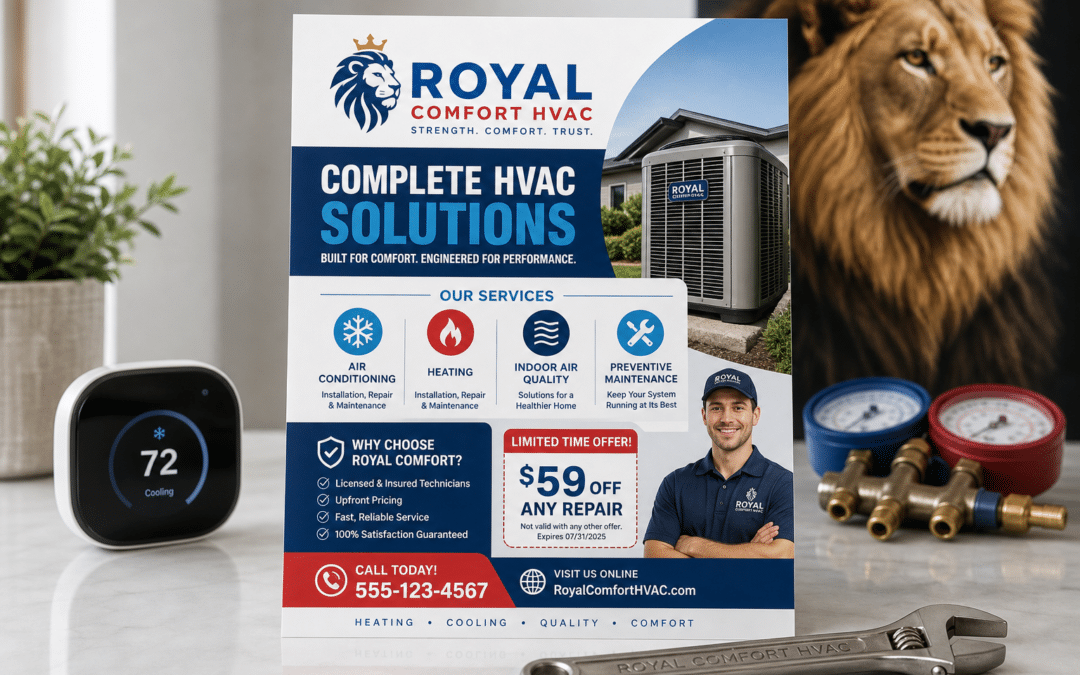
Print marketing and flyer design ROI for HVAC is often underestimated—yet, when executed with focus and tracked rigorously, it delivers a measurable, sometimes market-beating return. HVAC companies that treat print as a strategic, data-driven channel (rather than an outdated afterthought) routinely generate leads, book urgent repairs, and reach homeowners digital ads often miss. The numbers are real: print campaigns have driven response rates, cost-per-lead, and appointment surges that digital alone rarely matches—provided you target smartly, track every response, and design for action, not just awareness.
Key Takeaways
- Print marketing and flyer design ROI for HVAC is proven when campaigns are targeted, tracked, and linked to time-sensitive, high-value offers—sometimes outperforming digital in direct response and cost per lead (DrukarniaPro, Kapa99).
- Most HVAC businesses leave money on the table by approaching print as a generic, scattershot tactic instead of integrating it with digital touchpoints and using real tracking methods.
- Direct mail and flyer canvassing drive the strongest ROI for urgent repairs, seasonal tune-ups, and neighborhood saturation—especially when tracked with unique codes, phone numbers, or landing pages.
- Measuring true print ROI means looking beyond response rates to customer lifetime value, geographic targeting precision, and professional design quality.
- The most effective HVAC marketing strategies coordinate print and digital—using print to trigger action and digital to follow up, retarget, and close the loop.
Does Print Marketing Really Deliver ROI for HVAC Companies?
Despite the digital-first mindset dominating most marketing playbooks, print marketing and flyer design ROI for HVAC is not only alive—it’s often higher than digital for specific, high-intent scenarios. The tired “print is dead” myth doesn’t hold up against real-world results. For example, a direct mail campaign for an HVAC business delivered an 8.5% response rate and a customer acquisition cost three times lower than digital channels, according to DrukarniaPro. This isn’t a fluke: when the offer is urgent, local, and relevant, print consistently brings in qualified leads at a lower cost than most expect.
The real mistake: treating print as a “spray and pray” tactic. Print’s ROI hinges on three factors—targeting the right neighborhoods, crafting a compelling offer, and integrating print with your digital and phone tracking systems. When those pieces align, print can punch far above its perceived weight in local HVAC marketing.
What’s the Real-World Impact of Flyers for HVAC Lead Generation?
Flyers aren’t just old-school—they’re a direct line to homeowners who may never see your digital ads. The key is focused distribution and design built for conversion. For instance, handing out HVAC flyers door-to-door can convert at a 3-5% rate; that means distributing 200 flyers could net 6-10 qualified contacts in an afternoon, as reported by Kapa99. This level of immediate, trackable feedback is rare in digital, especially for local, urgent services.
But most HVAC flyers fail because they’re bland and unfocused. A generic “Call us for service” message is forgettable; a flyer highlighting a seasonal tune-up or emergency repair offer gets noticed and acted on. Consider the case of a Mississauga HVAC company: by promoting a clear seasonal offer via flyers, they saw a 350% increase in appointments in just one month (Flyer Canada). The difference? Precision targeting—right neighborhoods, right timing, right message.
Print vs Digital Marketing: Which Channel Wins for HVAC?
The print-versus-digital debate is a false choice. The smartest HVAC marketers combine both—using print to drive direct response and digital to reinforce, retarget, and convert. For example, a homeowner might receive your flyer, look up your reviews on Google, and then see your retargeted online ad later that week. That “surround sound” effect drives recall and trust.
Compare core channels:
| Channel | Strengths | Challenges | Best Use for HVAC |
|---|---|---|---|
| Flyer Distribution | Immediate local reach; tangible and memorable; not filtered by ad blockers | Requires upfront design/print costs; manual tracking unless set up properly | Neighborhood saturation, urgent/emergency repairs, seasonal offers |
| Direct Mail | Geo-targeted by zip code; trackable; professional credibility | Higher per-piece cost; slower setup and production | Maintenance plans, pre-season tune-up pushes |
| PPC/Google Ads | High intent; instant results; granular analytics (impressions, clicks, conversions) | Rising cost-per-click; fierce competition in some markets | Emergency service capture, “near me” queries |
| Social Media Ads | Visual storytelling; audience retargeting; sharable content | Short attention spans; ad fatigue; harder to directly attribute appointments | Brand awareness, community building, promotions to followers |
The lesson: maximize ROI by coordinating print drops with digital retargeting, tracking responses by channel, and tailoring offers to each audience. For a deeper breakdown of how home services can integrate these touchpoints, see conversion-focused web design strategies for home services.
Case Study Scenarios: When Print Outperforms Digital
Print isn’t always the answer, but in certain HVAC scenarios, it’s the clear winner. Consider these real-world cases:
- Neighborhood Emergency Blitz: After a major storm, a Toronto HVAC contractor specializing in emergency repairs used flyers to target neighborhoods with power outages and damaged units. The result: an immediate surge in repair calls and booked jobs (Flyer Canada).
- Seasonal Tune-Up Push: A Mississauga HVAC company ran a flyer campaign spotlighting pre-summer tune-ups, leading to a 350% jump in appointments within weeks (Flyer Canada).
- Hyperlocal Brand Launch: For a new HVAC business entering a crowded market, a direct mailer paired with local PPC and social ads rapidly built neighborhood awareness—far faster than digital alone could achieve.
In every case, print succeeded because it was urgent, hyperlocal, and tied to a clear offer—not just a generic branding play. Digital alone often misses these offline, high-intent moments.
The “R.E.A.C.H.” Framework for HVAC Print Marketing ROI
Too many HVAC businesses guess at what works. The R.E.A.C.H. framework breaks down a repeatable, practical method for maximizing and tracking print marketing and flyer design ROI for HVAC:
- R—Right Audience: Use your CRM or recent job history to pinpoint the zip codes, home ages, and income brackets that book most frequently. For example, homes built before 1990 may need more repairs; cross-reference local property records or geo-mapping tools to focus your drops.
- E—Engaging Offer: Skip the laundry list of services. Instead, push a time-sensitive offer—like “$79 A/C Tune-Up Before June 1” or “24-Hour Emergency Repair.” If you’re unsure what resonates, split your flyers between two offers and track which drives more calls (basic A/B testing).
- A—Attractive Design: Invest in professional flyer design. Use real photos of your team, not just stock HVAC images. Highlight the headline offer above the fold, use bold colors, and include a strong call to action. QR codes are essential for bridging print to digital—link them to a dedicated, mobile-friendly landing page that matches the flyer’s look.
- C—Clear Tracking: Assign a unique phone number (using a call-tracking tool like CallRail or CallTrackingMetrics), a custom promo code, or a dedicated URL to every print campaign. Even a simple spreadsheet can help you tie each call or form submission to its source.
- H—Hybrid Follow-Up: Don’t let leads go cold. After flyer drops, retarget those neighborhoods with Facebook or Google Ads, and follow up with SMS or email if you collect addresses. Fast responses (within minutes, not hours) dramatically increase conversion odds, especially for emergency offers.
When each R.E.A.C.H. step is executed, print becomes a predictable, trackable, and highly profitable lead channel. For more on embedding these steps into a marketing workflow, see how other local service providers manage print ROI in our article on print marketing ROI for chiropractors.
Flyer Design: What Actually Moves the Needle (and What Doesn’t)
Most HVAC flyers underperform because they’re formulaic—packed with boilerplate copy, tiny print, and a buried phone number. Strong ROI starts with design choices that demand action:
- Headline & Offer Placement: Lead with the main offer (“$79 Tune-Up” or “Same-Day Furnace Repair”)—not your logo. The headline should be the first thing a homeowner sees.
- Trust-Building Visuals: Use real images—your crew, trucks with city landmarks, or before/after shots from local jobs. Stock art rarely builds trust.
- Obvious Next Steps: Feature a large, clickable QR code, a prominent phone number, and a short, memorable URL. Tie each to a unique campaign landing page for tracking.
- Credibility Proofs: Display certification badges (e.g., NATE, BBB), Google review ratings, and “Serving [Your City] Since [Year]” for local credibility.
What rarely works: cramming every service onto the page, using dated design templates, or failing to match your flyer’s branding to your website and digital ads. For cost and vendor selection tips, see real pricing insights for print marketing and flyer design.
Tracking and Measuring Print Marketing ROI: The Practical Playbook
This is where most HVAC businesses drop the ball. Sending out flyers is easy; tracking true ROI is the hard part. Here’s a practical checklist:
- Call Tracking Numbers: Use a service like CallRail or CallTrackingMetrics to assign a different number to each campaign or neighborhood, so you know which flyers generate calls.
- Dedicated Landing Pages: Create a unique page (e.g., /summer-tuneup) for each major flyer drop; link via QR code and short URL for clean attribution.
- Promo Codes or Offers: Make your flyer offer redeemable only with a code (“Mention this flyer for $20 off”), so staff can log each call’s source.
- Staff Training: Train whoever answers the phone to ask, “How did you hear about us?” and record the answer in your CRM or call-tracking sheet.
- Monthly ROI Review: At the end of every month, tally new jobs, revenue, and repeat clients from each print campaign. Compare to digital campaigns on cost per lead, close rate, and average customer lifetime value.
Integrating print tracking with your digital CRM or Google Analytics closes the attribution gap. If your business is already using AI data analytics tools or CRM systems, syncing print and digital data unlocks deeper insights and smarter budget decisions.
Common Pitfalls: Where Print Marketing for HVAC Fails
Why do some HVAC shops get their phones ringing from flyers while others hear crickets? It’s rarely about sheer volume—usually, it’s these mistakes:
- Unfocused Targeting: Mailing to every household is a waste. Smart campaigns use recent job data, local weather events (like storms), or property characteristics to zero in on the highest-propensity homes.
- Outdated or DIY Design: Amateurish designs make you look small-time—especially when competing with established brands. Invest in professional, conversion-focused design.
- No Tracking: Sending flyers with no unique code, number, or URL means you’ll never know what worked.
- No Urgency: Flyers that don’t give homeowners a reason to act now (“Limited time”, “First 10 callers”, “Book by June 1”) almost always get tossed.
The bottom line: print marketing and flyer design ROI for HVAC is driven by precise targeting, compelling design, and disciplined follow-up. To see how other home service brands avoid these mistakes, check out the 2026 playbook for conversion-focused home services.
Integrating Print with Your Broader HVAC Marketing Strategies
Too many HVAC businesses keep print siloed from digital, missing out on multiplier effects. High-ROI operators orchestrate campaigns that thread together flyers, direct mail, Google Ads, email, and even AI-powered content. For example: mail a flyer for a seasonal tune-up, retarget that neighborhood with Facebook ads, and follow up with SMS reminders to respondents. That’s true multi-channel marketing.
Print also amplifies digital. Adding a QR code to your flyer that links to an online booking page or Google review profile bridges the offline/online gap. Smart marketers also sync flyer drops with new website launches—see more in conversion-focused web design strategies for home services.
If you’re exploring AI content creation or AI social media management, pair these tools with flyer campaigns using dynamic QR codes or automated follow-ups for even more trackability. The most successful strategies never treat print and digital as rivals—they coordinate both for maximum impact.
Budgets, Trade-Offs, and When to Prioritize Print
Is print worth it for your HVAC business? The honest answer: it depends on your local market, your goals, and how disciplined you are with targeting and tracking. Many HVAC businesses spend somewhere in the low-to-mid four figures per print campaign, but the real question isn’t cost—it’s opportunity. Skipping print means missing homeowners who aren’t Googling for HVAC help, or who need a nudge to act on a service they’ve been putting off. But over-investing in print without digital tracking or follow-up is just burning cash.
The most successful HVAC companies review campaign results quarterly, shift budget based on real data, and maintain a balanced mix of print and digital tailored to local seasonality. For a detailed breakdown of print and flyer costs, see flyer and print marketing pricing insights.
As a final aside, many Orange County HVAC businesses (and others nationally) work with agencies like Lion Click Media to navigate these trade-offs, but the core principles apply to any business: target with intent, track every lead, and focus your budget where real results show up.
Frequently Asked Questions
Is print marketing still effective for HVAC businesses?
Print marketing remains effective for HVAC companies focused on local neighborhoods with targeted, well-designed flyers and measurable response methods.
How can I track leads from flyer campaigns in HVAC marketing?
Use unique promo codes, dedicated phone numbers, or QR codes linked to AI-powered booking or chat assistants to track and attribute leads from print flyers.
What is the best time of year for HVAC print marketing?
Seasonal peaks like early summer for AC tune-ups or early fall for heating system checks are ideal times to run print marketing campaigns for HVAC services.
Can small HVAC businesses afford professional flyer printing services?
Many small HVAC businesses budget in the low-to-mid four figures for professional flyer design and printing, balancing quality and cost for effective local outreach.
Should HVAC companies prioritize digital or print marketing?
Prioritize both by integrating print campaigns with digital tools for lead capture and retargeting; print builds local trust while digital ensures fast, measurable responses.
How do AI tools improve print marketing ROI for HVAC?
AI tools enhance print ROI by capturing leads via chat assistants, analyzing response data, and optimizing targeting to reduce wasted spend and boost conversions.
Are flyer distribution services necessary for HVAC print campaigns?
Professional flyer distribution helps ensure targeted reach and consistent delivery, which improves print campaign effectiveness compared to random or DIY drops.
Get Your Free AI Marketing Audit
See exactly where you are leaving leads on the table and how Lion Click Media can help you rank higher, capture more customers, and Make Your Brand ROAR. No cost, no obligation.
Claim My Free Audit →Or chat with our 24/7 AI assistant (bottom-right) for instant answers.