
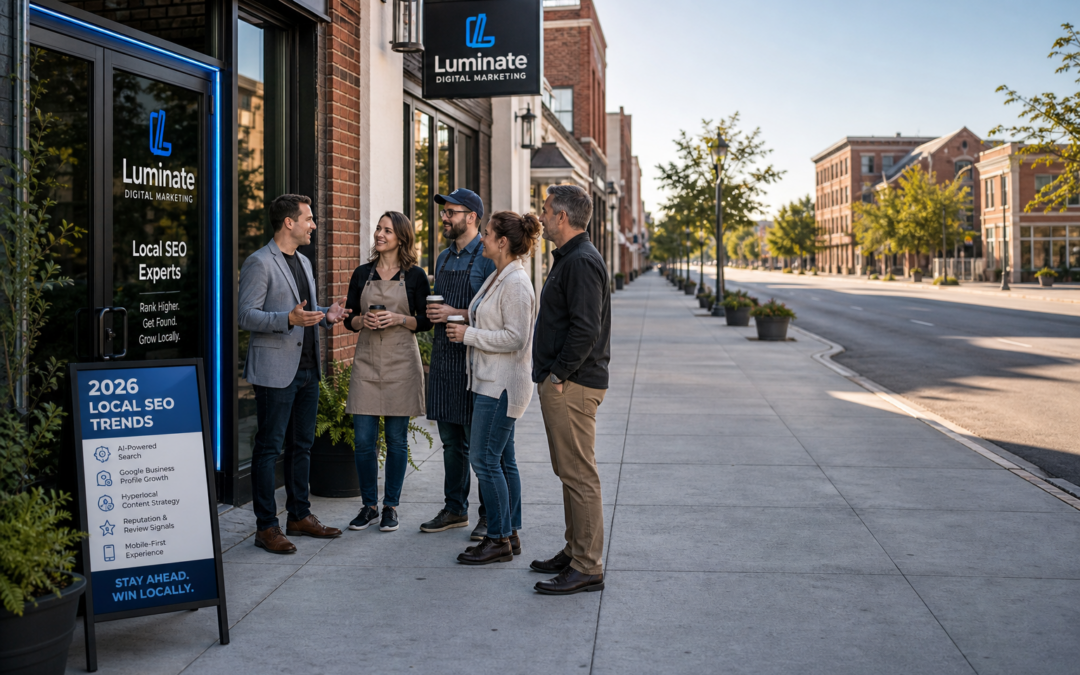
Local SEO in 2026 requires an active, multifaceted approach, not just basic listing management. To rank well and attract local customers, U.S. businesses must combine real-time Google Business Profile engagement, short-form video, structured data, voice search readiness, and AI-supported insights. Those who make local SEO an ongoing, hands-on discipline—not a set-and-forget task—are the ones who consistently climb local search rankings and meet evolving consumer expectations.
Key Takeaways
- Google Business Profile (GBP) now demands ongoing, authentic engagement—accuracy alone is not enough to stand out.
- Short-form video has become a major ranking and engagement driver, particularly among younger audiences.
- AI, entity optimization (organizing your business’s information so search engines understand your expertise and offerings), and structured data are fundamentally changing how local businesses get discovered in search.
- Voice search and accessibility are table stakes; businesses that ignore these risk losing out on high-intent local traffic.
- Sticking with “SEO basics” or last year’s tactics almost guarantees stagnation as both search platforms and user habits rapidly evolve.
Why “Local SEO Trends” in 2026 Go Far Beyond Algorithm Updates
Too many marketers still treat local SEO trends as little more than following Google’s latest algorithm updates. In 2026, this mindset misses the mark: the real differentiator is how your business shows up as a dynamic, trusted local brand—both to search engines and to real customers. The “set and forget” era for Google Business Profile and keyword stuffing is long gone. Today, platforms like Google, Bing, and Apple Maps reward businesses for genuine engagement, fresh multimedia content, and well-structured, current data.
For example, imagine a Seattle coffee shop that shares weekly videos of barista tips, promptly answers every review (positive or negative), and updates its GBP with new seasonal menus and events. This business is far more likely to appear high in map packs than a competitor with a perfectly optimized but static profile. Across the U.S., small and mid-sized businesses that invest in ongoing profile management, diverse content, and technical hygiene are seeing steadily better discovery and engagement—while those clinging to surface-level tactics fall behind. For more on this shift in local SEO priorities, see Search Engine Land’s 2024 Local SEO Strategies Guide.
What Actually Moves the Needle: The S.A.V.E. Framework for Local SEO in 2026
To help businesses cut through the noise, the S.A.V.E. Framework—Specificity, Authority, Video, Engagement—offers a clear, actionable path for local SEO in 2026. Each step goes deeper than the superficial approaches most competitors use. Below, concrete examples illustrate how each component works in practice:
-
Specificity: Go past broad “near me” terms—map out your true hyperlocal neighborhoods, service areas, and nearby landmarks. Build out targeted landing pages or content blocks for each, answering real questions locals ask (e.g., “best vegan brunch Capitol Hill Seattle”), and tie every piece to structured data. For instance, a Chicago real estate team might create pages for each neighborhood with market trends and local testimonials. Use Google Search Console’s “Queries” report to identify actual long-tail searches you’re missing.
Case example: A Minneapolis home services provider created dedicated pages for each suburb, featuring localized FAQs and testimonials, and saw a steady increase in calls from those specific areas. -
Authority: Don’t stop at reviews. Earn trust with credible signals: pursue local press mentions, join chamber of commerce directories, and collaborate with community organizations. Feature recognizable local partner logos and testimonials on your site, and use schema markup to explicitly tie these entities to your business.
Case example: A Portland bike shop secured a feature in a local newspaper and joined the city’s green business directory; these references were marked up with Organization schema, helping boost their perceived authority in search.
Tools like Moz Local and Semrush’s Link Building Tool can help track and grow local authority links. For further reading, see Moz’s Local SEO Ranking Factors. -
Video: Regularly post short-form video (30–90 seconds) directly to Google Business Profile and your website—not just TikTok or Instagram. Use these to answer FAQs, introduce staff, show unique processes, or spotlight local events. For instance, a hardware store could upload quick “employee pick of the week” demos.
Case example: A New Orleans bakery posted weekly cake decorating tips as GBP videos; over time, they noticed more profile views and a rise in direct inquiries about their classes.
Consistency matters: aim for a weekly or bi-weekly cadence to build momentum, not just a one-off splash. -
Engagement: Treat every review, Q&A, and message as an opportunity to demonstrate responsiveness. Assign a real person to reply daily—don’t just automate generic responses. Monitor GBP’s “Messages” and “Questions & Answers” features, and use review management tools like GatherUp or Birdeye to stay on top of feedback across platforms.
Case example: An Austin dental practice responded to every review within 24 hours, often addressing issues in detail. This pattern of engagement led to more positive mentions and increased word-of-mouth referrals.
Most businesses skip steps 1 and 4—they obsess over keywords and review counts but ignore hyperlocal nuance and the ongoing dialogue that signals relevance and trust. The S.A.V.E. Framework forces attention to what actually drives local visibility and conversions in 2026. For a more detailed breakdown of local ranking factors, see BrightLocal’s Local Ranking Factors.
Is Google Business Profile Still the Kingpin? Most Marketers Miss the Real Opportunity
Google Business Profile (GBP) remains essential, but the way to win has shifted. Treating GBP like a static directory listing is a critical mistake. In 2026, frequent content updates, photo and video uploads, rapid review responses, and creative use of GBP features (like product menus and booking integrations) are what move the needle.
Take the example of a Miami dental clinic: if they upload bi-weekly videos answering common questions and use GBP’s booking feature, they’re much more likely to dominate the Local Pack over a competitor who only updates hours once a year. Regularly check for new GBP features (Google quietly rolls these out), and track which posts or photos generate the most calls or clicks using GBP’s built-in analytics. For a detailed breakdown of new GBP features and optimization advice, see Google Business Profile optimization trends.
The bottom line: treat your GBP as a living marketing and service asset—schedule content updates, assign team roles for engagement, and review analytics monthly to identify what’s working. For official best practices, Google’s own GBP Help Center is a useful resource.
Short-Form Video: The Underrated Driver of Local Search Ranking
Short-form video is rapidly becoming a dominant force in local search, but many local businesses still overlook it. While reviews and photos remain important, video content now grabs attention from both users and algorithms. Google increasingly surfaces video results—even pulling clips directly into map and search listings for businesses that upload regularly to their GBP. This trend is highlighted in Search Engine Land’s coverage of Google’s local video features.
The tactical edge: upload your videos directly to Google Business Profile and your website, not just social channels. A Texas auto shop might post short “how-to” clips on checking oil or a “staff spotlight” series—these tend to lead to more profile views and longer user sessions. For best results, commit to a steady rhythm (weekly or bi-weekly), focusing on authenticity over slick production. If you need help getting started, explore video creation services tailored to local businesses.
Most marketers make the mistake of treating video as a one-off project. Instead, think of it as an ongoing content pillar—regular uploads build brand recognition, improve dwell time, and engage younger audiences who increasingly expect video-first content. For more on the power of video in local search, see WordStream’s guide on video marketing for local SEO.
AI-Powered Marketing and Structured Data: The New Core of Local SEO
Artificial intelligence (AI) is now baked into how Google and other platforms process and rank local content. AI in this context means software that can analyze patterns in user behavior and website data to make predictions and surface the most relevant businesses. AI interprets user intent, entity relationships (connections between people, places, and things), and even the sentiment of reviews, so your content and interactions must send unified, locally relevant signals. Meanwhile, structured data (also called schema markup) is no longer optional—it explicitly tells search engines what you offer, where you are, and what makes you relevant.
Here’s where most businesses miss out: they apply basic schema (like Organization or LocalBusiness) but skip deeper markups such as service menus, events, or FAQs. For example, an event venue in New Jersey that marks up its calendar with schema.org/Event can get its listings featured directly in Google results. AI-powered tools like Surfer Local and Local Viking can help identify markup gaps and optimize for entity relevance, but always review automated outputs for accuracy.
When considering AI-driven platforms, prioritize those that integrate directly with your website CMS (content management system), monitor data accuracy, and flag issues in real time. For deeper guidance, see AI data analytics and AI content creation for local context—not just generic automation. To better understand the role of structured data, review Google’s structured data documentation and Search Engine Journal’s guide to schema for local SEO.
If you’re new to schema markup, start with Google’s free Structured Data Markup Helper, which walks you through tagging your content step by step. Many website builders and WordPress plugins (like Yoast SEO) also offer built-in schema features with beginner-friendly interfaces.
Voice Search Optimization: The Overlooked Channel for Local Discovery
Voice search is now a must-have for local SEO, yet many businesses are still behind. With more consumers using smart speakers, in-car assistants, and mobile voice queries, your content’s phrasing and structure matter more than ever. Voice searches are typically longer and more conversational—think, “Who’s the best pediatrician open now near me?” not just “pediatrician near me.” According to a Think with Google report, local intent is a top driver of voice search queries.
To show up for these queries, update your website and GBP with natural-language answers to common questions, and keep your business info (hours, services, location) current. Embedding a FAQ section with conversational phrasing and marking it up with FAQ schema is now standard. For example, a Denver pet groomer could add, “Can I get same-day dog grooming appointments?” to both their GBP and website, increasing the odds of being included in voice results.
A key insight: accessibility overlaps with voice optimization. Sites readable by screen readers and fully completed GBP profiles help both human users and voice assistants find and recommend your business. For more technical details, check Google’s structured data documentation.
Comparison: Local SEO Tools and Platforms for 2026
Choosing the right local SEO toolkit depends on your business’s size and needs. Here’s a candid comparison of leading options and their trade-offs. For current pricing ranges and user ratings, see each provider’s site or reputable sources like Capterra or G2 (user scores typically range from 4.2 to 4.7 out of 5 for most of these tools, but always check for the latest reviews).
| Platform | Strengths | Weaknesses | Typical Pricing | User Ratings | Best For |
|---|---|---|---|---|---|
| Google Business Profile Manager | Direct integration, real-time updates, free core features | Limited analytics, lacks advanced scheduling | Free | 4.7/5 (G2) | Businesses focused on Google visibility first |
| BrightLocal | Comprehensive local audit, review monitoring, citation tracking | Can be overwhelming for small teams; monthly cost adds up | Estimated: $35–$90/month | 4.6/5 (Capterra) | Multi-location businesses, agencies |
| Yext | Centralized listings management, robust schema deployment | Requires ongoing subscription, sometimes overkill for single-location shops | Estimated: $199+/year | 4.2/5 (G2) | Brands with many listings and advanced needs |
| Whitespark | Citation building, review generation, local rank tracking | Manual processes for some features; best for specific tasks | Estimated: $25–$150/month | 4.7/5 (Capterra) | Businesses looking for targeted citation or review help |
| AI-Driven Solutions (e.g., Local Viking, Surfer Local) | Automated reporting, AI insights, geogrid rank tracking | Learning curve, can produce generic recommendations if not properly customized | Estimated: $20–$99/month | 4.3/5 (G2, varies by tool) | Data-oriented teams, early adopters |
For example, a single-location florist in Kansas City might stick with GBP Manager and occasional Whitespark citation campaigns, while a franchise brand should look at BrightLocal or Yext for centralized control and structured data automation. For more real-world tool comparisons, see alternatives for local SEO services in 2026.
How to Make Structured Data Your Secret Weapon (Most Local Businesses Don’t)
Structured data (schema markup) remains the most underused advantage in local SEO—especially among small and mid-sized U.S. businesses. Schema markup “translates” your business information into a format search engines can understand directly, unlocking features like review stars, FAQ accordions, and event highlights in search results.
To do this right, map out your actual services, locations, and customer questions, then use Google’s Structured Data Markup Helper or WordPress plugins like Yoast SEO to implement schema. Here’s a beginner-friendly, stepwise approach:
- List out all the services you provide, your physical locations, and commonly asked customer questions.
- Access the Structured Data Markup Helper or your website platform’s schema tools.
- Tag each service, business detail, and FAQ with the appropriate schema type (examples below).
- Test your markup using the Rich Results Test Tool to ensure Google recognizes your structured data.
- Schedule quarterly reviews in Google Search Console to catch errors or schema warnings.
- LocalBusiness (name, address, phone, hours)
- Service (detailed offerings, pricing, areas served)
- Review (customer testimonials)
- FAQ (voice-optimized common questions and answers)
- Event (classes, workshops, special events if relevant)
Don’t treat schema as a one-time setup. Schedule quarterly audits—platform requirements and search features change frequently. Use Google Search Console to monitor for errors or warnings. If you need outside help, website development and management services can ensure your structured data stays up to date. For more in-depth technical guidance, see Search Engine Journal’s schema markup guide.
What U.S. Marketers Get Wrong About “Local” on a National Scale
A persistent blind spot: Many U.S. businesses treat local SEO as a generic checklist, ignoring crucial regional and demographic nuances. What works for a tech startup in San Francisco rarely maps directly to a home services contractor in rural Georgia. Local slang, dialect, and even payment preferences impact both search behavior and how Google interprets relevance.
For example, a New York retailer might see better traction with landing pages built around specific neighborhoods (“Upper East Side shoe repair”), while a Phoenix landscaper would benefit from detailed service area maps and bilingual content. National brands must empower local managers to customize listings, photos, and review responses or risk appearing out-of-touch. For practical workflow examples, see local SEO for U.S. franchise businesses for a full guide to scaling local strategies across multiple markets.
The lesson: let the “local” in your strategy genuinely reflect the quirks, needs, and language of each community—not just the bare minimum Google requires for a map pin. For more on adapting national strategies to local markets, see Search Engine Journal’s national-to-local SEO guide.
Integrating AI and Automation: Where to Invest for Local SEO Advantage
AI-powered marketing and automation tools are now mainstream, even for main street businesses. In 2026, it’s common to see local brands using AI to optimize reviews, schedule GBP posts, analyze competitors, and manage leads through live chat. But the goal isn’t to chase every new tool—it’s to pinpoint workflow gaps where automation saves time or reveals insights you’d otherwise miss.
For instance, a multi-location home services company can use AI social media management to monitor and respond to feedback across dozens of GBP listings, while a boutique law firm might automate lead intake with an AI live chat assistant. The win is not just efficiency, but the ability to deliver fast, consistent responses and keep business data accurate at scale.
A caveat: automation should never fully replace human touch—especially in nuanced interactions. Automated review responses that sound canned can turn customers off. The best-performing businesses blend AI for efficiency with real human oversight, using automation for the routine and reserving personal attention for what matters most. For a third-party perspective, see WordStream’s look at AI in local SEO.
Checklist: Staying Ahead of Local SEO Trends in 2026
Staying on top of local SEO demands routine attention, not just annual check-ins. Use this checklist to stay ahead:
- Audit your Google Business Profile monthly for new features and engagement metrics
- Post short-form video content at least bi-weekly on GBP and your website
- Integrate structured data (schema markup) for services, reviews, and FAQs
- Optimize for voice search with conversational content and up-to-date business info
- Monitor reviews and Q&A daily, responding authentically and promptly
- Schedule quarterly audits of all citations and directory listings for accuracy
- Test new AI and automation tools, but keep clear human oversight in place
Following these steps will help any U.S. business build not just a presence, but a real competitive edge as new local search trends and technologies emerge. For further tactics, see the latest local SEO service trends for American small businesses and best practices for California businesses. For more on adapting your local SEO to industry-specific needs, see local SEO for law firms and local SEO for healthcare clinics.
Conclusion: Local SEO in 2026 Demands Technical Depth and Human Touch
Winning local SEO in 2026 is about more than chasing algorithm rumors or ticking boxes. It requires technical rigor—structured data, AI-powered insights, and platform integration—paired with creativity and genuine engagement. The businesses that pull ahead are those treating Google Business Profile as a living channel, investing in regular video and voice-friendly content, and embracing smart automation without losing authenticity. Whether you’re a national franchise or a small Orange County boutique, adapting quickly, experimenting with new tactics, and reflecting your community’s real needs is what sets leaders apart in local search. Lion Click Media regularly tracks these shifts to help businesses stay ahead, but the principles above can be put to work by any team that’s willing to stay curious and committed.
Frequently Asked Questions
How much does local SEO typically cost for small businesses in the U.S.?
Local SEO costs vary widely, but many small U.S. businesses budget in the low-to-mid four figures monthly depending on services like content creation, video production, and technical SEO.
Is video creation necessary for every local SEO campaign in 2026?
Not always; video is highly effective but can be overkill for niche or low-competition markets where focusing on reputation and basic SEO may yield better ROI first.
What new structured data types should I add for local SEO this year?
Beyond basic local business schema, include real-time data like service availability, booking options, events, and safety protocols to meet Google's evolving expectations.
Can I use AI tools to create local SEO content and videos myself?
Yes, AI tools can help produce quality content and videos efficiently, but integrating them into a cohesive local SEO strategy often requires expert guidance for best results.
How do Google Business Profile advanced reports help improve local SEO?
They provide detailed insights into search queries and user actions, enabling targeted optimizations for posts, descriptions, and content that capture high-intent local traffic.
What’s the best way to optimize for voice search locally?
Focus on conversational, question-based content that matches how people speak, ensure quick load times, and keep your Google Business Profile info accurate and complete.
How often should I update my local SEO video content?
Refreshing video content every few months or when new promotions or services launch keeps your profile engaging and signals freshness to search engines.
Get Your Free AI Marketing Audit
See exactly where you are leaving leads on the table and how Lion Click Media can help you rank higher, capture more customers, and Make Your Brand ROAR. No cost, no obligation.
Claim My Free Audit →Or chat with our 24/7 AI assistant (bottom-right) for instant answers.