
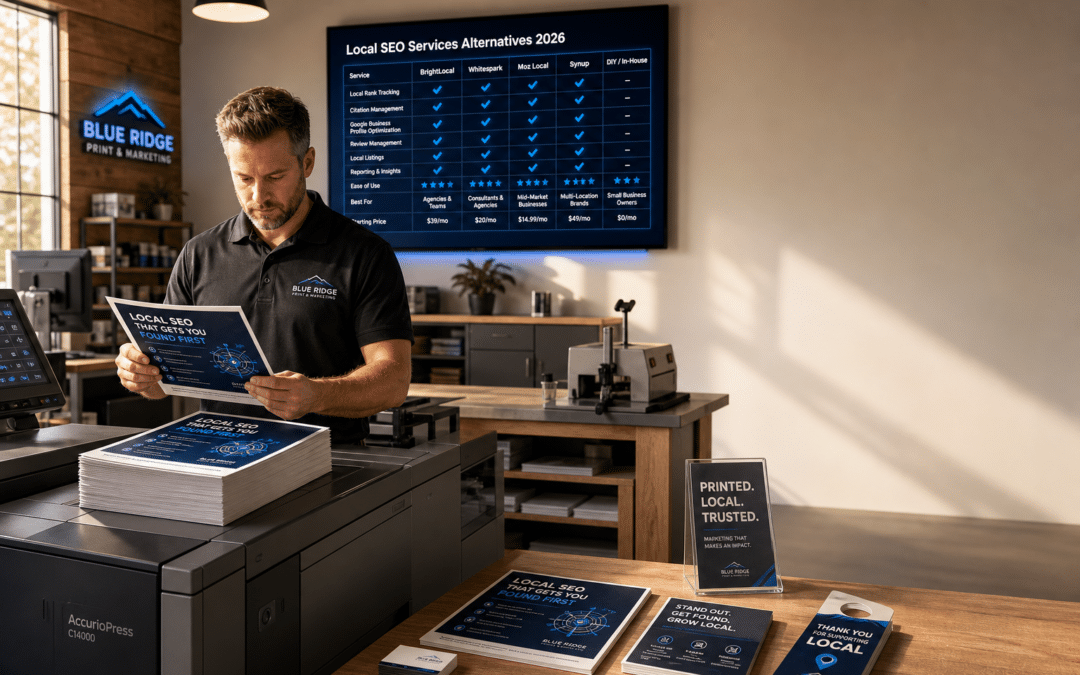
Local SEO services alternatives aren’t just “Plan B”—they’re essential building blocks for any serious local marketing strategy. Relying on SEO alone is a recipe for missed opportunities and slow growth. The most effective local businesses mix digital and offline tactics—print, AI-powered campaigns, tightly managed Google Business Profiles, and more—tailored to their market, budget, and in-house skills. The real question isn’t whether alternatives exist, but how to blend them into a system that delivers measurable, sustainable local results.
Key Takeaways
- Local SEO services alternatives range from print marketing and community sponsorships to AI-powered tools and paid digital ads—each with distinct strengths and weaknesses.
- Print marketing, including targeted flyers and direct mail, can spark immediate local action and remains a surprisingly effective complement to digital channels.
- AI-driven marketing solutions offer automation and advanced targeting but demand ongoing human oversight to ensure local relevance and avoid waste.
- There’s no universal “best” channel—what works for a med spa may flop for a hardware store. Matching tactics to your audience and tracking results is non-negotiable.
- The most resilient local strategies blend multiple channels, use real attribution methods, and adapt quarterly—never trusting generic “best practices” over local data.
Is Local SEO Still Worth It, or Are There Better Alternatives?
It’s time for a reality check: local SEO is foundational for most brick-and-mortar businesses, but it won’t carry your marketing alone—and it’s not the only way to bring in local customers. According to SEOScaleUp, 46% of all Google searches have local intent, and 76% of those searchers visit a business within 24 hours. That’s a massive opportunity, but it’s not exhaustive—plenty of successful shops and service providers never crack the top Google “3-pack.”
The biggest mistake? Treating local SEO as all-or-nothing. Real-world winners combine digital and offline tactics: a well-optimized Google Business Profile, active review management, and tangible print marketing can all play distinct, complementary roles. The real challenge is never “SEO or something else?”—it’s “what mix of channels actually fits my market, my budget, and my team’s bandwidth?” The most effective strategies are never just SEO, never just one thing.
Print Marketing: Does It Still Deliver for Local Businesses?
Print marketing—especially flyers, direct mail, and local magazine ads—remains a high-impact way to drive recall and prompt action. The data backs it up: ImagePrinter.com found that 89% of consumers remember receiving a flyer, and nearly half go on to visit a shop or request more info, outperforming most digital ad recall rates.
But the real potential of print isn’t in mass mailings—it’s in precision. Savvy businesses use flyer printing services to create exclusive offers for local events or collaborate with neighboring businesses to split costs and tap overlapping audiences. Print pieces can bridge the gap to digital: use QR codes for review requests or special offers, and you can track exactly which campaigns convert. For examples tailored to medical spas, see this flyer design guide for Orange County med spas.
A flyer stuck on a fridge can prompt a visit days or weeks later—unlike digital ads swiped away in seconds. The key is tight targeting and rigorous tracking (unique codes, custom URLs). Otherwise, you’re just throwing money at the wall.
How Do AI-Powered Marketing Solutions Stack Up?
AI-powered marketing isn’t science fiction anymore—it’s a set of real tools reshaping local advertising. Platforms like ChatGPT, Jasper, and AdCreative.ai can automate content drafts, power smart chatbots, and optimize ad targeting in ways that save time and often cut costs per action.
But here’s where most business owners miss the mark: AI only delivers when paired with local intelligence and careful oversight. For example, AI can instantly generate dozens of social ad variations, but unless you feed it real insights about your neighborhood (local slang, event tie-ins, regional offers), the results risk sounding generic or even off-key. In hyper-competitive local markets, this makes or breaks your ROI. For a deeper comparison of AI versus traditional live chat, see this breakdown of AI live chat alternatives.
Think of AI as a force multiplier, not a replacement for human marketing. Use it to spot which offers get the best response, automate Google Business Profile updates, or handle review requests at scale. But expect to invest up front in training and to keep monitoring—AI is never “set and forget.”
Beyond SEO: What Are the Main Local Marketing Options?
If you’re sizing up local SEO services alternatives, you need to see all your options—not just “SEO vs. ads.” Here’s a breakdown of actionable channels, with real-world trade-offs and tools you should know:
- Print Marketing (Flyers, Direct Mail, Local Magazines): High recall and in-person impact, ideal for driving visits. Typical budgets for professional campaigns land in the low-to-mid four figures, though DIY can be cheaper. For actual 2026 cost breakdowns, see this guide to real print marketing costs.
- Google Business Profile Optimization: Essential for map pack visibility. Go beyond the basics: weekly updates, review management with platforms like GatherUp or BirdEye, and use of Google Posts can drive more clicks than keyword stuffing ever will.
- AI-Powered Digital Campaigns: Fast to launch and highly data-driven, but require tools like Jasper or AdCreative.ai and regular human review. For service businesses, combining AI content with conversion-focused web design is where the real lift happens.
- Local Sponsorships and Events: Build trust and hyper-local branding, but ROI is slow and often hard to measure. Use event-specific UTM codes and trackable URLs to measure real impact.
- Paid Social and Search Advertising: Immediate visibility on platforms like Meta Ads or Google Ads, but easy to overspend without tight attribution. For how paid social influences search ROAS (return on ad spend), see this article.
- Referral and Loyalty Programs: High value in tight-knit communities. Use tools like ReferralCandy or Smile.io to automate and track referrals and repeat business.
Don’t just copy competitors. The biggest wins often come from combining two or three channels in ways others haven’t tried—like pairing print flyers with QR codes for review requests, or using AI analytics to retarget event attendees with personalized offers.
Comparison Table: Local SEO Services Alternatives at a Glance
| Option | Best For | Typical Costs (2026) | Time to See Results | Biggest Caveat |
|---|---|---|---|---|
| Print Marketing (Flyers/Direct Mail) | Retail, clinics, local events | Low hundreds for DIY; low-to-mid four figures for professional, targeted campaigns | Often within days or weeks after distribution | ROI tracking requires unique codes or offers—otherwise, results are murky |
| Google Business Profile Optimization | All local businesses | Minimal if in-house; modest monthly for outside management | Weeks to months—faster in less competitive markets | Needs ongoing updates and review management to sustain rankings |
| AI-Powered Digital Marketing | Service providers, e-commerce, multi-location brands | Starts in the mid-to-high three figures monthly for basic tools | Can be rapid—sometimes days; tied to ad spend and data quality | Requires active oversight to avoid wasted spend or off-brand content |
| Paid Social & Search Ads | Businesses needing quick visibility | Flexible; many local shops spend in the low-to-mid four figures monthly | Immediate impressions; conversions may take longer | Overspending is easy without strong tracking/attribution |
| Local Sponsorships/Events | Community-focused brands | Highly variable; from a few hundred to much more for major events | Weeks to months; brand lift is gradual | ROI is difficult to quantify—results are rarely immediate |
Scenario Deep Dive: When Print Marketing Outperforms Digital
Imagine a new bakery opening in a mid-sized town. They invest in local SEO and print flyers. While SEO efforts take months to show up in search rankings, a targeted flyer drop (timed with opening week and offering a unique discount) brings in a steady stream of first-time customers almost immediately. The reason? ImagePrinter.com reports that 89% of consumers remember receiving a flyer, and 48% act on print offers—outperforming most digital recall rates.
What most businesses miss: tracking print ROI is possible. Include a unique discount code or QR link on your flyer, and you’ll know exactly how many customers respond—no more guessing. For advanced strategies, check out how clinics pick the right print marketing agency and what real flyer campaigns cost in 2026.
Bottom line: print and digital don’t compete—they complement each other. Tangible marketing fills the gap while digital ramps up, especially for launches, seasonal deals, or reactivating lapsed customers.
Framework Spotlight: The L.E.A.D. Model for Choosing Local Marketing Alternatives
Sorting through local SEO services alternatives is overwhelming without a process. The L.E.A.D. Model offers a practical, step-by-step framework:
- Local Context: Get specific about your audience and physical location. What do your target customers actually notice? Use tools like Google’s “Popular Times” to analyze foot traffic, and talk to nearby business owners for real-world insights.
- Engagement Channels: List every channel your audience genuinely uses—print, Google Business Profile, Facebook groups, community bulletin boards, etc. Don’t default to what’s flashy; match your mix to actual customer habits. For example, older homeowners may respond to direct mail, while local parents might find you via Nextdoor or Instagram.
- Attribution Methods: Build tracking into every channel. Use unique promo codes on print, trackable URLs for digital ads, and ask every new customer how they heard about you. Consider an AI analytics platform (like Google Analytics 4 or HubSpot) to consolidate results and spot patterns across channels.
- Dynamic Adjustment: Review your marketing mix every quarter. Drop channels that underperform, double down on what’s working, and run at least one new experiment. Local markets shift fast—adjust with them or get left behind.
Most business owners get stuck at step one—assuming what worked for a neighbor will work for them. The L.E.A.D. Model forces you to think locally, measure everything, and never run on autopilot.
What Role Does Google Business Profile Optimization Play?
Optimizing your Google Business Profile is the single most direct way to appear in local search results for service and retail businesses. The data is clear: SEOScaleUp found that 46% of all Google searches have local intent, and 76% of those searchers visit a business within 24 hours. That’s a level of purchase intent no other channel can match.
Yet most businesses treat their Google profile as a one-off task—fill it out, upload some photos, and forget it. The winners treat it as a living channel: post weekly updates, actively manage reviews (with platforms like BirdEye or GatherUp), and use features like Q&A and product/service highlights. For businesses running print campaigns, use your Google profile as the digital anchor—tie print offers to your online presence and encourage every in-person customer to leave a review.
Practical tip: every time you hand out a flyer or finish a job, ask for a Google review and show customers how to find your profile. The synergy between print and Google Business Profile can’t be overstated—done right, each channel amplifies the other.
AI Tools vs. Human Touch: Where Should You Draw the Line?
AI marketing tools are powerful, but they’re blind to local nuance. A chatbot or ad generator might produce flawless copy, but it won’t catch the inside jokes, local references, or even regional slang that make your business feel authentic. Imagine an AI-generated ad featuring the wrong city skyline or using an out-of-place phrase—it’s an instant miss.
The temptation is to automate everything, fast. Resist it. AI is best for repetitive tasks—sending review requests, drafting blog outlines, segmenting email lists. Anything customer-facing (ads, flyers, website copy) should get a local human pass before going live. For a look at how real businesses strike this balance, see how Laguna Beach small businesses combine AI and local know-how.
Recommended workflow: use AI for the heavy lifting (first drafts, data crunching), but always assign a team member—or yourself—to review and localize. You’ll save time, avoid embarrassing errors, and keep your brand voice on point.
Real-World Example: A Service Business Blending Channels
Consider a local plumbing company in a crowded metro area. Their organic search rankings have plateaued, so they’re evaluating local SEO services alternatives:
- They overhaul their website for faster load times and better conversion—see website development & management best practices.
- They launch a focused Google Business Profile campaign, posting updates every week and responding to all reviews—increasing both visibility and customer trust.
- They distribute print door hangers with unique tracking codes to select neighborhoods, timing drops after big local events or during peak demand seasons.
- They use AI content creation to draft blog posts that answer common plumbing questions, supporting both SEO and customer education.
The result? While SEO rankings tick up gradually, the print and AI-powered campaigns produce measurable leads and new jobs within weeks—not months. The blend keeps the phone ringing and insulates the business from the volatility of any single channel.
The biggest pitfall: chasing only what’s new, or sticking with a single familiar tactic. The most resilient local businesses in 2026 are the ones willing to blend, test, measure, and adjust—never trusting a single “silver bullet.”
How to Evaluate Costs and ROI Across Local Marketing Alternatives
Cost always matters—but fixating on price tags alone is short-sighted. Some channels (like print or paid search ads) require upfront investment but deliver fast results; others (like SEO or Google Business Profile optimization) build slowly but compound over time. The right mix depends on how quickly you need results and how well you can track outcomes back to each channel.
For print marketing, many local businesses budget somewhere in the low-to-mid four figures for a professional campaign, but DIY can cost less. Managed Google Business Profile optimization is affordable in-house, but costs rise with more frequent content and review management. AI-powered marketing tools can start low but escalate quickly with advanced features. For real-world numbers, see Print Marketing & Flyer Design Costs in 2026 and AI Content Creation Cost for Mission Viejo Businesses.
The only metric that really matters: cost per result. Use unique landing pages, call tracking numbers, and customer surveys to tie leads or purchases to specific channels. Ignore “industry averages”—what matters is your own results in your own market.
Final Thoughts: The Right Mix Is Unique to Each Local Business
There’s no universal “best” alternative to local SEO services—only the right blend for your goals, market, and resources. Some neighborhoods still respond best to flyers; others demand AI-powered targeting and a living Google profile. The sharpest business owners never bet it all on one channel—they test, track, and adjust constantly.
For a modern approach, try combining targeted print marketing, AI-driven digital tactics, and an actively managed Google Business Profile. While Orange County agencies like Lion Click Media can help, the core principles are universal: keep your marketing locally relevant, measurable, and always evolving.
The bottom line: “alternatives” aren’t substitutes for SEO—they’re essential ingredients for a local growth engine built to fit your business, not someone else’s playbook.
Frequently Asked Questions
What is the best low-budget alternative to local SEO services?
Optimizing your Google Business Profile is one of the best low-budget alternatives as it requires mostly time and effort rather than money, helping improve local visibility without heavy costs.
Can print flyers still drive local business in the digital age?
Yes, well-targeted flyer and printing services remain effective for driving local foot traffic and brand recall, especially when combined with digital lead capture like QR codes.
How do AI marketing tools improve local advertising efforts?
AI tools automate content creation, ad targeting, and performance analysis, enabling faster, data-driven local campaigns that adjust to market changes with less manual effort.
Is paid local advertising better than investing in local SEO services?
Paid ads offer immediate visibility and targeting but require ongoing budget and management; local SEO builds sustainable organic traffic but takes longer to show results. Combining both often works best.
How important are online reviews for local business success?
Online reviews significantly impact customer trust and local search rankings; actively managing your reputation with review platforms is crucial alongside any local marketing strategy.
What are common mistakes businesses make when choosing local SEO alternatives?
Common errors include chasing every trendy tactic without focus, neglecting integration with lead capture, and underestimating the management effort required for each option.
Can small businesses handle AI-powered marketing without large teams?
Yes, many AI tools are designed for SMBs but require some human oversight to guide strategy and ensure relevance; pairing AI with expert support maximizes results.
Get Your Free AI Marketing Audit
See exactly where you are leaving leads on the table and how Lion Click Media can help you rank higher, capture more customers, and Make Your Brand ROAR. No cost, no obligation.
Claim My Free Audit →Or chat with our 24/7 AI assistant (bottom-right) for instant answers.