
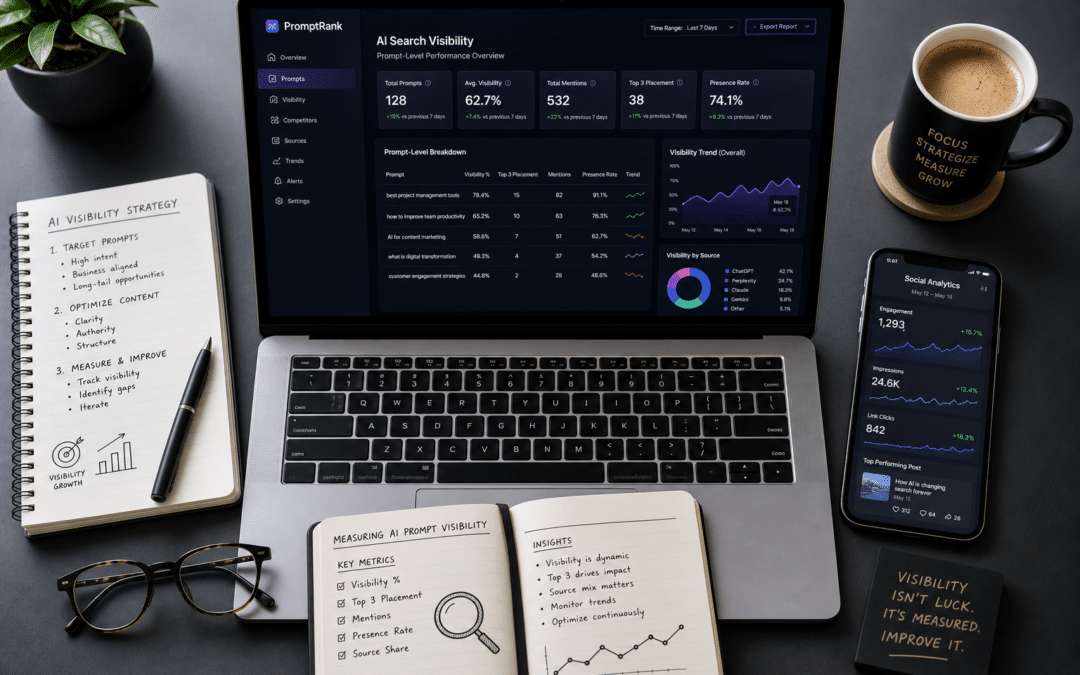
Understand how to effectively measure prompt-level visibility in AI search and enhance your business’s online presence in Orange County.
“To effectively measure prompt-level visibility in AI search, focus on analyzing user engagement metrics, search ranking positions, and conversion rates associated with specific prompts. By leveraging AI-driven tools and techniques, you can optimize your content for improved visibility and performance in AI-powered search engines.”
Key Takeaways
- Prompt-level visibility is crucial for AI search optimization and achieving better search results.
- Utilize user engagement metrics to assess the effectiveness of AI-generated prompts.
- Analyze search ranking positions to understand prompt performance in AI search visibility.
- Conversion rates provide insights into the prompt’s effectiveness in driving desired actions.
- Incorporating AI-driven marketing techniques can enhance prompt-level metrics.
Understanding Prompt-Level Visibility in AI Search
Prompt-level visibility in AI search refers to the ability of specific prompts to appear and rank well in AI-driven search engines. As AI continues to revolutionize the way users search for information, understanding how to measure and optimize this visibility is paramount. AI search visibility not only affects how easily users can find your content, but it also influences the overall success of digital marketing strategies.
In the context of AI-driven marketing, prompt-level visibility allows businesses to tailor their content more effectively. By understanding which prompts yield the best results, marketers can refine their strategies to target the right audience segments. This involves analyzing how users interact with content generated from specific prompts, thereby gauging the relevance and effectiveness of your AI search optimization efforts.
Using User Engagement Metrics
User engagement metrics are vital for measuring prompt-level visibility. Metrics such as click-through rates (CTR), time spent on page, and bounce rates provide insights into how users are interacting with your content. A high CTR signifies that users find your prompt appealing, while longer time on page indicates relevant and engaging content. Conversely, a high bounce rate might suggest that the prompt does not accurately address the user's query.
- Click-Through Rate (CTR): This metric helps determine how often users click on a link after being presented with a prompt.
- Time on Page: Understanding how long users stay on a page can indicate the relevance of your content.
- Bounce Rate: A lower bounce rate can suggest that the content meets the expectations set by the prompt.
Evaluating Search Ranking Positions
Search ranking positions are another critical component in measuring prompt-level visibility. By analyzing where your prompts rank in AI search results, you can identify which prompts are effectively optimized for search engines. Higher ranking positions typically correlate with increased visibility and, consequently, greater traffic.
To improve your prompts' search ranking positions, consider integrating AI data analytics into your strategy. By analyzing search trends and competitor performance, you can uncover opportunities for optimizing your prompts further. This approach not only enhances visibility but also strengthens your overall AI advertising campaigns.
Assessing Conversion Rates
Conversion rates are a powerful indicator of how well your prompts drive desired actions from users. Whether the goal is to encourage users to book a service, download a resource, or make a purchase, tracking conversion rates provides a clear picture of prompt effectiveness. A high conversion rate indicates that your prompt is aligned with user intent and effectively encourages action.
To increase conversion rates, consider refining your [AI content creation](https://lionclickmedia.com/ai-content-creation/) strategies. Ensure that your prompts are not only visible but also persuasive and action-oriented. This involves crafting compelling calls-to-action and making it easy for users to complete desired tasks.
Implementing AI-Driven Optimization Techniques
AI-driven optimization techniques play a pivotal role in enhancing prompt-level metrics. By utilizing machine learning algorithms, you can gain insights into user behavior, predict search trends, and tailor your content to meet evolving needs. This proactive approach ensures your content remains relevant and competitive in AI search results.
For businesses looking to maximize their [AI social media management](https://lionclickmedia.com/ai-social-media-management/) efforts, integrating AI techniques can provide a significant advantage. Automated tools can help identify the best-performing prompts, enabling you to focus your efforts on strategies that yield the highest returns.
Leveraging Internal and External Linking Strategies
Effective linking strategies can also boost prompt-level visibility. By incorporating relevant internal links within your content, you guide users to other valuable resources on your website, enhancing both user experience and SEO. Likewise, external links to authoritative sources can bolster your content's credibility and improve its search engine ranking.
Consider linking to related services such as [website development & management](https://lionclickmedia.com/website-development-management/) and [e-commerce services](https://lionclickmedia.com/e-commerce-services/) to provide users with a comprehensive view of your offerings. This not only enhances prompt visibility but also supports your broader digital marketing objectives.
Continuous Monitoring and Adjustment
Continuous monitoring and adjustment are crucial for maintaining high prompt-level visibility. As search algorithms evolve and user behaviors change, staying informed about the latest trends and performance metrics is essential. Regularly review your prompt-level metrics and adjust your strategies accordingly to ensure sustained success.
Utilizing advanced analytics tools can provide real-time insights into your prompts' performance. This data-driven approach allows you to make informed decisions and pivot your strategies as needed, ensuring your content remains competitive in AI search landscapes.
To explore how AI-driven solutions can enhance your business's online presence, book a free strategy call with Lion Click Media today. Our experts are here to help you navigate the complexities of AI search optimization and achieve your digital marketing goals. Call us at (949) 669-4742 to start your journey to improved search visibility and business growth.
Integrating Semantic Search Techniques
As AI search engines increasingly employ semantic search capabilities, understanding how to optimize prompts for this advanced search methodology is essential. Semantic search seeks to understand the context and intent behind a user's query rather than merely relying on keyword matching. This shift necessitates a more nuanced approach to prompt optimization, where the focus is on context, relevance, and user intent.
To effectively integrate semantic search techniques, begin by analyzing user queries and identifying common themes or questions. Develop prompts that address these themes comprehensively, ensuring that your content provides in-depth answers and solutions. Additionally, leverage natural language processing (NLP) tools to refine your content's language, making it more conversational and aligned with the way users naturally search for information.
For example, if you're optimizing prompts for an online travel agency, go beyond simple keyword phrases like "cheap flights" and craft prompts that answer user questions such as "What are the most affordable destinations for a family vacation?" By addressing specific user concerns, your prompts are more likely to appear in relevant search results, thereby increasing visibility and engagement.
Utilizing Structured Data Markup
Structured data markup is a powerful tool for improving prompt-level visibility in AI search results. By implementing schema markup, you provide search engines with additional context about your content, enabling them to deliver more accurate and relevant results to users. This can lead to enhanced visibility through rich snippets, knowledge graphs, and other advanced search features.
Begin by identifying the types of structured data that are most applicable to your content. For instance, if you're running an e-commerce site, product schema can help your products stand out in search results by displaying images, prices, and availability directly in the search snippet. Similarly, if you're publishing articles, use article schema to highlight key details such as the author, publication date, and article sections.
Implementing structured data requires a technical understanding of schema.org vocabulary and integration with your website's HTML. Consider using tools such as Google's Structured Data Markup Helper to streamline the process. By enriching your content with structured data, you not only improve search visibility but also enhance the user experience by providing more informative search results.
Exploring Voice Search Optimization
With the rise of voice-activated devices, optimizing prompts for voice search is becoming increasingly important. Voice searches tend to be more conversational and longer in nature, often resembling full questions rather than keyword phrases. This shift requires a different approach to prompt creation and content optimization.
Start by analyzing common voice search queries relevant to your industry. Tools like AnswerThePublic can provide insights into the types of questions users are asking via voice search. Once you have identified these queries, develop prompts that incorporate natural language and question-based formats. Focus on creating content that directly answers these questions in a concise and informative manner.
Additionally, consider the importance of local SEO in voice search optimization. Many voice searches are location-specific, such as "near me" queries. Ensure your prompts are optimized for local search by including geographical keywords and maintaining up-to-date local business listings. This approach not only improves visibility in voice search results but also drives foot traffic to physical locations.
Enhancing Personalization with AI
Personalization is a key factor in optimizing prompt-level visibility, as AI technologies allow for tailored content experiences that resonate with individual users. By leveraging AI-driven personalization techniques, businesses can deliver prompts that align with user preferences, behaviors, and previous interactions.
Begin by collecting and analyzing user data, such as browsing history, past interactions, and purchase behavior. Use this data to segment your audience and develop targeted prompts that cater to specific user segments. For instance, if a user frequently purchases eco-friendly products, tailor your prompts to highlight sustainable options and related content.
AI tools can automate this personalization process by dynamically generating prompts based on real-time user data. Consider integrating recommendation engines and chatbots into your strategy to further enhance personalization. By delivering relevant and personalized prompts, you increase the likelihood of capturing user attention and driving conversions.
Incorporating these advanced strategies into your AI search optimization efforts not only boosts prompt-level visibility but also strengthens your overall digital marketing initiatives. By staying ahead of emerging trends and leveraging cutting-edge technologies, you can ensure your content remains competitive in an ever-evolving search landscape.
Ready to put this into action? Explore Lion Click Media's AI Social Media Management, AI Content Creation, AI Advertising Campaigns to see how our Orange County team turns AI-powered marketing into more leads and sales.
Frequently Asked Questions
What is prompt-level visibility?
How can AI improve search visibility?
What metrics are important for measuring AI search visibility?
How does AI Social Media Management help with visibility?
Why is local SEO important for AI search?
What tools can help with AI search optimization?
Can AI search visibility benefit all industries?
Keep Reading
- The Latest Jobs in Search Marketing: AI-Driven Roles
- Mastering AI Content Creation: Navigate Google's 2026 Update
- AI Social Media Management: Boost Engagement & Authority
Get Your Free AI Marketing Audit
See exactly where you are leaving leads on the table and how Lion Click Media can help you rank higher, capture more customers, and Make Your Brand ROAR. No cost, no obligation.
Claim My Free Audit →Or chat with our 24/7 AI assistant (bottom-right) for instant answers.