
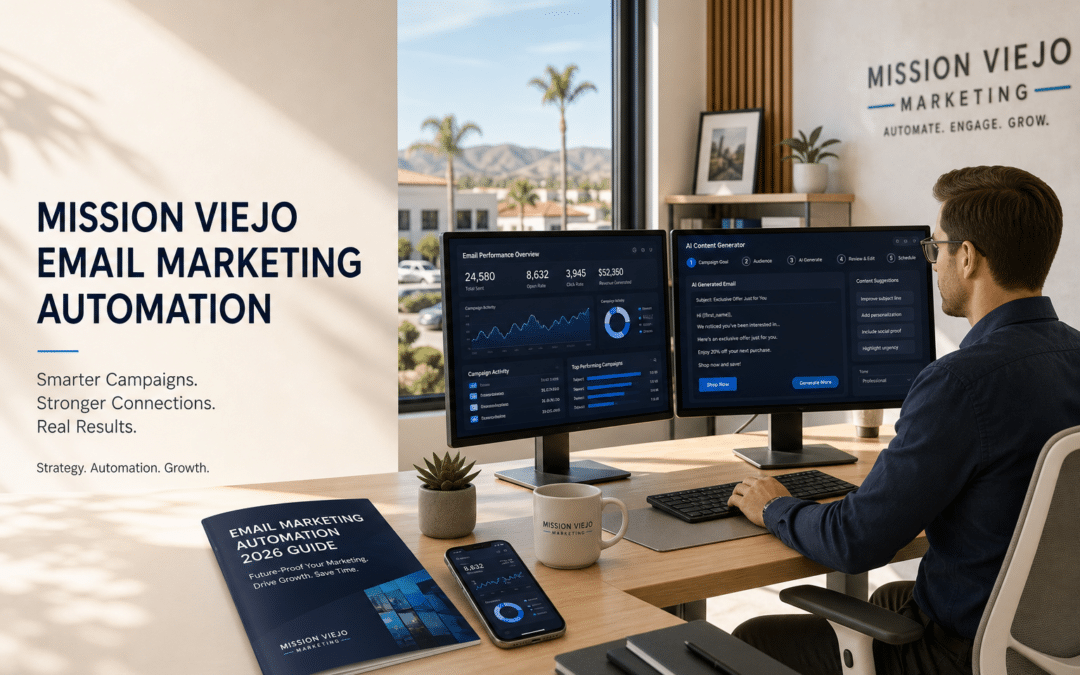
Email marketing automation is no longer just about sending scheduled newsletters or coupons—it’s a system that enables local businesses in Mission Viejo to deliver timely, relevant messages triggered by real customer actions, not guesswork. The businesses seeing the best results in 2026 are those using automation to build genuine relationships, adapt using data and AI, and focus their resources on what actually drives business—rather than automating for its own sake.
Key Takeaways
- Email marketing automation sends personalized, behavior-based emails—far more effective than manual or “bulk” blasts.
- Top-performing automation strategies rely on real CRM integration, AI-driven content, and smart segmentation tailored to local audiences.
- Automated campaigns deliver noticeably higher revenue per send than their share of total email volume, as shown in Stripo Email Marketing Statistics 2026 and Generative AI for Email Marketing: Complete Guide (2026).
- Continuous refinement—quarterly reviews, A/B testing, and mapping to the customer journey—is essential for local businesses in Mission Viejo and Orange County.
- Automation works best when it supplements, not replaces, authentic local brand voice and hands-on customer care.
What Is Email Marketing Automation—And Why Does the Definition Matter in 2026?
Email marketing automation used to mean setting up a basic drip campaign and letting it run. In 2026, that definition is outdated. Now, automation means a toolkit of software and workflows that send the right message, to the right person, at exactly the right time—based on real data, not just generic schedules. For example, a Mission Viejo real estate agency might automatically follow up with prospective buyers who viewed open house details, sending them tailored property suggestions within hours, not days.
This evolution matters because, even today, many small businesses assume automation is just “set it and forget it.” In reality, the businesses succeeding in Mission Viejo are those who regularly review and optimize their automation flows, tightly integrate with their CRM, and use AI to craft content that truly resonates. As detailed in Stripo Email Marketing Statistics 2026, automated emails account for a significant share of email-attributed sales despite making up a small portion of total email sends. The clear takeaway: automation’s value lies in relevance and timing, not in sending more emails.
Why Local Businesses in Mission Viejo and Orange County Need Automation Now
Many local business owners dismiss automation as something for e-commerce giants or software companies. That’s a costly misconception. Imagine a Mission Viejo bakery: with automation, every new customer receives a thank-you note, a seasonal offer before major holidays, and a friendly reminder if they haven’t returned in a while—all automatically once the system is set up. This is how small teams can remain competitive with much larger brands.
What actually matters is connecting automation to your real customer journey—focusing on the touchpoints that drive loyalty and repeat business, not trying to use every feature at once. For instance, a local auto shop might set up reminders for oil changes six months after service, plus a one-click survey to gather feedback. The key is to keep automations simple, actionable, and relevant to your audience. For a practical, step-by-step walkthrough of how these flows work in the background, see How Does Marketing Automation Actually Work? A Step-by-Step Breakdown. Even a Mission Viejo dental practice might use automation for patient check-up reminders and post-visit feedback requests—showing that service industries of all types can benefit.
Inside the Modern Email Marketing Automation Toolbox
Most guides dump a long list of tools on you. That’s not helpful. What Mission Viejo and Orange County businesses need is to know what these tools actually do—and which features matter for a small local operation. Beyond basic bulk senders, modern automation platforms offer deep CRM integration, AI content capabilities, and segmentation to make every message count.
- Email drip campaigns: Automated, pre-set sequences triggered by real actions (like signups or purchases) to nurture leads over time and keep prospects engaged.
- CRM integration: Two-way syncing with customer databases so every message is informed by real purchase history, preferences, and engagement.
- AI content creation: Tools that generate subject lines, message copy, and even images tailored to each segment—ideal for small teams with limited resources. For practical tips on using AI tools, check out Mastering AI Content Creation: Navigate Google’s 2026 Update.
- Segmentation tools: The ability to group your audience by location, behavior, or past purchases, so each email feels personal and timely.
- Analytics dashboards: Real-time feedback on what’s working—open rates, clicks, conversions—so you can refine your approach based on real data.
You don’t need the most expensive or complex platform. The best tool is the one you’ll actually use, that syncs with your CRM or POS, and fits your daily workflow. It’s easy to get caught up in unnecessary features—start with core needs, and only add complexity as your team grows more confident. For additional perspective, HubSpot’s email marketing resource center and Mailchimp’s email automation guide offer independent, detailed overviews of current tool capabilities.
How Does Email Automation Outperform Traditional Campaigns? (With Real Data)
A common myth is that sending more emails gets more results. In reality, automated campaigns deliver much better performance per send. According to the Stripo Email Marketing Statistics 2026, automated emails are responsible for a disproportionately large share of email-driven revenue, even though they represent a relatively small percentage of all emails sent. This isn’t just a small advantage—it can mean a major shift in how local businesses see returns from their email marketing.
Why? Because automated emails are triggered by real intent—like a cart abandonment or a new signup—so they land in inboxes when recipients actually care. Mass blasts, on the other hand, hit everyone at once and often get ignored. For example, a Mission Viejo fitness studio could set up an automation for new trial members: a welcome email on day one, an invite to a beginner class on day three, and a check-in after a week. These messages are timely, relevant, and directly tied to the recipient’s actions—far more effective than a generic monthly update.
Don’t assume automation is only for big lists. Small, well-segmented audiences often see even higher engagement, since every message feels tailored. If you’re still relying on manual campaigns, it’s time to rethink your strategy. For more ideas on integrating automation into your local marketing, see Is Marketing Automation Worth It for Restaurants in 2026? Real Math Explained.
Framework: The S.E.N.T. Method for Local Email Automation Success
A clear framework helps cut through generic advice. The S.E.N.T. Method—Segment, Engage, Nurture, Test—is a practical way to approach automation, but it’s worth going deeper than the basics to get results in Mission Viejo and Orange County.
- Segment: Go beyond simply splitting by age or zip code. Use your CRM and automation tool to create actionable groups based on behavior and intent—Mission Viejo residents who visited your shop in the last year, regular event attendees, or lapsed clients. For example, a local spa might tag customers who haven’t booked in six months and send them a “welcome back” package with a personalized offer.
- Engage: Design drip campaigns that trigger on specific behaviors—such as signups, purchases, birthdays, or even review submissions. Use AI to generate custom subject lines and content for each group. For instance, a Mission Viejo pet store could send a personalized “Happy Adoption Anniversary!” with a targeted discount for treats or grooming services.
- Nurture: Think beyond discounts. Set up ongoing sequences for sharing educational content, community spotlights, or customer testimonials. A local law firm could send monthly legal tips tailored to small businesses, while a Mission Viejo wellness clinic might highlight a local patient’s success story (with permission), deepening local ties and trust. Effective lead nurturing means regularly checking in with both prospects and existing clients to maintain engagement, not just pitching offers.
- Test: Don’t assume your first setup is perfect. Regularly A/B test subject lines, send times, and content. Use analytics to see which segments and automations actually drive results, and iterate. Quarterly reviews are a must—refresh stale offers and prune what isn’t working. For detailed testing ideas, see How to A/B Test Digital Marketing Campaigns Without Getting Lost.
One common oversight: nurturing current customers as actively as you do leads. Automated check-ins, referral requests, and loyalty perks are powerful levers for turning one-time buyers into repeat fans—especially when the content speaks to their interests, not just your promotions.
What Role Does AI Content Creation Play in 2026 Email Automation?
AI content creation isn’t just a “nice-to-have” anymore—it’s a practical way for local brands to compete with larger organizations. According to Stripo Email Marketing Statistics 2026, a large share of marketers now use generative AI in their workflows, and Generative AI for Email Marketing: Complete Guide (2026) reports that most rate AI-generated content as effective. Local businesses in Mission Viejo are using AI to automatically generate subject lines, adapt messaging for different segments, and even create images—freeing up time for higher-touch tasks that require a human touch.
The main advantage isn’t just speed, but relevance. For example, an Orange County HVAC business can have AI draft maintenance tips based on past service dates and local weather, making sure every customer receives content that feels genuinely personalized. AI can even adapt tone and content style to fit the local culture, making emails feel more like a real conversation than a template. For industry-specific breakdowns, see AI Content Creation for HVAC Companies in Orange County and The 2026 AI Content Creation Playbook for Real Estate.
However, AI content still needs a human review for tone and accuracy, especially for sensitive or highly local communications. The best results come from blending AI efficiency with your own brand voice. For a deeper dive into ensuring compliance and alignment with your business values, WordStream’s guide to AI in email marketing offers outside perspective on the topic.
Email Segmentation: The Secret to High-Impact Automation
Segmentation is the engine that makes automation work. Yet most small businesses still blast emails to their entire list, missing the opportunity to craft messages that feel relevant and timely. For a Mission Viejo business, this could mean missing the chance to offer families a back-to-school promotion, while business clients might care more about year-end services.
Effective segmentation isn’t just about age or zip code. Instead, group your contacts by behaviors that actually predict engagement: purchase frequency, service type, response to past offers, or website browsing history. For example, a bakery might tag customers as “sweet” or “savory” lovers based on past orders, sending each group different offers. A Mission Viejo landscaping company might segment by service frequency and property type, sending reminders or seasonal tips tailored to residential or commercial clients. This makes every email feel like a helpful suggestion, not an ad.
Start by syncing your CRM data—purchase dates, engagement stats—into your automation platform. Set up rules for each segment: a birthday coupon, a three-month follow-up for lapsed buyers, or an invite to a VIP event. Automation tools like Mailchimp or ActiveCampaign make this process straightforward for even small teams. For more hands-on segmentation strategies, see Segmentation Strategies for Local Email Marketing Campaigns.
Comparing Top Email Marketing Automation Tools for Local Businesses
Choosing a platform is about more than just features—it’s about what fits your workflow, budget, and existing tech stack. Here’s a side-by-side look at options well-suited for Mission Viejo and Orange County businesses:
| Platform | Best For | CRM Integration | AI Content Creation | Segmentation Depth | Pricing (Typical Range) |
|---|---|---|---|---|---|
| Mailchimp | Small businesses, ease of use | Native, supports many CRMs | Integrated AI (subject lines, content) | Moderate | Entry-level to mid-range (usually $15–$75/month for most small lists in 2026) |
| ActiveCampaign | Advanced automation, lead nurturing | Deep two-way sync | AI-powered suggestions and automation | High | Mid-range (commonly $30–$150/month depending on features and list size) |
| Constant Contact | Local services, retail, events | Basic integration | AI-assisted templates | Basic to moderate | Affordable for small lists (typically $12–$50/month) |
| Klaviyo | E-commerce, Shopify, WooCommerce | Strong e-commerce focus | AI content and predictive analytics | Very high | Scales with list size (est. $20–$400+/month depending on store volume) |
| HubSpot | All-in-one CRM + automation | Native, full-featured CRM | AI content and smart send | Enterprise-level | Higher, but includes CRM (starts around $50/month, often $100+ for full automation) |
Smart operators prioritize tools that their team can actually use—something that integrates cleanly with their CRM or POS, and is easy to maintain. Most Mission Viejo businesses start simple (Mailchimp, Constant Contact), then move to more advanced platforms (ActiveCampaign, HubSpot) as needs grow and confidence builds. For deeper comparison, G2’s email marketing category offers verified user reviews and feature breakdowns.
Real-World Scenarios: Email Automation in Action for Mission Viejo Businesses
Here are three realistic scenarios showing how email automation works for different business models in the area:
- Service Provider (HVAC company): An Orange County HVAC shop connects its CRM to ActiveCampaign, sending six-month service reminders, post-job follow-ups, and seasonal promotions. AI-generated content personalizes each message with local weather tips and reminders, so customers feel genuinely cared for at just the right moment.
- Retailer (Mission Viejo bakery): The bakery uses Mailchimp to segment regulars, occasional buyers, and lapsed customers. Each group gets targeted offers—VIP previews, new product launches, or “we miss you” discounts—automatically, ensuring no one’s forgotten in the daily rush.
- Professional Services (real estate agent): A local agent automates a new-lead drip: intro email, a Mission Viejo homebuyer’s guide, and a personalized follow-up. AI tools help create property spotlights and market updates, freeing up time for client meetings and showings.
The lesson: automation isn’t about replacing human connection—it’s about scaling it, so every client feels remembered and valued, even as your business grows.
Common Missteps—and How to Avoid Them
Many businesses automate for the sake of it—setting up generic flows and never looking back. That’s a recipe for stale, ignored messages. Another big mistake: ignoring mobile optimization. According to Stripo Email Marketing Statistics 2026, a large portion of email opens happen on mobile, so if your emails aren’t mobile-friendly, you risk losing a significant part of your audience.
- Review automation flows quarterly. Update offers, swap out old images, and delete irrelevant messages.
- Test every email on your phone before sending—formatting, images, and buttons must work flawlessly on mobile.
- Clean your list regularly to remove inactive addresses and improve deliverability.
- Lean on analytics to spot what’s underperforming—then tweak your segmentation or messaging accordingly.
- Prioritize lead nurturing after the initial sign-up; a simple check-in or educational follow-up can make a big difference in moving prospects toward becoming loyal customers.
One overlooked move: combine email automation with live website chat or AI-powered lead intake for a seamless customer experience. For more on integrating automation into your digital marketing mix, see Is Marketing Automation Worth It for Restaurants in 2026? Real Math Explained.
Bringing It All Together: Making Email Automation Work for Your Local Brand
Businesses thriving with email marketing automation in 2026 don’t treat it as a one-time setup. They see it as an ongoing process of learning, segmenting, and personalizing to keep pace with customer needs. Whether you’re a Mission Viejo boutique, Orange County law firm, HVAC shop, or local medical practice, the fundamentals are the same: set clear goals, build automations around real customer behavior, and use AI tools to enhance—not replace—your local voice.
Final word: Automation isn’t a shortcut, but it is a practical way to amplify what works. The businesses that combine automation with strong website management, smart social media, and a clear local identity are the ones breaking through the inbox noise. For those seeking expert support, a platform like Lion Click Media can help you get started—but your real advantage will come from a mindset of ongoing improvement and a willingness to adapt as technology and customer expectations keep evolving.
Frequently Asked Questions
How often should I send automated emails to customers?
Frequency depends on your audience and campaign goals; typically, automated sequences space emails several days apart to avoid overwhelming recipients while keeping engagement steady.
Can I use email marketing automation without a CRM?
You can, but without a CRM, your targeting and personalization options are limited, reducing the effectiveness of automated campaigns.
Is AI content creation safe to use for compliance and brand voice?
Yes, when paired with human review and clear brand guidelines, AI-generated content can be consistent, compliant, and on brand.
What’s the difference between drip campaigns and triggered emails?
Drip campaigns send emails on a fixed schedule regardless of behavior, while triggered emails respond to specific customer actions or events.
Can small businesses in Mission Viejo afford email marketing automation?
Many local small businesses can start with affordable plans and scale as they see results, making automation accessible even on modest budgets.
How do I keep my email list clean for automation?
Regularly remove inactive contacts, use double opt-in signups, and monitor bounce rates to maintain a healthy, engaged email list.
Does email automation help with local SEO in Orange County?
Indirectly; while email automation doesn’t directly impact SEO, it improves customer engagement and repeat business, which can boost local reputation and reviews.
Get Your Free AI Marketing Audit
See exactly where you are leaving leads on the table and how Lion Click Media can help you rank higher, capture more customers, and Make Your Brand ROAR. No cost, no obligation.
Claim My Free Audit →Or chat with our 24/7 AI assistant (bottom-right) for instant answers.