
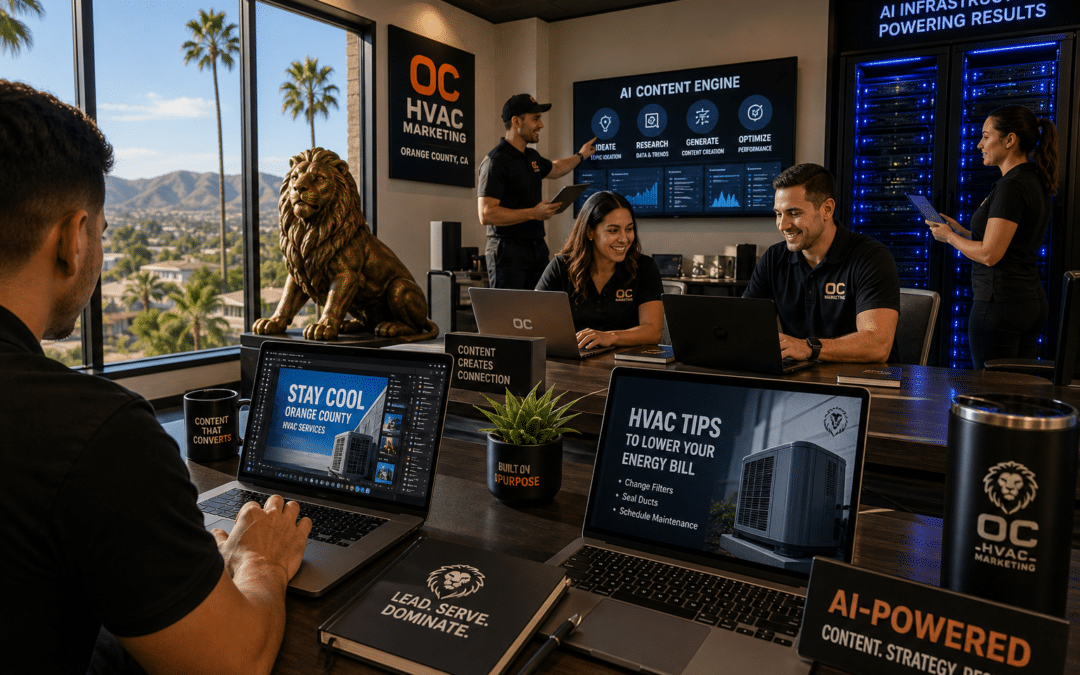
AI content creation gives Orange County HVAC companies a faster way to publish the local pages and FAQ answers homeowners actually search for — from “AC repair near me” to “furnace cost in Irvine” — as long as a trade-savvy human edits every draft before it goes live. It means more visibility and more booked calls, not generic filler.
AI content creation works for HVAC companies when it’s treated as a drafting tool, not a finished product: AI compresses the blank-page problem from hours to minutes, while a real technician or owner keeps every claim and service-area detail accurate. Paired with the right local SEO structure, that combination is what moves rankings, AI Overview citations, and phone calls — not the AI itself.
Key Takeaways
- AI speeds up first drafts, but pages that outrank competitors are the ones a technician or owner fact-checks — AI without trade review reads generic and gets buried.
- Orange County splits into two HVAC markets: coastal cities run mild cooling loads, while inland cities like Mission Viejo and Anaheim see real summer heat spikes.
- Individual city service-area pages outperform a single generic “service area” page for multi-city HVAC companies.
- A fully optimized Google Business Profile plus consistent citations does more for “near me” and emergency searches than blog content alone.
- AI Overviews and answer engines pull from clearly structured question-and-answer content with clean schema.
- Seasonal demand is predictable enough to plan a content calendar around, instead of reacting after the first heat wave.
What Is AI Content Creation, and What Does It Actually Change for an HVAC Company?
AI content creation is the use of large language models to help research, draft, and structure written content — blog posts, service pages, FAQ sections — faster than a person starting from a blank page. For an HVAC company, the real shift is speed, not authorship: the blank page compresses from hours to minutes. That means the trade knowledge your team already has — diagnosing a failing capacitor, why aging R-22 systems are harder to service, what a load calculation involves — gets published more often instead of staying in a technician’s head.
The risk is treating AI output as a finished product instead of a first draft. A model that has never crawled under a house in Orange County doesn’t know that older homes in Costa Mesa or Santa Ana often run undersized ductwork, or that HOA rules in Mission Viejo and Rancho Santa Margarita can restrict where a condenser unit gets placed. That’s local, trade-specific knowledge — exactly what separates content that ranks and converts from content that could describe any HVAC company in any city.
Why Doesn’t Orange County HVAC Marketing Work Like a National Playbook?
Most HVAC marketing advice is written for a national average: hot summers, cold winters, one predictable AC-replacement season. Orange County doesn’t fit that pattern. The coast — Newport Beach, Laguna Beach, Huntington Beach — rarely breaks the mid-80s even in August, so AC there behaves more like a comfort upgrade than a survival purchase. A few miles inland, in Mission Viejo, Lake Forest, Irvine, Anaheim, and Yorba Linda, summer highs regularly climb into the 90s and past 100, and a broken AC during a heat wave becomes a same-day emergency call.
That split matters for content and ad strategy, not just curiosity. A company running one generic “AC repair Orange County” page is competing for a broad, expensive keyword while missing the more specific, higher-intent searches homeowners in each area actually type — “AC repair Mission Viejo,” “HVAC company Lake Forest,” “emergency AC Anaheim.” Content built around the real geography of demand, rather than a single countywide page, tends to earn both better rankings and better-qualified leads.
How Should an OC HVAC Company Structure Its Website for Local Search?
The most common structural mistake is confusing a service page with a service-area page. A service page describes what you do — AC repair, furnace installation. A service-area page describes where, with details relevant to that city’s housing stock and search behavior. Both need to exist as separate pages, not one page trying to do both jobs.
- Core service pages for each major offering: AC repair, installation, furnace repair, heat pump service, maintenance plans, indoor air quality.
- A dedicated service-area page per city you serve, each with genuinely unique content — not the same paragraph with the city name swapped.
- An emergency/same-day page ranking for urgent intent (“AC not working,” “no heat”) with a direct phone path, not a contact form.
- A blog or resource section, like this guide, that answers research-stage questions and links into the service pages.
- A reviews page that reinforces trust with real customer feedback, described honestly — not invented statistics.
How Do You Keep AI-Assisted Content Accurate Enough to Trust?
Google’s guidance on content quality penalizes low-value, inaccurate, or manipulative content, not AI assistance itself, regardless of who typed the first draft. For HVAC companies, the practical test is simpler: would a technician who has worked on these systems agree with every sentence? A draft that claims a SEER rating will “cut your bill in half” is the kind of overreach that damages both trust and rankings.
- Start from a real question a customer has actually asked — not a keyword tool’s guess.
- Let AI produce a structural first draft: outline, headers, a rough pass at explanations.
- Have someone with real HVAC experience mark anything vague, wrong, or generic.
- Replace vague claims with specifics: brands you actually install, real service-area boundaries, maintenance intervals you actually recommend.
- Cut any invented statistic, quote, or case study that can’t be backed up.
- Publish under a real, named author or the company byline — not “Admin.”
What Local SEO Signals Actually Move the Needle for HVAC Companies?
Content matters, but it’s one input among several. For a local service business, the Google Business Profile is arguably the single highest-leverage asset — it’s what shows up in the map pack for “HVAC near me,” and it responds directly to review volume, recency, category accuracy, and how completely the profile is filled out.
- Keep the Google Business Profile category, service area, and hours accurate — and update them, don’t set once and forget.
- Ask every satisfied customer for a review; recency and volume both matter more than most owners expect.
- Keep your business name, address, and phone number identical across your website, GBP, and every directory listing.
- Add LocalBusiness and Service schema to your service-area pages so search engines and AI Overviews can parse who you are and where you work, then track whether it’s moving results with our HVAC marketing analytics playbook.
- Earn a handful of genuinely local backlinks — chamber of commerce, local news, sponsorships — over generic guest-post links.
How Do You Turn Seasonal Demand Spikes Into a Content Calendar?
HVAC demand in Orange County follows a predictable rhythm that most companies market to reactively instead of proactively. Pre-summer tune-up campaigns work best in April and May, before the first real heat wave, when homeowners are receptive to preventive messaging instead of panicking over a dead system. Once inland temperatures spike from June through September, search behavior shifts almost entirely to urgent, same-day intent, and an emergency landing page with a fast mobile experience matters more than any blog post. Fall brings furnace and heat-pump check content; the mild OC winter suits indoor air quality and system-replacement content, since it’s the off-season for install crews.
| Season | Typical Search Behavior | Content Priority |
|---|---|---|
| Apr – May (pre-summer) | Planning, comparison-shopping | Tune-up specials, AC replacement guides |
| Jun – Sep (peak heat, inland) | Urgent, same-day | Emergency landing page, mobile speed, fresh GBP |
| Oct – Nov (fall) | Preventive, budget-planning | Furnace and heat pump check content |
| Dec – Mar (mild winter) | Research-stage, lower urgency | Indoor air quality, financing, full-system guides |
What Does a Practical AI Content Workflow Look Like, Step by Step?
Beyond editorial accuracy, there’s an operational sequence that keeps AI-assisted content production consistent instead of ad hoc:
- Pull real search queries from Search Console, GBP insights, and the questions your front desk hears every week.
- Group queries into topics — informational, transactional, local — each with its own template.
- Draft with AI using an outline that already includes cities served, brands you carry, real maintenance intervals.
- Route every draft through a technical accuracy pass before a copy and SEO pass.
- Add genuine visuals: real job photos, your own trucks and team, not stock photography.
- Mark up the page with Service, LocalBusiness, FAQPage, and BreadcrumbList schema.
- Publish, link it from related service and service-area pages, and share it where it will get read.
- Track calls and form fills by page, not just rankings — a ranking page with no calls needs a different fix.
It’s the same loop our AI Content Creation and AI Data Analytics teams run for home-services clients, paired with AI Advertising Campaigns so paid and organic reinforce the same seasonal calendar.
How Do You Optimize HVAC Content for AI Overviews and Answer Engines?
Google’s AI Overviews, and answer engines like ChatGPT and Perplexity, don’t read a page the way a human scanning for a phone number does — they look for a direct, well-structured answer to the exact question asked, ideally one that’s easy to extract without ambiguity. That favors HVAC content that states the answer plainly in the first sentence or two of a section, then supports it with specifics, rather than content that builds slowly toward a conclusion.
The pattern that works consistently: an H2 or H3 phrased the way someone would actually ask the question (“How much does AC replacement cost in Orange County?” not “Cost Considerations”), a direct answer in the first sentence, then two or three sentences of supporting detail. Add FAQPage schema to make that structure machine-readable, and keep every answer factually conservative — an answer engine citing a made-up number back to your site does more damage to trust than not being cited at all. See our guide on measuring prompt-level visibility in AI search for how to track it.
AI content creation works best as an amplifier for expertise your team already has, turning it into pages homeowners are actually searching, faster than a manual content process ever could. The Orange County HVAC companies that benefit most treat AI as a drafting tool, keep a trade expert in the editorial loop, structure their site around real service-area geography, and build content around the seasonal rhythm of demand instead of reacting to it.
Frequently Asked Questions
Can AI actually write HVAC content that sounds like a real technician, not a generic blog?
Not on its own — AI drafts read generically without first-hand experience with your service area. A technician or owner editing every draft with real specifics is what gets it there.
How much should an HVAC company edit AI-generated content before publishing?
Enough that every factual claim and technical detail has been checked by someone who actually does the work. Grammar is the easy part; local and technical accuracy is where the editing time should go.
Does Google penalize AI-written content for HVAC websites?
Google’s guidance targets low-quality or manipulative content, not AI assistance itself. Well-edited, accurate content performs the same whether a human or a model wrote the first draft.
What’s the difference between a service page and a service-area page, and does a small OC HVAC company need both?
A service page explains what you offer, like AC repair. A service-area page explains where, with city-specific details. Companies serving more than one or two cities benefit from both.
How often should an HVAC company publish new content to see SEO results?
Consistency beats volume — a page or two of genuinely useful, locally specific content per month, sustained over several months, tends to outperform a large batch published once and abandoned.
How does AI content creation help with Google Business Profile and map pack rankings?
Content doesn’t directly move GBP rankings, but it reinforces the same local signals your profile states, strengthening the overall picture.
What should go on an emergency HVAC landing page like “AC not working Orange County”?
A direct answer near the top, a tap-to-call number, real service-area coverage, and fast load speed — urgent searchers decide in seconds.
How does Lion Click Media handle AI content creation for HVAC clients?
We pair AI-assisted drafting with a human editorial process grounded in your actual service area, then add the technical SEO and schema markup that helps search engines and AI answer engines trust it.
Keep Reading
Get Your Free AI Marketing Audit
See exactly where you are leaving leads on the table and how Lion Click Media can help you rank higher, capture more customers, and Make Your Brand ROAR. No cost, no obligation.
Claim My Free Audit →Or chat with our 24/7 AI assistant (bottom-right) for instant answers.