
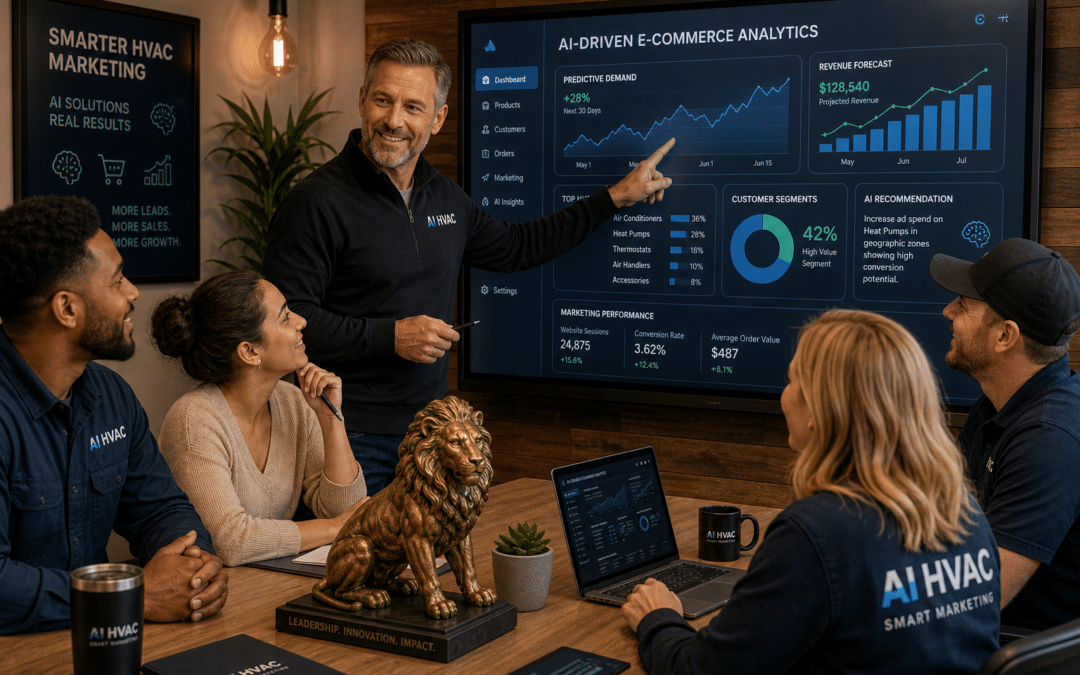
AI E-Commerce Marketing for HVAC companies in 2026 is about more than plugging in generic ad automation or tossing a chatbot onto your site. It requires a connected, HVAC-specific strategy that covers how you structure products for AI search, how your team sells technical solutions, how you integrate data, and how you adapt as the landscape changes. The HVAC companies that succeed aren’t just chasing shiny new AI features—they’re mastering the fundamentals of AI-driven visibility, trust, and process improvement, tailored to the complex demands of this industry.
Key Takeaways
- In 2026, AI E-Commerce Marketing is standard in HVAC, but results depend on tailoring strategies to fit the industry’s unique sales and compliance challenges.
- Optimizing HVAC e-commerce sites for AI-powered search and recommendations is now essential, with over 60% of HVAC-related Google searches showing AI Overviews (HVAC SEO Team).
- Data integration across sales, service, and marketing platforms is often overlooked, but it’s critical for making AI marketing actually deliver value.
- Generic AI marketing tactics aren’t enough—frameworks like the R.O.A.R. Method work only when paired with HVAC-specific steps and disciplined data management.
- No single approach fits all: In-house, agency, and hybrid AI e-commerce models each have trade-offs, and the right choice depends on your team, systems, and growth goals.
- Diversifying your sources and learning from both HVAC industry research and broader e-commerce technology reviews (see TechRadar for platform comparisons and 16Best for AI in e-commerce stats) builds trust and keeps your strategy current.
Why Are HVAC Companies Facing a New E-Commerce Reality in 2026?
The HVAC industry has always faced hurdles online: buyers often need technical advice, special pricing, or bundled installation that most retail platforms weren’t built to handle. But the bar has raised again. By 2026, 84% of marketing teams use at least one AI tool regularly, up from 61% just two years earlier (Presenc AI). In short, using AI is now expected, not a differentiator.
What many HVAC business owners overlook is how AI-driven search is rewriting visibility and lead generation. In July 2026, 63% of US HVAC-related searches surfaced a Google AI Overview (HVAC SEO Team). If your product data isn’t structured for AI summaries and recommendations, you risk being invisible to a large portion of your potential customers. The challenge now is to ensure your products and services are discoverable and trusted in an AI-first search environment, not just to run ads or answer chats.
The takeaway: Treating AI as just another tool is a dead end. To keep up, HVAC companies must embed AI into every customer interaction and process—or risk falling behind as digital expectations rise.
What Makes HVAC Online Store Optimization Different in an AI Era?
Most e-commerce advice doesn’t fit the realities of HVAC. Products are complex, sales cycles are more consultative, and local rules matter—a far cry from selling shoes or gadgets. Generic AI plugins and broad marketing guides rarely address these nuances.
In 2026, optimizing your HVAC store isn’t about generic conversion tricks, but about structuring your data so AI search and recommendation engines can actually understand and promote your products. For instance, adding detailed schema markup (like HVACProduct type, compatibility specs, and local installation options) to every product makes your inventory eligible for AI Overviews and advanced product carousels. Still, a large share of HVAC stores skip schema markup or use outdated product feeds—locking themselves out of valuable online visibility.
A practical HVAC AI optimization checklist:
- Implement industry-specific schema (such as
HVACProduct,Service, andLocalBusiness) on every product and service page to boost AI search visibility. TechRadar’s overview of e-commerce platforms can help you assess which platforms support advanced schema markup out of the box. - Keep live inventory and pricing updated, so AI-powered recommendations and Google Merchant Center listings reflect current availability.
- Use AI-powered product finders that guide buyers through compatibility (like filtering by home size, climate, or system type). Tools such as Zoovu or Constructor.io can be customized for HVAC’s unique options.
- Integrate AI live chat for both technical pre-sale questions and quick post-sale support—connected to your CRM for seamless handoff. For more, see the section below on chat and lead capture.
- Go beyond simple A/B testing: Use AI-driven behavior analytics tools (such as Hotjar or FullStory) to understand and optimize how real customers move through your landing pages.
For more on pairing content with technical store optimization, see AI content creation for HVAC companies for practical examples.
For a broader look at how AI is transforming e-commerce beyond HVAC, 16Best’s AI in e-commerce roundup highlights trends you can adapt for complex technical products.
How Should HVAC Marketers Rethink AI Live Chat and Lead Capture?
AI-powered live chat is now an expectation, not a novelty. The biggest mistake HVAC teams make is treating chatbots as generic lead-capture forms, rather than as expert advisors who can actually move complex sales forward.
Imagine a homeowner searching for a replacement air handler. An AI chat assistant trained on your real product specs and installation rules won’t just say “in stock”—it will ask about system compatibility, local codes, and can even book a site visit or installation estimate. This kind of workflow can turn what might have been a week-long research process into a same-day sale. Conversely, HVAC sites using off-the-shelf chatbots often frustrate potential buyers, misroute technical questions, or just collect emails with no context.
The most effective HVAC e-commerce sites in 2026 connect AI chat tools (like Intercom or HubSpot Chat) directly with CRM and support ticketing systems. This allows for personalized recommendations, instant troubleshooting, and smart escalation to human experts when needed. For step-by-step implementation, see the 2026 guide to AI live chat & lead capture for HVAC.
For a broader perspective on AI-powered customer service, TechRadar’s best live chat software roundup compares leading solutions for technical industries.
Which AI E-Commerce Marketing Strategies Actually Drive Sales for HVAC?
With the explosion of AI tools—automated copywriting, smart ad bidding, predictive analytics—it’s tempting for HVAC companies to try everything. But top performers focus on what moves the needle for their specific sales process.
Key insight: AI-powered recommendation engines tuned for HVAC buyer behavior (such as “people with similar systems in your area also bought…”) consistently outperform generic e-commerce upsell widgets. The same goes for predictive service reminders—using AI to estimate when a customer might need a filter change or system maintenance—if and only if your data is accurate and up to date.
Step-by-step approach to high-impact AI E-Commerce Marketing in HVAC:
- Audit your data flows: Identify where sales, service, or support data is siloed or incomplete. These gaps undermine AI accuracy and frustrate customers.
- Deploy task-specific AI agents (for product recommendations, live chat, service reminders, and ad targeting) using platforms like Salesforce Einstein or Microsoft Dynamics 365 AI, which frequently appear in independent reviews (see TechRadar’s AI tools guide).
- Set up closed-loop analytics—track not just ad clicks, but actual sales, installations, and follow-up service revenue. Focus on metrics like ROAS (return on ad spend, meaning revenue divided by what you spend on ads) and customer lifetime value, not just surface-level “vanity” stats.
- Continuously retrain your AI models based on real customer outcomes, not just website visits or ad impressions.
For more on analytics and attribution, see the 2026 AI marketing analytics playbook for HVAC.
For further reading on choosing and integrating AI marketing strategies in complex e-commerce environments, 16Best’s AI in e-commerce guide is a helpful external reference.
How Does the R.O.A.R. Method Apply to AI E-Commerce Marketing for HVAC Companies?
The R.O.A.R. Method—Research, Optimize, Automate, Review—is a proven framework for AI E-Commerce Marketing in HVAC, but it only works when each step is made specific and tactical for this industry. Too often, businesses apply it at a surface level and miss the details that drive results.
- Research: Use AI tools to analyze HVAC forums, support logs, and install feedback—not just basic keyword trends. For example, mining chat logs for questions about duct sizing could reveal common confusion and prompt you to update your product finder or add a video explainer. A real-world scenario: An HVAC distributor who reviewed a month of chat logs found that many customers struggled with SEER rating comparisons. Adding a dynamic comparison tool to their site helped clarify choices and led to a noticeable uptick in qualified leads.
- Optimize: Implement structured data using HVAC-relevant schema markup, deploy AI-driven product finders, and build dynamic landing pages tailored to each buyer segment (homeowners vs. contractors). Use tools like Google’s Structured Data Testing Tool to validate your markup. For example, a regional HVAC supplier might use custom landing pages for different climate zones, each showing locally relevant products and installation options.
- Automate: Connect AI tools for email, live chat, and retargeting—but importantly, sync these with service dispatch and inventory systems. For instance, automating reminders for seasonal maintenance only works if they’re triggered by actual service records, not just a static list. Imagine a system where a recent AC installation automatically schedules the first maintenance reminder six months out, using real purchase data.
- Review: Run monthly reviews bringing together marketing, sales, and service teams. Don’t just look at campaign ROI—also track installation success rates, support response times, and customer feedback. For example, if you notice chatbots are escalating too many conversations to humans without resolving issues, retrain the AI or update your product data. This ongoing review is what turns AI from a static tool into a competitive advantage.
The most common misstep? Skipping the Review phase and treating AI as “set and forget.” In HVAC, where a mismatched part or slow follow-up can lose a customer for years, this kind of ongoing iteration is absolutely essential.
For more on pairing process frameworks with HVAC-specific execution, see AI E-Commerce Marketing for HVAC Companies: In-House vs Agency.
What Are the Real Trade-Offs: In-House, Hybrid, or Agency-Led AI E-Commerce?
DIY AI tools might sound like a shortcut, but the real decision between in-house, agency, or hybrid models depends on your team, tech stack, and business priorities—not just cost or tool access. Here’s a summary to help HVAC companies weigh the options:
| Approach | Pros | Cons | Best For |
|---|---|---|---|
| In-House AI |
|
|
Large HVAC companies with established IT/marketing teams |
| Agency-Led AI |
|
|
HVAC businesses wanting a fast ramp-up or lacking internal bandwidth |
| Hybrid (In-House + Agency) |
|
|
Growth-focused HVAC firms ready to scale online sales |
For a detailed breakdown—including staffing, workflow, and cost considerations—see AI E-Commerce Marketing for HVAC Companies: In-House vs Agency.
One important caveat: Many mid-sized HVAC businesses underestimate the ongoing training and data management required to keep in-house AI running smoothly. Even with an agency partner, plan to dedicate time for staff to maintain product data, review AI recommendations, and handle exceptions.
For neutral, third-party reviews of e-commerce and marketing agencies, TechRadar’s best digital marketing agencies page provides a broader industry comparison.
How Is AI Changing HVAC E-Commerce Customer Expectations?
By 2026, customers expect seamless, personalized online experiences everywhere—including HVAC. AI-referred traffic to US retail sites grew 4,700% year-over-year in July 2025 (Adobe Digital Insights), and HVAC buyers are increasingly arriving via AI-powered recommendations, not just ads or direct searches.
A common misconception: HVAC customers will tolerate clunky websites or slow responses because the products are technical. In reality, they’re often less patient—if your site can’t answer compatibility or pricing questions quickly, or if your AI chat can’t escalate to a human specialist, buyers will go elsewhere. For example, a homeowner comparing replacement condensers is much more likely to choose the site that generates a clear, AI-powered quote and can schedule an install right away.
To keep pace, HVAC e-commerce sites should focus on:
- Instant, AI-driven quoting and scheduling tools (platforms like ScheduleEngine or Housecall Pro now offer AI integrations)
- Personalized product and service bundles, based on past purchases or system data
- Omnichannel support (chat, SMS, phone) with AI assistants that remember prior conversations
- Rich, AI-enhanced product content—think video explainers and easy-to-skim comparison guides. For more, see AI content creation services and video creation for HVAC e-commerce
For a snapshot of how AI is shifting customer expectations beyond HVAC, see TechRadar’s AI in e-commerce trends.
What Role Does Data Integration Play in HVAC Digital Marketing for 2026?
If there’s one make-or-break factor in AI E-Commerce Marketing for HVAC, it’s data integration. Most HVAC companies use multiple platforms—sales, service, inventory, marketing—and AI can only deliver value if it’s working with connected, up-to-date data.
The reality: Most failures in AI marketing come not from “bad prompts” or weak tools, but from fragmented or outdated data. For example, an AI ad campaign not synced with live inventory can waste budget promoting out-of-stock products. Likewise, sending service reminders based on stale CRM records can annoy customers with irrelevant offers.
Steps to get data integration right:
- Select e-commerce and CRM platforms with strong APIs and built-in AI integrations. TechRadar’s CRM software guide reviews solutions that support this kind of interoperability.
- Map every customer touchpoint—from quote to installation to follow-up—and ensure data flows both ways between sales, support, and marketing tools.
- Schedule regular audits to catch data mismatches (like product specs, pricing, or service intervals) and fix them before they affect customers.
- Feed unified data into your AI analytics for accurate attribution, forecasting, and personalization. For more, see AI data analytics for HVAC e-commerce and the 2026 AI marketing analytics playbook.
For more ways AI is reshaping the broader e-commerce data landscape, 16Best’s AI in e-commerce report provides additional context.
What Are the Biggest AI E-Commerce Marketing Pitfalls for HVAC Companies?
AI won’t fix a broken e-commerce foundation. The biggest pitfall is assuming new tech alone will drive sales or customer satisfaction. In practice, AI amplifies both strengths and weaknesses—companies with clean product data, clear service processes, and integrated systems see real gains, while those with messy data just automate confusion.
Another common mistake is neglecting the human element. While AI chat can handle routine queries, HVAC buyers often face complex, high-stakes decisions that require expert advice from a real person. If you don’t train your team to interpret AI-driven insights and handle escalations smoothly, you risk losing both revenue and reputation.
A final trap: Falling behind on AI search and discovery trends. With 63% of HVAC searches now showing Google AI Overview results (HVAC SEO Team), failing to optimize content and data for AI can cut your online visibility dramatically. Staying discoverable means keeping up with how algorithms—and customers—are evolving.
For more on common mistakes and how to avoid them, the 2026 AI marketing analytics playbook for HVAC includes real-world examples and troubleshooting steps.
How Should HVAC Companies Prioritize Their AI E-Commerce Roadmap?
With 84% of marketing teams now using at least one AI tool (Presenc AI), the list of options can feel overwhelming. The answer isn’t to try everything, but to prioritize based on business needs and customer behavior.
A practical 2026 AI E-Commerce Marketing roadmap for HVAC companies:
- Audit your current e-commerce, CRM, and service systems for AI readiness and integration gaps.
- First, invest in data cleanup and schema markup—the foundation for AI-driven visibility and trust.
- Pilot one or two high-impact AI tools (like live chat or product finders) and measure real sales outcomes, not just web traffic or leads gathered.
- Train your team to work alongside AI, with clear protocols for escalating complex cases to human experts.
- Review results quarterly, using attribution analytics to double down on what’s driving profitable growth—and adapt as AI and search trends shift.
If you’re considering outside help, Lion Click Media is one of several agencies specializing in HVAC digital marketing for 2026—but the real key is internal buy-in and process improvement, not just which vendor you choose.
The bottom line: HVAC companies that win in 2026 will be those that use AI as a force multiplier for strong fundamentals and constant learning—not as a shortcut. Focus on getting your data, processes, and customer experience right, and let AI accelerate what’s already working.
Frequently Asked Questions
What AI tools are best for HVAC e-commerce lead capture?
AI live chat assistants that understand HVAC terminology and integrate with CRM systems are the best for capturing and qualifying leads 24/7, reducing missed opportunities.
Can small HVAC companies benefit from AI e-commerce marketing?
Yes, small HVAC companies can start with affordable AI tools like chatbots and product recommendations to improve online conversions, though scaling may require expert help.
How do AI advertising campaigns differ from traditional HVAC marketing ads?
AI campaigns automate audience segmentation, bid adjustments, and creative testing in real time, focusing spend on prospects most likely to convert, unlike static traditional ads.
Is it necessary to update my HVAC website for AI optimization?
Yes, AI optimization requires a fast, user-friendly website with structured data and dynamic product recommendations to maximize conversions and SEO benefits.
How do I measure ROI on AI e-commerce marketing for HVAC?
Track metrics like return on ad spend (ROAS), customer acquisition cost (CAC), and conversion rates using integrated AI analytics and CRM data to measure marketing effectiveness.
What are common pitfalls when adopting AI in HVAC e-commerce?
Common pitfalls include poor tool integration, overreliance on automation without human oversight, and failing to track data properly, which can waste budget and lose leads.
Can AI help with HVAC seasonal promotions and upsells?
Absolutely. AI-driven personalization and ad targeting can highlight seasonal HVAC products and timely upsells to the right customers, increasing average order value.
Get Your Free AI Marketing Audit
See exactly where you are leaving leads on the table and how Lion Click Media can help you rank higher, capture more customers, and Make Your Brand ROAR. No cost, no obligation.
Claim My Free Audit →Or chat with our 24/7 AI assistant (bottom-right) for instant answers.