
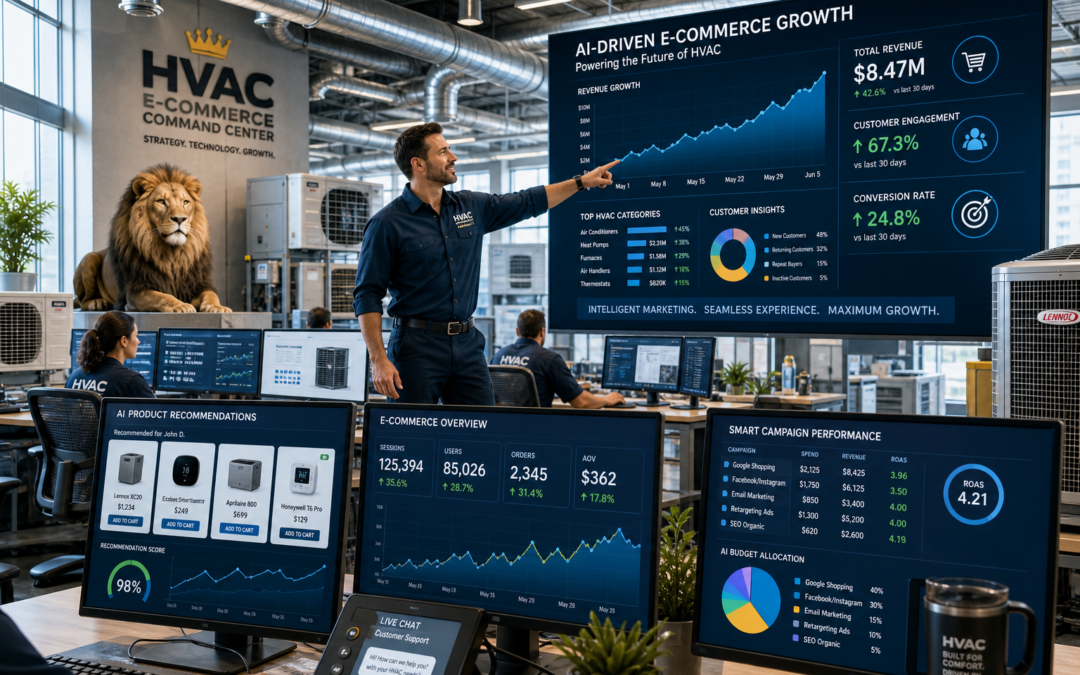
For HVAC companies weighing in-house versus agency-led AI E-Commerce Marketing strategies in 2026, the real differentiator is not just cost or operational control—it’s the readiness to adapt as AI and digital commerce transform how buyers find, compare, and purchase HVAC products and services. While agencies are typically first to adopt new AI-driven e-commerce solutions for HVAC, in-house teams potentially offer tighter brand alignment—if, and only if, you’re prepared to invest consistently in talent, technology, and process. Most businesses underestimate how quickly the landscape shifts. Ultimately, the companies that thrive are those that structure for adaptability and ongoing learning, rather than focusing solely on short-term cost savings or convenience. By establishing a clear framework for decision-making—and recognizing the specific demands of AI E-Commerce Marketing for HVAC—you can position your business to stay ahead of digital disruption.
Key Takeaways
- AI marketing agencies tend to implement new AI tools and strategies in HVAC digital marketing campaigns faster than most in-house teams, providing first-mover advantages as search and e-commerce behaviors evolve (Riseup Agency, 2025).
- Building an effective in-house AI e-commerce marketing team requires ongoing investment in salaries, training, and infrastructure—costs that often exceed what many HVAC firms can sustain over time (AMW Group, 2026).
- In-house teams risk falling behind without regular input from outside experts, while agencies offer cross-account insights from working with multiple HVAC and home services brands and keep pace with broader AI and e-commerce innovations.
- Hybrid approaches—combining internal strategy with agency execution—often provide the best balance of control, cost, and access to specialized AI skills and e-commerce solutions for HVAC.
- AI E-Commerce Marketing for HVAC delivers actual results only when combined with continuous learning, rigorous analytics, and real-world experimentation—not just the use of new tools.
Why Most HVAC Companies Hit a Wall with In-House AI E-Commerce Marketing
In-house marketing can seem attractive thanks to the promise of greater control and deeper brand familiarity. Yet for HVAC companies, in-house teams often hit hard limits—especially as AI-driven e-commerce grows more sophisticated each year.
A frequent mistake: assuming that hiring a single tech-savvy marketer and buying a few AI tools will make the business competitive. In reality, assembling and retaining a team with the right mix of technical, creative, and HVAC-specific e-commerce expertise is a complex, ongoing challenge. Top AI marketing talent is in demand and often recruited by agencies, tech companies, and larger firms.
According to AMW Group, the total annual cost of running an in-house AI marketing team—which encompasses salaries, benefits, and the required tech stack—can be substantial. Many HVAC businesses find this figure outside their typical marketing budget, especially compared to agency partnerships, which tend to be more scalable and flexible.
What’s most often overlooked is that maintaining an in-house team means continual investment in upskilling—covering everything from prompt engineering for AI copywriting tools to integrating with platforms like HubSpot, ServiceTitan, or Housecall Pro. Without a structured plan for ongoing learning and the adoption of new AI e-commerce solutions for HVAC, even a well-funded in-house team can quickly fall behind competitors.
- Key challenge: Keeping internal teams current with fast-moving AI and e-commerce innovations requires dedicated time for research, vendor evaluation, and skill development.
- Potential risk: Without outside input, in-house teams may struggle to spot emerging trends or best practices, leading to stagnation.
Agencies Are Winning the AI Race—Why That Gives HVAC E-Commerce a Competitive Edge
The performance gap between agencies and in-house teams in AI E-Commerce Marketing for HVAC is growing. In 2025, 61% of marketing agencies reported leveraging generative AI in their work, compared to just 17% of in-house teams. This lead is expanding as search platforms like Google’s AI Overviews roll out globally—growing from 7 to 229 countries in a single year (AI Search: Implications for Information Markets).
AI marketing agencies don’t just adopt new tools first—they implement them across multiple HVAC and home services accounts. For example, agencies are typically first to deploy AI-driven dynamic pricing, predictive product recommendations, and automated quote engines tailored for HVAC e-commerce. In-house teams often spend weeks or months evaluating and learning new tools that agencies have already tested in real campaigns.
- Cross-industry insights: Agencies working with multiple HVAC clients can more easily identify which AI-powered chatbots actually convert, or which schema markup strategies help HVAC products get indexed in AI-driven search results.
- Faster implementation: Agencies often have libraries of proven e-commerce templates and workflows, allowing HVAC businesses to roll out new AI lead generation features or product recommendation engines more quickly.
While agencies are often the first to adapt to changes, in-house teams can close the gap by investing in industry networking, specialized training, and ongoing collaboration with external experts.
For further context on how AI marketing agencies are shaping strategies in HVAC and other home services, see AI E-Commerce Marketing for Home Services: In-House vs Agency.
Cost Comparison: In-House vs. Agency for AI E-Commerce Marketing (2026)
Cost is rarely the only factor, but it’s often the first consideration for HVAC companies evaluating e-commerce marketing models. The table below outlines typical annual investment ranges for each approach in 2026, based on industry research and real-world estimates.
| Model | Typical Annual Cost (2026) | Pros | Cons |
|---|---|---|---|
| In-House AI Marketing Team | ~$400,000 (including salaries, benefits, tools) |
|
|
| AI Marketing Agency | $150,000–$250,000 (varies by scope and market) |
|
|
| Hybrid (In-House Strategy, Agency Execution) | $200,000–$350,000 (estimated blend) |
|
|
The takeaway: Unless your HVAC business is large enough to justify this level of fixed investment and can continually attract high-end technical talent, an AI marketing agency partnership or a hybrid approach will typically offer more capability and adaptability for the investment (AMW Group, 2026).
- For smaller HVAC firms, many budget somewhere in the low- to mid-six figures annually for e-commerce marketing, though actual needs vary by region and service mix.
- Hybrid models are increasingly common for businesses seeking both strategic control and quick adoption of new AI-driven e-commerce solutions for HVAC.
For further guidance on budgeting and investment, see the 2026 AI E-Commerce Marketing Playbook for HVAC Companies.
What Actually Makes AI E-Commerce Work for HVAC Companies?
The most common pitfall for HVAC companies is assuming that purchasing AI tools marks the finish line. In reality, results come from pairing those tools with high-quality data, a structured process of experimentation, and continuous learning.
- Example: An HVAC company may implement AI-powered chatbots to handle live service inquiries on its e-commerce site, but without A/B testing different scripts and tracking conversions, the investment may not yield meaningful results.
- Follow-up automation: Automated email or SMS campaigns require ongoing tweaks based on analytics; otherwise, conversion rates can stagnate.
A frequent gap in HVAC AI marketing is the lack of robust analytics pipelines. Teams often focus on surface metrics like website traffic or click counts, overlooking deeper signals such as cohort-based conversions or customer lifetime value.
- For a step-by-step playbook on structuring analytics for AI-driven HVAC marketing, see 2026 AI Marketing Analytics Playbook for HVAC Companies.
Key elements of effective AI E-Commerce Marketing for HVAC include:
- Real-time integration of customer data from HVAC service platforms such as ServiceTitan or Housecall Pro
- Schema markup for product and service pages to improve visibility in AI-driven search results
- Ongoing experimentation with content personalization using tools like ChatGPT or Jasper
- Accurate attribution tracking to measure which AI-driven campaigns drive actual HVAC sales, not just clicks
Industry organizations such as the Air Conditioning, Heating & Refrigeration News (ACHR News) and Forrester Research regularly publish trends and best practices on e-commerce and AI adoption relevant to HVAC, providing independent perspectives that supplement agency findings.
The R.O.A.R. Method for HVAC AI E-Commerce: A Practical Framework
To bring structure to AI E-Commerce Marketing for HVAC, the R.O.A.R. Method offers a four-step process. Here’s a deeper look at each phase, with practical action items and deeper context:
-
Research:
- Map out the full customer journey for HVAC buyers, noting unique pain points—such as urgent repair needs, seasonal demand spikes, or specific regulatory requirements.
- Use Google Analytics and AI-driven heatmapping tools (like Hotjar) to visualize how users move through your online store or booking flows.
- Gather direct feedback with voice-of-customer surveys and review mining—identify what buyers say about your site, products, and competitors.
- Review insights from independent sources, such as Forrester Research, to benchmark your digital buyer journey against industry standards.
-
Optimize:
- Focus on high-value e-commerce flows: online service booking, replacement part ordering, and maintenance plan sign-ups.
- Apply AI-driven content personalization—test dynamic product recommendations, personalized landing pages, and adaptive navigation menus.
- Implement structured schema markup (using tools like Merkle Schema Markup Generator) to enhance search visibility, especially as AI-driven search expands.
- Collaborate with your agency or internal team to test and iterate on new e-commerce features, guided by analytics.
-
Automate:
- Deploy AI chatbots (e.g., Intercom, Drift) for round-the-clock lead capture and service triage.
- Automate follow-up using HVAC-specific sequences in Klaviyo or Mailchimp, segmenting by product interest, service history, or time of year.
- Experiment with dynamic pricing plugins and integrate these systems directly with your HVAC CRM for seamless inventory and lead management.
- Set up automated workflows for review requests and customer feedback loops post-service.
-
Review:
- Schedule monthly analytics reviews focused on conversion rates, customer lifetime value, and attribution of sales to specific AI marketing tactics—don’t just look at traffic volume.
- Use dashboard tools like Google Data Studio or Looker to track progress and spot patterns.
- Benchmark your results against published industry data when possible, and adjust strategies based on what actually moves the needle for HVAC e-commerce.
- Include learnings from both wins and failures to fuel continuous improvement.
A frequent mistake is rushing into “Optimize” and “Automate” steps without thorough “Research” or regular “Review.” HVAC companies that skip these bookend steps often see diminishing returns and miss out on valuable learning cycles. The R.O.A.R. Method, when followed in full, keeps AI E-Commerce Marketing programs agile, evidence-based, and continuously improving.
For a more detailed discussion of this methodology, including HVAC-specific use cases and integration tips, see the 2026 AI E-Commerce Marketing Playbook for HVAC Companies.
Scenario: HVAC Online Store Optimization—Agency vs. In-House Execution
Imagine a mid-sized HVAC company launching an e-commerce store for replacement parts and service plans. The in-house marketing lead is experienced in traditional PPC and SEO, but new to AI-powered e-commerce. Their task: integrate AI-driven product recommendations, dynamic FAQ content, and automated cart abandonment campaigns.
- With an agency: The business can tap proven e-commerce templates and specialized tools for AI-powered content, schema markup, and predictive analytics. Rollout is typically faster, and agencies bring cross-client knowledge on what works for HVAC lead generation and boosting average order value.
- With an in-house approach: Progress is slower. The internal team spends weeks researching which AI e-commerce platform fits their inventory system, and post-launch, optimization can lag as learning curves and integration challenges mount. Ongoing HVAC store optimization is a continuous process—not a one-off project.
For an in-depth guide to optimizing HVAC e-commerce stores with AI, see E-Commerce Services and review the AI content creation for HVAC companies article for content automation strategies.
AI Lead Generation for HVAC: What Works (and What Fails) in 2026
AI lead generation HVAC strategies are about more than just adding a chatbot or running “smart” ads. Companies seeing real ROI in 2026 orchestrate engagement across multiple touchpoints—website, chat, email, SMS, and often phone—using AI to match message, offer, and timing to the visitor’s intent and service need.
- Illustrative example: One HVAC business simply adds a basic AI assistant to answer product questions. Another layers in a conversational lead intake bot, interactive product quizzes, and retargeting campaigns that adjust messaging based on a visitor’s previous site behavior. The second approach typically sees steadier, more qualified lead flow, not just casual clicks.
- Integration is the linchpin: AI lead capture only delivers ROI when it’s deeply connected to CRM, service dispatch, inventory, and analytics systems.
For specific, HVAC-focused tactics and case breakdowns, see AI Live Chat & Lead Capture: 2026 Guide for Orange County HVAC.
To stay current with independent trends and best practices in AI lead generation and digital marketing, resources like the American Marketing Association research library and McKinsey Technology Insights are valuable for HVAC owners seeking non-vendor perspectives.
Trade-Offs and Hidden Costs: Control, Speed, and Innovation
Every model—AI marketing agency, in-house, or hybrid—comes with trade-offs that aren’t always visible in vendor presentations. In-house teams may enjoy granular control over messaging and data, but often struggle to keep up with innovation in HVAC digital marketing and AI lead generation. Agencies move faster, bring outside perspectives, and maintain institutional knowledge across projects, but need trust and robust onboarding to capture HVAC-specific brand nuances.
One hidden risk of going in-house: knowledge decay. When a key marketing hire leaves, much of your AI and e-commerce expertise may walk out the door. Agencies are structurally incentivized to train their teams on the latest tools, maintaining continuity even as staff changes. In fact, in 2026, 79% of DTC brands partner with external agencies for their marketing efforts—a strong signal that many businesses value external expertise and protection against talent churn.
It’s also critical to note that agencies are usually early adopters of major e-commerce and search innovations. For instance, Google’s AI Overviews expanded rapidly worldwide between 2024 and 2025 (AI Search: Implications for Information Markets), and agencies were the first to experiment with new schema markup strategies to keep HVAC clients visible as these changes rolled out. HVAC businesses relying solely on in-house teams often notice these shifts only after competitors have already gained ground.
- For more on the impact of talent and innovation cycles, see AI Content Creation for strategies to reduce single-point-of-failure risks in HVAC marketing teams.
How to Decide: A Checklist for HVAC Business Owners
Too many HVAC owners decide between agency and in-house marketing based on gut feel or legacy relationships. A structured approach is more reliable and can help clarify trade-offs. Use this checklist to assess what’s realistic for your business:
- Do you have—or can you recruit—the technical AI, analytics, and e-commerce expertise necessary for ongoing innovation in HVAC digital marketing?
- Is your marketing budget able to absorb the full cost of in-house salaries, training, and AI infrastructure for HVAC e-commerce solutions?
- Are you prepared for the slower learning curve of in-house teams, or do you need to stay at the leading edge of AI lead generation HVAC strategies?
- Does your current or potential agency demonstrate real HVAC e-commerce experience, with transparent analytics and verifiable results?
- Would a hybrid approach (internal strategy, agency execution) give you the best mix of control and adaptability in HVAC AI E-Commerce Marketing?
For a step-by-step breakdown on how to operationalize this checklist and set up internal reviews, see the 2026 AI E-Commerce Marketing Playbook for HVAC Companies.
Hybrid Strategies: The Overlooked Sweet Spot for Most HVAC Firms
Most high-performing HVAC e-commerce programs don’t rigidly pick a single model. Instead, they blend internal strategic oversight with specialized agency support. This hybrid approach lets you keep brand decisions in-house while tapping agency expertise for technical execution, rapid experimentation, and ongoing AI platform integration.
- Keep content strategy and customer experience mapping internal, but outsource AI-powered ad campaigns, advanced analytics, and e-commerce development to a specialist agency.
- Establish clear communication protocols, shared dashboards, and regular joint reviews—treat agencies as strategic partners, not just vendors, to unlock real agility and adaptability.
This approach helps to minimize knowledge silos and ensures both sides stay current. For more on how hybrid models work in practice across the trades, see AI E-Commerce Marketing for Home Services: In-House vs Agency.
Conclusion: Future-Proofing HVAC E-Commerce with Smart AI Marketing Choices
AI is now woven into the fabric of modern business—including the S&P 500, where 11% of enterprises had AI deeply integrated into processes in 2025. For HVAC companies, the choice is clear: struggle to keep up internally, or collaborate with partners who live and breathe these changes. The pace of change in AI E-Commerce Marketing almost always rewards those who structure for agility, not just short-term convenience.
The businesses that thrive will be those who balance real-world costs, continuous learning, and strategic adaptability. By grounding your approach in frameworks like the R.O.A.R. Method and learning from both internal experience and external expertise, you can avoid common pitfalls and adapt as AI transforms the HVAC e-commerce landscape. For tactical guides and deeper dives—from AI content and analytics to e-commerce optimization—see resources like the 2026 AI Marketing Analytics Playbook for HVAC Companies and AI content creation for HVAC companies.
For those ready to take the next step, here are practical starting points:
- For content automation, see AI Content Creation
- To upgrade your live lead capture, consider AI Live Chat & Lead Intake Assistant
- For e-commerce store builds and optimization, review E-Commerce Services
- For in-depth analytics, explore AI Data Analytics
Make your decision based on adaptability and independent evidence, not just tradition—whether you build, buy, or blend your approach, the winners will be those who keep learning and stay nimble as AI reshapes the HVAC e-commerce world. For additional industry context, independent research from sources like the ACHR News and Forrester Research can supplement agency or vendor perspectives and help future-proof your digital marketing strategy.
Frequently Asked Questions
Can small HVAC companies benefit from AI e-commerce marketing?
Yes, small HVAC companies can benefit, especially by partnering with agencies that provide AI tools and expertise without the overhead of building in-house teams.
What AI tools are essential for HVAC e-commerce marketing?
Key AI tools include customer data platforms, AI-driven ad management systems, product recommendation engines, and AI chatbots for lead intake and customer support.
How does AI improve lead generation for HVAC companies online?
AI improves lead generation by analyzing customer behavior to personalize offers, automating lead qualification with chatbots, and optimizing ad spend based on real-time data.
Is data privacy a concern when using AI marketing agencies?
Data privacy is critical; ensure agencies comply with regulations and have clear policies on data handling and security to protect customer information.
How long does it typically take to see results from AI e-commerce marketing?
Results vary, but businesses often notice measurable improvements in engagement and conversions within a few weeks to a few months after implementation and optimization.
Can AI marketing replace traditional HVAC sales teams?
AI marketing enhances but does not replace sales teams; it automates lead capture and qualification, allowing sales staff to focus on closing and service.
What are common mistakes HVAC companies make with AI marketing?
Common mistakes include underestimating ongoing maintenance, poor data quality, lack of clear goals, and ignoring the need for human oversight alongside AI tools.
Get Your Free AI Marketing Audit
See exactly where you are leaving leads on the table and how Lion Click Media can help you rank higher, capture more customers, and Make Your Brand ROAR. No cost, no obligation.
Claim My Free Audit →Or chat with our 24/7 AI assistant (bottom-right) for instant answers.