
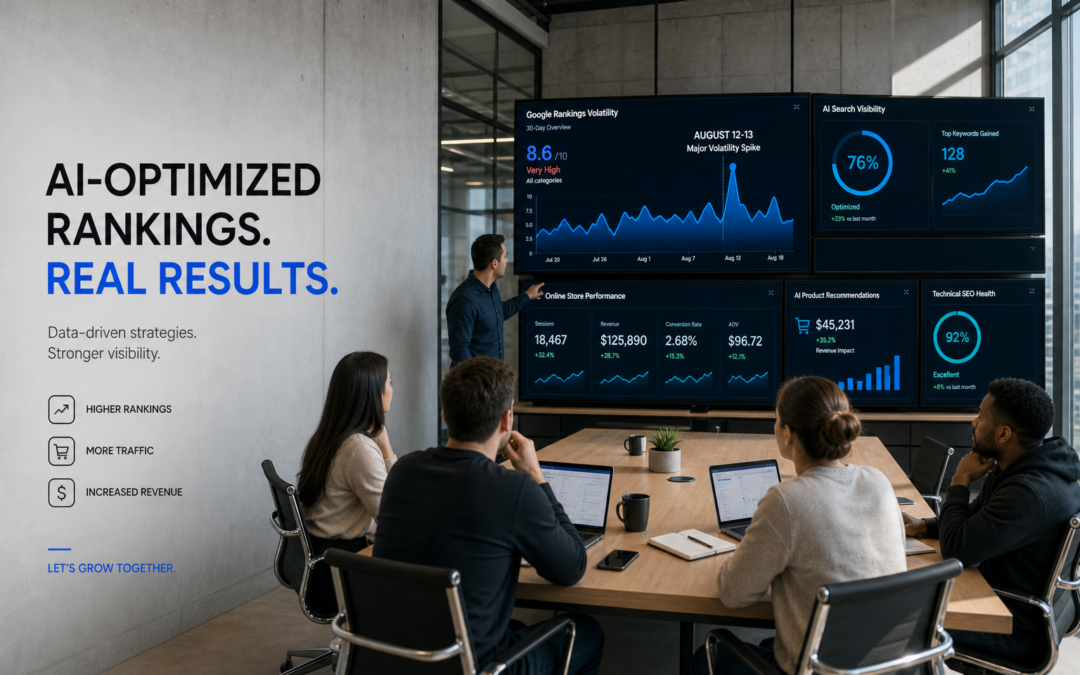
Google search ranking volatility surged on August 12-13, sending e-commerce site rankings into sudden swings. For U.S. brands, this isn’t just a warning sign—it’s a wake-up call: Google’s algorithmic turbulence is now a permanent fixture, not a rare event. Brands that treat volatility as a core risk—by understanding its drivers, acting quickly with a structured playbook, and systematically building resilience—will protect revenue and outmaneuver less-prepared competitors. This guide breaks down the most common misconceptions about volatility, offers practitioner-level frameworks, and illustrates exactly how leading e-commerce teams diagnose, respond, and future-proof their rankings in a U.S. context.
Key Takeaways
- Ranking volatility is part of e-commerce SEO, caused by both Google algorithm changes and the technical complexity of large, ever-evolving catalogs (digitalzoop.com.au).
- Teams that detect volatility quickly—using clear thresholds and a disciplined, stepwise response—recover faster and can even gain ground while competitors hesitate.
- Internal technical changes, routine catalog updates, and weak processes are often overlooked as root causes of ranking swings and can amplify every algorithm update.
- Effective volatility response blends layered monitoring (automated and manual), root-cause diagnosis (including log file analysis), and documented action protocols.
- AI-powered SEO tools such as SurferSEO can accelerate detection and recommend fixes, but require expert human oversight to interpret context and avoid overcorrection.
Why Did Google Search Ranking Volatility Spike in Mid-August?
Sharp, sudden volatility like that seen on August 12-13 typically signals that Google is testing or rolling out significant changes—often with little or no public confirmation. In early February 2025, for example, the SEO community documented major e-commerce ranking swings, likely tied to an unconfirmed algorithm update (iovista.com). Again in September 2025, significant disruptions hit brands even after an official core update had ended (jxtgroup.com).
A repeated misconception: volatility is only about Google’s algorithm. In reality, e-commerce sites—especially those with thousands of SKUs and continuous site changes—are inherently dynamic and prone to instability. For instance, a simple change to product navigation or a bulk inventory update can create unexpected ranking turbulence. When Google’s crawling and ranking systems—now deeply influenced by AI and machine learning—re-evaluate site quality, these internal changes can quickly escalate into major visibility swings.
Pro tip: treat volatility as an always-on risk. If your team only reacts when Google makes headlines, you’re playing catch-up.
What Makes E-Commerce Sites Especially Prone to SEO Volatility?
E-commerce sites are uniquely volatile because they’re in a state of constant change. According to digitalzoop.com.au, the vast number of URLs, ongoing stock changes, internal link updates, and product duplication risks all contribute to this instability.
Consider a U.S. apparel retailer prepping for a fall launch: they might update hundreds of product pages in a week. If canonical tags are misapplied, or a developer accidentally deindexes out-of-stock items, entire categories can disappear from Google overnight. Or, reworking navigation to promote new arrivals can unintentionally bury bestsellers, altering site authority and triggering ranking drops in unrelated categories. These issues aren’t hypothetical—retailers across the U.S. report such scenarios every season, and each algorithm tweak amplifies the effects.
Takeaway: every routine change—inventory updates, navigation tweaks, even adding a new internal search—can cause or worsen volatility. Most teams don’t realize these internal risks until rankings have already suffered.
How Should Brands Monitor and Diagnose Search Volatility?
Many e-commerce companies notice volatility only after traffic drops or sales slow—by then, recovery is harder. Top-performing teams use a layered monitoring approach, combining automated tools and manual investigation, and they set up clear action thresholds.
Beyond a weekly glance at Google Analytics or Search Console, expert practitioners implement:
- Daily rank tracking for top-converting keywords and product groups—segmented by category and device, not just global averages.
- Weekly site crawls (with tools like Screaming Frog or Sitebulb) to catch indexing and technical errors, broken links, accidental noindex tags, and canonicalization problems.
- Regular log file analysis to see exactly how Googlebot is crawling the site, spot crawl budget issues, and identify unexpected blocks—this is how technical SEOs catch issues that dashboards miss (Search Engine Journal).
- Backlink monitoring (using Ahrefs, Majestic, or similar platforms) to catch sudden shifts or losses that might impact authority or trust.
- Manual review of affected pages for subtle problems—like missing manufacturer part numbers or unoptimized schema markup.
- Reference to Google’s Quality Rater Guidelines during manual audits, especially after volatility events, with focus on E-E-A-T (Experience, Expertise, Authoritativeness, Trustworthiness) signals (Google Search Blog).
Concrete scenario: A specialty electronics retailer sees a ranking dip on mobile. Log file review reveals Googlebot is not crawling their mobile site due to a robots.txt update—an issue missed by automated dashboards but caught through direct log analysis.
Don’t rely on any single tool. Volatility’s root causes rarely show up in one place—triangulate your findings, document every anomaly, and keep a changelog of both site changes and detected issues. For more on integrating data analytics and AI-driven alerts, see AI Data Analytics for e-commerce.
What Most E-Commerce Brands Get Wrong About Responding to Volatility
When volatility hits, most teams rush to fix visible symptoms—rewriting product copy, tweaking meta tags, or shuffling links—without diagnosing root causes. This shotgun approach often increases instability.
Here’s a real-world scenario: a team mass-edits product descriptions after a ranking dip, but the actual culprit is a misconfigured robots.txt file blocking key pages. Or, in another case, a rushed plugin rollback breaks structured data on hundreds of SKUs, compounding ranking losses. The common thread: a lack of structured response and clear prioritization.
Expert teams approach volatility methodically, focusing on proven ranking factors—crawlability, canonicalization, site speed, structured data (such as schema markup), and internal linking. They maintain a volatility playbook outlining who does what, in which order, and how fixes are tracked. This “pre-mortem” discipline is the difference between quick recovery and prolonged losses.
If you’re using AI-driven platforms or automation, remember: these tools can surface anomalies but can’t judge business context or priorities. Human oversight is essential to avoid overcorrection. For a breakdown of pitfalls and fixes in AI-driven workflows, see common AI social media management mistakes in e-commerce.
The V.I.R.A.L. Framework: A Structured Approach to Handling SEO Volatility
A disciplined response is non-negotiable. The V.I.R.A.L. Framework—Verify, Isolate, Remediate, Assess, and Learn—offers a stepwise process for managing ranking volatility. Below, each step is illustrated with practitioner-level detail and a real-world scenario:
- Verify: Confirm the volatility is real. Don’t trust a single tool or anecdotal report—compare multiple data sources (rank trackers, Google Search Console, log files) against your historical baselines. For instance, cross-check a SEMrush alert with Google’s own data and log files to rule out false alarms, like normal weekend/weekday cycles or seasonal dips.
- Isolate: Pinpoint what’s affected. Is the drop sitewide, limited to a category, or specific to mobile users? Segment by product type, device, and region. Example: a drop occurs only in the “outdoor gear” category on mobile, but desktop and other categories remain stable—suggesting a localized technical issue rather than a sitewide penalty.
- Remediate: Triage potential causes, starting with the most likely high-impact errors. Use a technical SEO checklist: check for duplicate content, missing canonical tags, crawl blocks, changes in structured data, or page speed regressions. For prioritization, start with fixes affecting top-revenue categories, then move to lower-priority pages. Document every change in a central log.
- Assess: Monitor results using before-and-after ranking comparisons and crawl diagnostics. Resist the urge to roll out multiple fixes at once—track which specific changes move the needle. For example, after restoring internal links, monitor whether affected pages regain impressions or clicks in Search Console within several days.
- Learn: Conduct a brief post-mortem. Identify the root trigger, document what worked, and update your SEO protocols and pre-launch QA checklists. For instance, if a navigation update led to a ranking drop, require future changes to go through a technical review on a staging site before launch.
Each step requires specific tools and clear ownership—skip one, and you risk compounding issues. Use the framework to build institutional knowledge and resilience.
Real-World Example: Diagnosing an August Ranking Drop
Imagine a national outdoor gear retailer sees organic traffic to its hiking boots category crater on August 13. Here’s how a practitioner would apply the V.I.R.A.L. Framework:
- Verify: Both SEMrush and Search Console confirm ranking loss for “waterproof hiking boots” and related terms, with log files showing a sudden drop in Googlebot crawl activity for that section.
- Isolate: The drop is confined to the hiking boots category—other footwear remains stable, so the team rules out a sitewide penalty.
- Remediate: A Screaming Frog crawl finds that a navigation update removed all links to the hiking boots hub. The team restores links from key category pages and updates the XML sitemap. At the same time, they use SurferSEO to review on-page signals for the affected category, identifying and correcting thin content issues in top products.
- Assess: Rankings begin to recover; Googlebot resumes crawling the hub page, as verified in log files. The team monitors both ranking improvements and crawl frequency for a week to ensure stability.
- Learn: Post-mortem review leads to a new protocol: all navigation changes are reviewed for SEO impact, tested in a staging environment, and checked against Google’s Quality Rater Guidelines before going live.
This scenario is not theoretical—similar mishaps drive volatility events across U.S. e-commerce sites, and the actual culprit is rarely the most obvious one.
How Do Google Algorithm Updates Interact with E-Commerce Site Complexity?
Google’s algorithm updates don’t just create volatility—they magnify underlying weaknesses in your site. Both February and September 2025 brought major e-commerce traffic swings tied to algorithmic changes (iovista.com, jxtgroup.com). If your catalog contains thin or duplicate content, a core update can rapidly cut rankings. If your internal linking is automated and frequently changes, a Google update that recalibrates link value can disrupt rankings across thousands of SKUs.
What’s often missed: algorithm updates interact with every technical and editorial change you make. Proactive brands run technical audits—using crawlers, log file analysis, and manual checklists—before big site updates and log all changes so they can correlate volatility events to internal actions. For a deeper look at how site structure and technical health impact rankings, see E-Commerce SEO Site Architecture Best Practices.
Comparison: Manual vs Automated vs AI-Powered Volatility Management
| Approach | Strengths | Weaknesses | Best for |
|---|---|---|---|
| Manual Monitoring & Fixes | High context awareness; can catch nuanced, brand-specific issues missed by automation | Slow, labor-intensive; prone to human error; reactive unless highly disciplined | Smaller U.S. e-commerce brands or those with limited SKUs and dedicated in-house expertise |
| Automated Tools | Fast anomaly detection; scalable across large catalogs; consistent alerts and error tracking | May miss context; can generate false positives; requires skilled setup and interpretation | Mid-to-large brands needing daily or weekly alerts, especially those with distributed teams |
| AI-Powered E-Commerce Solutions | Predictive insights; can surface hidden patterns; continuous learning based on new data | Still maturing; “black box” risk; needs expert oversight to interpret outputs and avoid harmful auto-fixes | Brands with large, dynamic catalogs and resources to tune and validate AI recommendations |
For most national e-commerce operations, the sweet spot is a hybrid: automated and AI-driven monitoring for scale and speed, plus strategic manual audits to catch subtle or brand-specific issues. For more on how AI is reshaping e-commerce, see the 2026 AI e-commerce marketing playbook for HVAC companies.
How Should U.S. E-Commerce Brands Balance Speed and Caution During Volatility?
Reacting too slowly risks prolonged revenue loss; acting too quickly can make things worse. The expert answer is to set and document action thresholds in advance—these should be tailored to your site and revenue model, not left to guesswork.
Example: A U.S. electronics retailer tracks rankings for its top five revenue-driving categories daily. Their protocol states: if any of these categories drop more than a full position for two consecutive days, the SEO lead initiates a technical audit (including log file analysis and a SurferSEO content audit) within 24 hours. If a single-day dip occurs, the change is recorded but no action is taken unless a pattern emerges over three or more days. For less critical categories, action is triggered only if a drop persists for a week.
To make these thresholds actionable:
- Document every planned change—catalog updates, navigation redesigns, plugin upgrades—in a centralized changelog.
- Assign clear owners for monitoring and response. Each major revenue-driving category should have a designated watcher responsible for flagging anomalies.
- Use AI-powered platforms to surface early warnings, but require human review before rolling out fixes. For a breakdown of internal vs agency approaches, see in-house vs agency options for AI e-commerce marketing.
What Role Does Content Quality and Uniqueness Play in Volatility?
Content quality is a major differentiator during algorithmic turbulence. When volatility spikes, Google often reevaluates product and category pages for thin, duplicated, or boilerplate content. Many U.S. retailers still reuse manufacturer descriptions or copy content across SKUs, which can amplify ranking swings when Google tightens quality filters.
The actionable move: prioritize unique, high-value content for your most important categories and products. Tools like Jasper and SurferSEO can help scale content creation, but outputs must be reviewed and rewritten to ensure brand voice, factual accuracy, and E-E-A-T signals. For a practical workflow, see AI Content Creation for e-commerce.
Illustrative scenario: a home goods retailer has 300 lamp products with near-identical descriptions. If Google updates its uniqueness scoring, those pages might all drop at once. By proactively rewriting just the top 20% of revenue-driving SKUs, the retailer can stabilize rankings and reduce future risk.
For more on content strategy and on-page optimization, see E-Commerce On-Page SEO Checklist.
How Can E-Commerce Teams Future-Proof Against the Next Volatility Event?
While no one can predict the next major algorithm update, you can build resilience by treating volatility as a constant. High-performing U.S. brands schedule regular technical SEO audits (including log file analysis), keep a content uniqueness roadmap, and use AI-driven anomaly detection as part of their stack.
Actionable steps:
- Schedule technical SEO reviews at least quarterly, and always before seasonal sales or major catalog changes.
- Identify your highest-converting pages and monitor them as “watchtower” URLs—early-warning signals for ranking shifts.
- Maintain a living playbook documenting every volatility event, response, and outcome for institutional learning. Include real post-mortems, not just summaries.
- Broaden your acquisition mix: integrate AI-powered social media and advertising to offset organic search dips. See options in AI Social Media Management and AI Advertising Campaigns, and learn how to build a diversified funnel in E-Commerce SEO vs PPC: Pros and Cons.
- If you need outside support, consider specialized partners—Lion Click Media (Orange County, CA) is one U.S.-based option, but many agencies now focus exclusively on e-commerce volatility management.
Volatility is a strategic challenge, not just a technical nuisance. The brands that systematize their response—combining structured monitoring, cross-team communication, and regular process reviews—adapt fastest and create a lasting competitive edge. For more on strengthening your store’s foundation, visit E-Commerce Services.
Final Thoughts: Volatility Is Here to Stay—But It’s Manageable
The August 12-13 volatility spike signals the new normal for U.S. e-commerce. Algorithm updates, internal site changes, and the evolving role of AI in search guarantee that volatility will remain high. The brands that win are those that build structured, repeatable frameworks, invest in content quality, and balance automation with hands-on expertise. They use tools like SurferSEO and log file analysis not just for troubleshooting, but as standard operating procedure.
Don’t chase every rumor or make hasty fixes at the first sign of turbulence. Treat volatility as a process to be managed—one that, with discipline and the right toolkit, can become a source of resilience and long-term growth. For further exploration of AI-driven e-commerce challenges and strategies, see Anthropic’s Claude Watermark and its impact on marketing strategy and the best AI e-commerce marketing strategies for 2026.
Frequently Asked Questions
What causes sudden spikes in Google search ranking volatility?
Sudden spikes usually result from Google rolling out algorithm updates or recalibrating ranking signals, which temporarily shuffle website positions while testing new factors.
How can e-commerce brands protect their rankings during volatility?
Brands should focus on solid technical SEO, accurate schema markup, user experience improvements, and leverage AI-driven analytics to identify and fix issues promptly.
Is a drop in ranking during volatility a sign of penalty?
Not necessarily; volatility often reflects algorithm changes rather than penalties, which are typically accompanied by explicit notifications in Google Search Console.
How long does Google search ranking volatility usually last after a spike?
Duration varies, but volatility spikes often stabilize within days to weeks as Google finalizes algorithm adjustments and rankings settle.
Can AI tools replace human SEO expertise during ranking fluctuations?
AI tools enhance data analysis and automation but are most effective when combined with human strategic oversight to interpret insights and prioritize actions.
Should small e-commerce stores invest in AI-powered services for ranking volatility?
Smaller stores benefit from selective AI tools for audits and content updates, but full-scale AI services might be overkill depending on budget and complexity.
What role does structured data play in reducing ranking volatility impacts?
Accurate structured data helps Google understand your products better, improving snippet quality and reducing ranking fluctuations tied to misinterpretation of content.
Get Your Free AI Marketing Audit
See exactly where you are leaving leads on the table and how Lion Click Media can help you rank higher, capture more customers, and Make Your Brand ROAR. No cost, no obligation.
Claim My Free Audit →Or chat with our 24/7 AI assistant (bottom-right) for instant answers.