
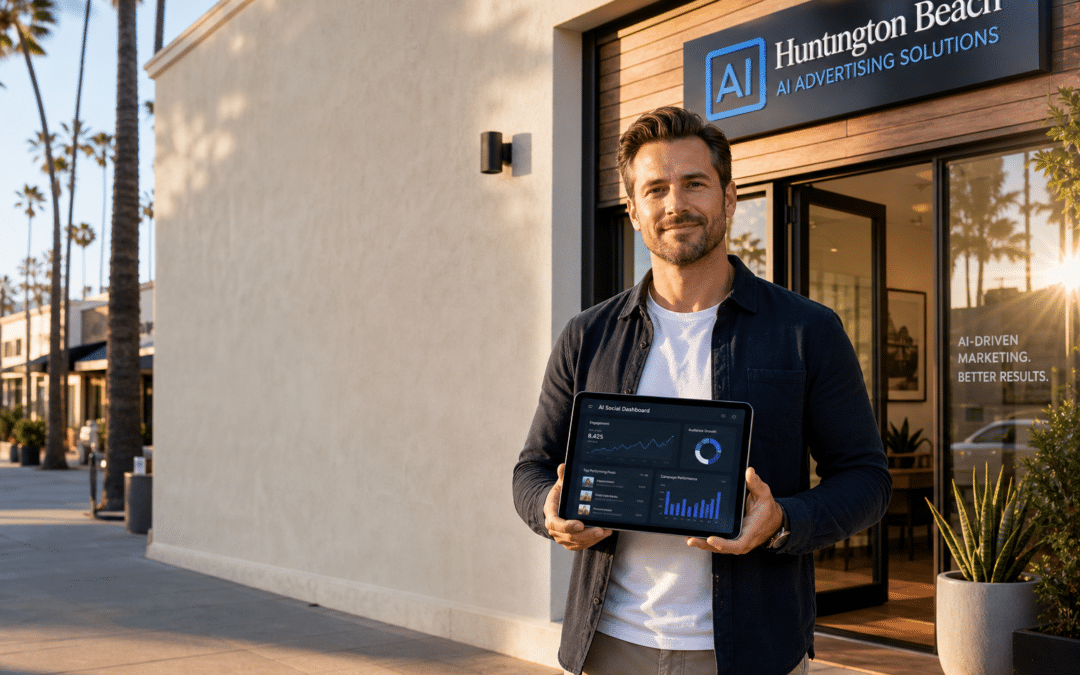
AI advertising for Huntington Beach businesses is no longer optional—it’s quickly becoming the standard for local companies serious about competing and growing. With adoption rates among small businesses in the U.S. now surging, AI-powered campaign targeting, social media management, and real-time optimization deliver sharper insights, fewer wasted dollars, and a faster path to acquiring local customers. The real shift: AI not only makes marketing more efficient, but gives owners back time to focus on what matters most—serving their customers and building their businesses.
Key Takeaways
- AI advertising is rapidly becoming mainstream for Huntington Beach small businesses, with adoption climbing sharply in recent years (Thryv).
- Automated, AI-powered campaigns outperform manual efforts in targeting, budget efficiency, and ongoing optimization—especially in competitive local markets.
- The biggest ROI for local owners comes from time savings and smarter, data-driven customer acquisition, not just lower ad costs.
- Choosing the right AI tools and frameworks means matching business goals to platform strengths—not every solution fits every local need.
- Success depends on blending AI automation with local expertise and regular human oversight; “set and forget” is a recipe for missed opportunities.
Why AI Advertising Is Becoming Standard for Huntington Beach Businesses
AI-driven marketing has gone from a nice-to-have experiment to a baseline requirement for Huntington Beach businesses that want to stay relevant. The old notion that AI is only for big brands or Silicon Valley startups is now outdated. In fact, AI adoption among small businesses surged by 41% between 2024 and 2025, growing from 39% to 55% usage in just a year (Thryv).
Despite this, many owners still underestimate how quickly their competitors are moving. There’s a lingering perception—especially among Main Street shops, salons, fitness studios, and restaurants—that AI advertising must be expensive or overly technical. But by the end of 2026, projections show over 80% of small businesses will be using AI marketing tools, up from just 54% in early 2026 (Forbes). The real risk isn’t overspending—it’s falling behind as customers increasingly expect smarter, more tailored advertising everywhere they look.
What trips up most business owners is the belief that AI advertising works the same for everyone. In reality, local context still matters—a Huntington Beach auto shop or surf retailer will get the best results by combining AI’s automation with deep knowledge of neighborhood trends, seasonal swings, and local competition. The winners are those who use AI as a force multiplier for their own expertise, rather than a replacement for it.
What Sets AI Advertising Apart From Traditional Digital Marketing?
AI-driven campaigns are not just a fancier way to run Google or Facebook ads—they fundamentally change how local businesses target, optimize, and scale their marketing. The key difference: continuous, real-time, data-driven learning. AI platforms like Meta Advantage+, Google Performance Max, and AdRoll use live audience data to adjust targeting, creative, and budget allocation on the fly—far faster than any manual approach.
Most owners have tried the basics: set a budget, choose keywords, and hope for the best. The problem? Manual campaigns often miss real-time shifts in customer behavior and waste spend on the wrong clicks. AI flips the script by analyzing performance data as it comes in, instantly adjusting bids, copy, and placements. For example, Google Performance Max can automatically raise bids for users who have recently searched for “Huntington Beach surfboards,” while Meta Advantage+ might serve different creative to locals scrolling Instagram on a rainy day.
The insight most miss: AI doesn’t just automate what a human would do—it uncovers patterns and opportunities most marketers would never spot. Imagine a surf shop discovering, via its AI dashboard, that posts about local surf conditions drive more store visits on Tuesdays than weekend sales promos. Acting on those timely insights is what turns AI from a buzzword into real-world growth.
How AI Social Media Management Drives Real Customer Acquisition
Social media is the main battleground for many local brands, but the pace and volume overwhelm most small teams. AI-powered tools for social media management now do far more than just schedule posts or spit out generic captions. They analyze which content formats drive engagement, spot trending local topics, and optimize posting times for maximum visibility. For example, a Huntington Beach surf shop using AI might discover that Instagram Reels featuring customer stories get shared and saved much more than product photos—insights surfaced automatically by modern platforms.
Going deeper, AI can prioritize engagement with the most valuable prospects. A fitness studio could use AI-driven chatbots to instantly respond to DMs about trial classes, while filtering out spam and irrelevant messages. This closes the gap between first contact and a booked appointment, turning social channels into true acquisition engines. For more detail on these tactics and tool comparisons, see AI social media management and the AI Social Media Management: Boost Engagement & Authority guide.
Choosing the Right AI Advertising Platform: What Actually Matters?
With dozens of AI marketing tools now on the market, it’s easy to be swayed by flashy features or rock-bottom prices. But the right platform is the one that actually fits your business goals, workflow, and technical comfort—not necessarily the most hyped option. Some platforms excel at automated campaign optimization but offer weak local targeting; others are strong on creative generation but lag on reporting or integration with local systems.
What most buyers overlook is the importance of matching your business goals—like driving phone calls, online bookings, or in-store visits—to the platform’s strengths. For instance, CallRail (for call tracking), Sprout Social (for detailed social analytics), and Google Analytics 4 (for multi-channel attribution) are often essential add-ons for getting the most from your AI spend.
The table below compares three real options for AI advertising platforms commonly used by Huntington Beach businesses:
| Platform | Strengths | Potential Drawbacks | Best Fit For |
|---|---|---|---|
| Meta Advantage+ (Facebook/Instagram) | Automated audience targeting, creative testing, strong local reach | Limited transparency, may prioritize platform spend over ROI | Retailers, restaurants, event-driven businesses |
| Google Performance Max | Cross-channel automation, real-time budget allocation, search intent data | Complex setup, less control over placements, learning curve | Service businesses, professional practices, appointment-driven shops |
| AdRoll | Retargeting, multi-channel automation, e-commerce focus | Works best for online sales, less local targeting depth | E-commerce sites, local stores expanding online sales |
Most local businesses get the best results by fully optimizing one core platform—tracking results closely—before adding more tools. Spreading efforts too thin usually leads to shallow, underperforming campaigns. For industry-specific comparisons of AI tools, see the 2026 AI Advertising Playbook for Chiropractors and the AI advertising management analysis for fitness studios.
The R.O.A.R. Framework: A Practical Approach to Automated Marketing in Orange County
AI advertising works best when guided by a disciplined, repeatable process. The R.O.A.R. Method—Review, Optimize, Automate, Refine—gives Huntington Beach businesses a practical roadmap for success, even without a technical background:
- Review: Start with a clear-eyed assessment of your current marketing. Map where leads and sales are really coming from—using Google Analytics, call tracking, or even a simple spreadsheet. For example, a local cleaning service might realize most profitable bookings originate from Facebook, not Google Ads, prompting a shift in strategy. If you need help with foundational tracking, see AI data analytics for local businesses.
- Optimize: Before layering in AI, tighten up your basics. Refine offers, update landing pages, and make sure contact forms or booking tools actually work. AI can’t fix a broken funnel—it only amplifies results from a solid foundation. If your website is outdated or slow, consider website development & management services before investing heavily in paid traffic.
- Automate: Add AI tools for campaign management, budget allocation, and content scheduling. Start with one or two platforms (like Meta Advantage+ or Google Performance Max), connect business profiles, and launch with a modest test budget. Use built-in split testing features to pit headlines, images, and calls-to-action against each other. Dedicate at least 15 minutes daily during the first month to monitoring performance—AI systems learn and adapt fastest with real feedback.
- Refine: Every 2-4 weeks, review detailed performance reports. Many local businesses stumble here—they set and forget campaigns, missing compounding gains from regular tweaks. Use insights from AI dashboards to reallocate budget, pause underperforming ads, or test new creative. Over time, this cycle builds a marketing engine that gets smarter and more efficient each month. For deeper measurement tactics, see how to measure prompt-level visibility in AI search.
The core advantage of R.O.A.R. is its focus on disciplined iteration. Businesses that make this a monthly habit almost always see steadier growth and higher-quality leads, compared to reviewing marketing once a quarter or less.
Concrete Examples: How AI Advertising Works for Real Huntington Beach Businesses
Theory is great, but local owners need to see how AI advertising plays out in the real world. Here are grounded scenarios from businesses like theirs:
- Example 1: Local Restaurant Group
A family-owned restaurant launches AI-driven Facebook ads targeting residents within five miles, using dynamic creative to promote weekday lunch specials. The platform detects that behind-the-scenes kitchen videos outperform static food shots, automatically shifting budget to the best-performing content. Within a few weeks, lunch reservations start to fill up more consistently. - Example 2: Surf Shop With E-Commerce
A surf retailer uses Google Performance Max to advertise both in-store and online. The AI segments audiences—new movers, local athletes, recent site visitors—and increases bids for ads shown to people who live nearby and have visited the website in the last week. As a result, the shop sees a steady rise in both foot traffic and higher-value online orders. - Example 3: Home Services Business
An HVAC contractor in Huntington Beach leverages AI for campaign management and lead response. The system monitors weather data, boosting ad spend automatically during heat waves, while AI chatbots handle quote requests and schedule appointments instantly. This approach minimizes missed leads and keeps the calendar full—especially during peak demand. For a deeper dive, see the AI Social Media Management for HVAC in Orange County: 2026 Guide.
All these examples share one thing: local relevance and responsiveness. AI surfaces what works in real time and pivots faster than any manual campaign can—making it possible for small businesses to punch above their weight in competitive markets.
What Most Local Businesses Get Wrong About Automated Marketing
There’s a stubborn myth that AI can run your marketing “on autopilot” with zero oversight. This is where even experienced owners in Huntington Beach and Orange County stumble. While AI does automate routine decisions, it still needs human judgment to keep campaigns aligned with business goals, community values, and brand reputation.
The common trap is “set and forget”—launching an AI-driven campaign and then ignoring it, hoping for the best. This hands-off approach often misses subtle shifts in customer sentiment, new competitive offers, or even changes in ad platform rules. Savvy owners stay involved: they check in regularly, provide creative direction, and use AI insights to guide real business decisions—like which services to promote or how to adjust messaging for seasonal demand. For more on building trust and standards with AI in marketing, see AI Agent Standards: Essential Insights for 2026.
The bottom line: AI is a powerful partner, not a replacement for active management. The businesses seeing the best results blend automation with hands-on oversight and a willingness to experiment.
ROI Reality: What AI Advertising Actually Delivers for Customer Acquisition
AI advertising is often hyped for its ROI, but what’s realistic for Huntington Beach businesses? According to Stealth Agents, small businesses using AI report an average return of 3.8 times their initial investment. But this only tells part of the story. The biggest value for most owners is not just the ad cost efficiency—it’s the time saved, reduction in wasted spend, and smarter customer acquisition that builds over time.
One angle many overlook: AI frees up owner and staff time that would otherwise be spent on manual campaign tweaks, basic reporting, or content creation. In fact, Amazon Ads reports that 87% of SMB marketing leaders believe AI in advertising will help future growth by freeing up time for strategic priorities. For a small business, this often translates into faster customer service, quicker order fulfillment, or better in-person engagement—benefits that never show up in a standard ad dashboard.
There are trade-offs: AI advertising does require some upfront learning and periodic troubleshooting, especially when integrating with older systems or unique local offers. And while most platforms promise “zero-touch” automation, owners should plan to spend time on setup and ongoing review to get the best results. The ultimate payoff comes when campaigns start generating steady leads or sales with less daily attention. For more on tracking and measuring these outcomes, see AI data analytics for local businesses.
Checklist: Getting Started With AI Advertising in Huntington Beach
Ready to move from theory to action? Use this checklist to launch or upgrade your AI advertising efforts:
- Audit your current marketing: List all active campaigns and platforms. Use analytics or call tracking to identify which channels are bringing in real results—and where budget is being wasted.
- Define clear goals: Specify what you want—more calls, online bookings, e-commerce sales, or in-store visits.
- Pick one main AI advertising platform to start: Match the choice to your primary goal and local audience, not just the cheapest or most popular option.
- Connect your social accounts, website, and CRM: Integration is essential for smooth data flow and accurate tracking.
- Set a test budget and monitor closely: Start small, let the AI learn, and review early performance daily for the first month.
- Refine creative and offers: Use AI-generated suggestions, but always add a local, authentic touch—like team photos, customer testimonials, or community events.
- Review and adjust every 2-4 weeks: Use AI analytics and your own judgment to shift spend, swap creative, or test new ideas.
- Plan for ongoing education: AI tools evolve quickly, so schedule time each quarter to stay up to date on new features or best practices. For creative support, see AI content creation and video creation services.
Following this checklist helps avoid common pitfalls—like overspending on the wrong tool, neglecting oversight, or confusing automation with real strategy.
Final Thoughts: The Future of AI Advertising for Local Businesses
Adoption of AI advertising is accelerating fast, especially in tech-forward regions like Huntington Beach and Orange County. Approximately 68% of U.S. small businesses with 10-100 employees were already using AI as of 2025 (AdAI). The window for early advantage is closing—the businesses winning new customers now are those willing to embrace automation, stay hands-on, and pair AI speed with local expertise.
AI advertising for Huntington Beach businesses works best as a strategic ally, not a replacement for your unique voice or local roots. The most effective owners combine automation with regular oversight, creative experimentation, and a relentless focus on what brings in real customers. For those ready to make the leap, the best move is to start—test, refine, and learn as you go. For others seeking guidance, Lion Click Media is one of several reputable partners helping local businesses navigate this new era of automated marketing in Orange County.
Frequently Asked Questions
How much does AI advertising cost for a small business in Huntington Beach?
AI advertising costs vary widely based on campaign scope and platforms used; many local businesses budget in the low-to-mid four figures monthly, but starting small and scaling based on results is the best approach.
Can AI social media management replace a human marketing team?
AI social media management excels at automating routine tasks and optimizing posting schedules, but human oversight ensures messaging stays authentic and aligned with brand voice, especially for local businesses.
What’s the difference between AI advertising and traditional digital ads?
AI advertising uses machine learning to automate targeting, bidding, and creative adjustments in real time, whereas traditional digital ads rely more on manual setup and periodic optimization.
How do I measure the success of AI advertising campaigns locally?
Track key metrics like click-through rates, cost per lead, and conversion rates tied to local targeting, combined with CRM data to understand customer acquisition cost and lifetime value.
Is AI advertising suitable for service-based businesses in Huntington Beach?
Yes, especially for service businesses with frequent customer interactions, AI advertising can drive steady leads by targeting local audiences and engaging them through personalized content and timely ads.
How quickly can AI advertising campaigns start showing results?
Many local businesses see noticeable engagement lifts within weeks, but depending on industry and budget, meaningful lead generation improvements typically emerge over a few months of consistent optimization.
Can AI advertising help with seasonal businesses in Huntington Beach?
Absolutely; AI can adjust campaigns dynamically to capitalize on seasonal demand spikes and local events, ensuring ad spend aligns with peak customer interest periods.
Get Your Free AI Marketing Audit
See exactly where you are leaving leads on the table and how Lion Click Media can help you rank higher, capture more customers, and Make Your Brand ROAR. No cost, no obligation.
Claim My Free Audit →Or chat with our 24/7 AI assistant (bottom-right) for instant answers.