
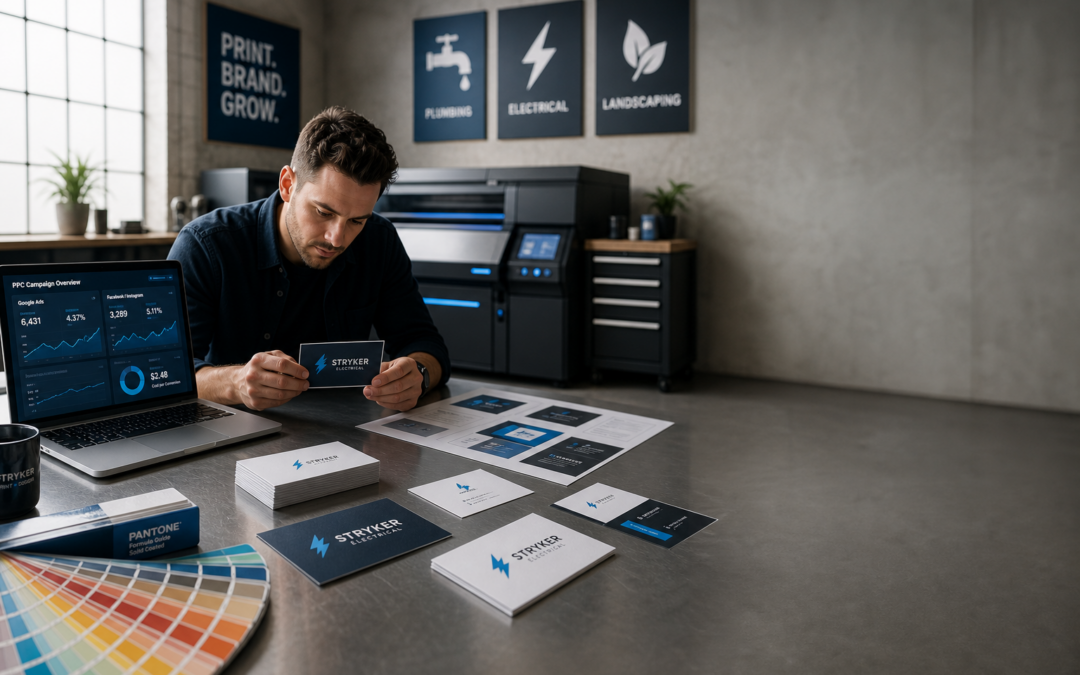
Logo and business card design is absolutely worth it for home services businesses in 2026—if you treat it as a strategic marketing asset, not just a cosmetic extra. The right visual identity still drives trust and recall, but the stakes are higher: homeowners research online, AI tools surface brands for comparison, and a poor showing can actively turn prospects away. Design should be deliberate and integrated across digital and physical channels, not an afterthought or box to check.
Key Takeaways
- A professionally designed logo and business card directly affect your business’s perceived credibility—poor quality can harm your reputation with both humans and AI-driven platforms (WeMet).
- Physical cards still work for in-person sales and referrals—but only when they reinforce your digital brand, not as standalone tools.
- AI-powered search and recommendation engines now pay attention to visual branding cues, so inconsistent or missing branding can limit your visibility (OpenLens).
- Most home services owners overlook the compound effect of cohesive branding on word-of-mouth, conversion rates, and AI search performance.
- Branding delivers the best ROI when logo and card design are integrated with your website, advertising, and review management—not treated as isolated projects.
Is Logo & Business Card Design Still Relevant for Home Services in 2026?
Absolutely—but the reasons have evolved. With nearly all homeowners researching services online and AI tools playing a bigger role, your branding isn’t just about first impressions at the kitchen table anymore. It’s everywhere: on your website, in search results, on social media, and on your trucks. According to WeMet, a 2026 study found that 72% of decision-makers believe a poor-quality business card damages their company’s image. That’s not vanity—it’s about establishing trust at every touchpoint, digital or physical.
Here’s where most home services businesses misstep: they treat logo and business card design as a quick, disposable purchase or a DIY project on Canva. In reality, your branding either multiplies the impact of every other marketing investment, or it quietly undercuts your credibility. For example, a plumbing company with a clean, cohesive logo and card will see that visual echoed across digital ads, uniforms, review sites, and vehicle wraps—boosting trust and making it easier for both customers and AI to recognize you. Inconsistent or amateur visuals, on the other hand, sow doubt—especially as AI tools like ChatGPT begin to influence homeowner research (Scorpion).
The real value in 2026: your logo and business card are the connective tissue between your physical and digital presence. They help you stand out—if you design them with the full customer journey in mind. For a breakdown of current design trends and practical examples, see Logo & Business Card Design Trends Los Angeles Marketers Need in 2026.
Why Home Services Branding Isn’t “Optional” Anymore—And What Most Owners Overlook
Branding has shifted from a “nice-to-have” to a baseline requirement. The modern homeowner almost always starts their search online, comparing multiple providers before reaching out. According to Scorpion, in 2026, 83% of homeowners start their search for home services online, with 22% using AI tools like ChatGPT for research and recommendations. This means your logo, business card, Google Business Profile avatar, and website visuals must all work together to convey credibility instantly—both to people and algorithms.
Most owners miss this: branding isn’t about looking fancy. It’s about removing friction and uncertainty for your customer. When your visual identity is memorable and consistent, it shortens the mental leap a homeowner makes to choose you over a dozen competitors. A cohesive logo, color palette, and typography signal reliability and pride—even before anyone reads a review. Conversely, mismatched fonts, colors, or card quality create subtle doubts that can cost you business in a crowded market.
The companies pulling ahead treat branding as the foundation for every marketing move—not a standalone project. They integrate logo and card design with their conversion-focused website, AI advertising, and even vehicle wraps. For a practical cost breakdown and real-world trade-offs, see Brand Identity & Logo Design Costs in 2026: Real Pricing.
What Actually Impacts Business Card ROI in Home Services?
Despite the dominance of digital marketing, business cards still matter for home services—when used strategically. A business card is more than a formality; it’s a tangible trust token you hand out at a job, a networking event, or a local coffee shop. The real ROI comes from how you use your cards to drive referrals and in-person conversions—not just having them printed.
- Quality and Consistency: A poorly designed or flimsy card can actively harm your image (WeMet). High-quality stock, professional design, and consistent branding signal attention to detail and professionalism—especially critical for trades where trust is everything.
- Strategic Placement: The businesses that see the most referrals use cards as part of a process: they train field staff to hand them out after a job well done, leave stacks at local businesses, and encourage customers to pass them along. For example, leaving cards with real estate offices can spark word-of-mouth that digital ads alone can’t replicate.
- Integrated Digital Elements: Modern cards often include QR codes linking directly to your Google reviews, booking page, or portfolio. This bridges the offline and online worlds, making it easy for prospects to take the next step.
The biggest waste: printing cards and letting them gather dust in your van. The best businesses treat cards as an active sales tool—tracking where they’re distributed and following up with customers. For more on maximizing your business card’s impact, see The Complete Los Angeles Buyer’s Guide.
Logo Design Benefits That Go Beyond Aesthetics
A logo is more than a badge—it’s a memory shortcut and a trust signal that works across every touchpoint. With AI and visual search tools evolving, your logo’s real value is in its consistency and recognizability, not just its look. A distinctive, adaptable logo helps homeowners remember you and makes it easier for AI to correctly identify your business online.
What many home service businesses underestimate is the compound effect of seeing the same logo on your card, website, Facebook page, and van. This sense of stability builds trust—especially as AI-driven search results increasingly use visual cues and review profiles to surface providers. For instance, if your logo is inconsistent or missing from key platforms, AI tools may overlook you in favor of third-party publishers (OpenLens).
The crucial insight: logos drive recall, not just recognition. Imagine a homeowner remembering your logo weeks after an estimate, or spotting your truck from down the block. That’s when branding investments pay off in repeat business and referrals. Want to avoid common mistakes? See 7 Logo Design Mistakes Costing Cosmetic Clinics Leads—the same pitfalls sink home service brands, too.
How AI, Search, and Visual Branding Intersect in 2026
AI-driven search and recommendation tools are fundamentally shifting how homeowners find local service providers. As of 2026, a significant portion of homeowners use platforms like ChatGPT for recommendations, and these tools often reference both third-party publishers and local business listings (Scorpion; OpenLens). Critically, your visual identity—logo, card imagery, branded photos—needs to be optimized for both people and algorithms.
Here’s what many businesses miss: AI tools scrape business information and images from everywhere—Google Business Profiles, your website, directories, and review sites. If your logo is blurry, inconsistent, or missing, you risk being overlooked or misrepresented. OpenLens found that for “hybrid-intent” plumber searches, only 40% of AI citations pointed to local businesses, with the rest going to third-party publishers (OpenLens).
The actionable move: upload high-resolution logo files to every major platform—Google, Yelp, local directories, and social media. This increases your odds of being featured accurately by AI tools and makes your brand stand out in search results. For more on integrating branding with your web presence, see the 2026 Conversion-Focused Web Design Playbook for Home Services.
The R.O.A.R. Method for Maximizing Branding ROI in Home Services
To get the most from your investment in branding, use the R.O.A.R. Method—Research, Own, Activate, Review. This approach ties every branding dollar to real marketing outcomes, not just looks.
- Research: Start by mapping your competitive landscape. Use tools like Google Trends to spot overused symbols and colors in your market, and Brandwatch or Sprout Social for social listening. Interview customers about what visuals make them trust a home service provider. Review competitors’ digital profiles and business cards to identify gaps you can fill.
- Own: Claim a distinct position. Don’t copy generic plumbing wrenches or blue/green color palettes just because they’re common. Work with a professional designer who understands how to create adaptable logos that work on trucks, uniforms, and online. For cards, invest in premium stock—matte, soft-touch, or spot UV finishes can make yours stand out physically. Use a consistent font and color palette across all materials to reinforce recognition.
- Activate: Deploy your branding everywhere: on your website, business cards, uniforms, vehicle wraps, invoices, and digital profiles. Add QR codes to cards that link directly to your Google reviews or booking page. Equip staff with talking points about your brand story. Make sure logo files are synced across your website, social media accounts, and review platforms.
- Review: Track how branding changes impact your business: ask every new customer how they found you and what caught their eye. Monitor web traffic, inbound calls, and form submissions after rolling out new cards or updating your logo. Tools like Google Analytics and CallRail can help measure outcomes. Use AI analytics to watch for changes in brand mentions and search visibility, then adjust your approach as needed.
The key: treat branding as an ongoing process, not a one-and-done project. Swap out card batches if they’re not resonating, tweak colors if they blend in, and update templates as your business evolves. For a deeper dive into the costs and logistics of this process, see Brand Identity & Logo Design Costs in 2026.
Comparison: DIY vs. Professional Logo & Business Card Design—What’s Right for You?
| Option | Pros | Cons | Best For |
|---|---|---|---|
| DIY Templates (e.g., Canva, Vistaprint) | Low upfront cost, quick turnaround, easy to update | Generic look, high risk of overlap with competitors, limited scalability | Startups with shoestring budgets or temporary ventures |
| Freelance Designer | Custom design, more unique than templates, one-on-one collaboration | Quality and expertise vary, may lack strategic guidance, risk if used for rebrands | Small businesses upgrading from DIY, those not ready for a full agency |
| Professional Agency | Strategic, cohesive branding across all touchpoints, high-quality files for web and print | Higher upfront investment, longer process, may bundle services you don’t need | Established businesses investing in long-term growth and market differentiation |
| AI-Powered Design Tools | Affordable, rapid option generation, useful for brainstorming | Lacks originality, can produce awkward results, limited support for complex needs | Early-stage brainstorming, quick fixes, or concept testing |
The real trade-off: DIY and AI tools seem budget-friendly, but rarely deliver true differentiation. In a competitive home services market, at least a professional freelancer is usually needed to stand out—while an agency can offer the strategy and asset integration that drive long-term results. For a side-by-side comparison tailored to real estate, see Brand Identity & Logo Design vs DIY for Real Estate Agents.
Real-World Scenarios: When Is Logo & Business Card Design Worth It—and When Isn’t It?
There’s no one-size-fits-all answer. Here are four specific scenarios to clarify when investing in professional logo and business card design delivers real value:
- Launching a New Brand or Rebranding: If you’re entering a crowded market or your old visuals look dated, professional design helps you stand out and look credible from day one. For example, a new HVAC business in Los Angeles will need a distinctive logo and sharp cards to break through.
- Expanding Service Areas: As you move into new neighborhoods or cities, a consistent visual identity helps build recognition and word-of-mouth referrals. Think of a landscaping company adding a second crew in a neighboring town—cohesive branding ensures your reputation travels with you.
- Shifting to Digital-First Marketing: If you’re ramping up AI advertising campaigns, social media, or online booking, your branding must match the quality and messaging of your digital assets. Weak visuals will undermine your efforts as AI tools increasingly reference branded images in their recommendations.
- Shoestring Budgets or Short-Term Operations: For a side-gig handyman or a one-off seasonal venture, DIY may be enough—but beware looking temporary or unprofessional. Even on a tight budget, steer clear of the most generic templates.
Bottom line: Don’t overspend if your business model doesn’t warrant it, but recognize that in most competitive home service niches, the boost in visual credibility pays off many times over as both human and AI-driven expectations rise.
Integrating Logo & Card Design with Your Digital Marketing Stack
Too many home service businesses treat logo and card design as a silo, disconnected from their digital marketing, website, or print advertising. The businesses seeing the best results treat branding as the foundation for their entire marketing stack.
- File Consistency: Store your logo files in multiple formats (SVG, PNG, JPEG) and resolutions for crisp display on cards and screens.
- Web Sync: Immediately update your website, booking forms, and AI-generated content with fresh branding assets.
- Review Management: Add your logo to Google Business Profile, Yelp, and major review sites. This helps AI search tools recognize your business and also reassures customers.
- Social Media Profiles: Use your logo as your profile image on Facebook, Instagram, and Nextdoor. Consistency here is non-negotiable, especially as AI social media management tools automate your posting and engagement.
- Print Collateral: Extend your design to flyers, door hangers, and vehicle wraps for a unified offline presence. For ROI insights on print, see Is Print Marketing & Flyer Design Worth It? Real ROI for HVAC.
The more consistently your branding appears—across digital and print, online and offline—the more credible and memorable your business becomes, to both people and algorithms.
Honest Trade-Offs: When Branding Isn’t Enough (and What to Fix First)
A professional logo and business card can’t fix deeper marketing or operational issues. Too many businesses hope a rebrand will rescue a struggling operation or distract from poor reviews. In truth, branding amplifies what’s working—it can’t cover up slow response times, negative feedback, or a clunky website.
If you’re struggling with low close rates, slow answers, or bad reviews, invest first in operational improvements and reputation management. For example, in 2026, home service businesses that adopted AI for phone answering, dispatch, and Google Business Profile management reduced their cost per booked job from $87 to $43 (The Stacc). Branding works best when paired with operational excellence and a modern digital strategy.
A concrete scenario: a plumbing company with reliable service and good reviews, but an outdated logo, will see a real lift from a brand refresh. But a company with chronic scheduling issues and a broken website won’t see much benefit from new cards alone. For actionable steps on improving your web conversion before (or alongside) a rebrand, see How Home Services Use Conversion-Focused Design to Win.
Conclusion: The Strategic Value of Design in Home Services Marketing
In 2026, the real question isn’t whether logo and business card design is worth it for home services businesses—it’s how strategically you execute. When branding is built into your online presence, review management, and AI-driven marketing, it delivers outsized returns in trust, recall, and conversion. The value isn’t in a pretty logo or a pile of gloss cards, but in the credibility and cohesion they bring to every customer interaction—from first search to final invoice.
For business owners serious about growing, logo and business card design should be the starting point of a smarter marketing system—one that connects your physical and digital presence, and helps both people and AI-driven platforms recognize and recommend you. That’s what separates businesses homeowners remember from those they scroll past.
Lion Click Media, based in Orange County, CA, is just one example of agencies that help home services brands bridge this gap—but regardless of who you work with, the principles remain: design for trust, integrate for impact, and review your results relentlessly.
Frequently Asked Questions
How much should I spend on logo design for a small home services business?
Spending varies widely, but many small home services businesses budget in the low-to-mid three figures for a professional logo that avoids generic or DIY pitfalls while providing scalable use across digital and print.
Can I use the same logo and business card design across all my advertising channels?
Yes, consistency in logo and business card design across all advertising channels, including AI-powered PPC and social media, strengthens brand recognition and trust, which helps improve campaign performance.
Are business cards still effective in the digital age for home service providers?
Business cards remain effective especially for face-to-face interactions and local events, serving as tangible reminders linking prospects to your brand, particularly when enhanced with digital elements like QR codes.
How does AI improve the value of my logo and business card design in marketing?
AI optimizes ad targeting and creative testing using your branding assets, ensuring that your logo and business card designs contribute to better lead quality and lower acquisition costs by reinforcing brand familiarity.
Is it better to hire a freelancer or an agency for my home service branding needs?
Freelancers can provide cost-effective, custom designs, but AI-powered agencies offer integrated branding and marketing strategies that leverage data-driven insights, which is critical in competitive markets aiming for growth.
What are common mistakes home services businesses make with logo design?
Common mistakes include choosing overly complex designs, ignoring scalability for different platforms, and underinvesting to the point the logo looks unprofessional or generic, all of which can hurt customer trust.
How can I measure if my logo and business card design are actually helping my business?
Tracking metrics like click-through rates in AI advertising campaigns, lead conversion rates, and customer feedback can help measure if your branding assets are driving engagement and trust effectively.
Get Your Free AI Marketing Audit
See exactly where you are leaving leads on the table and how Lion Click Media can help you rank higher, capture more customers, and Make Your Brand ROAR. No cost, no obligation.
Claim My Free Audit →Or chat with our 24/7 AI assistant (bottom-right) for instant answers.