
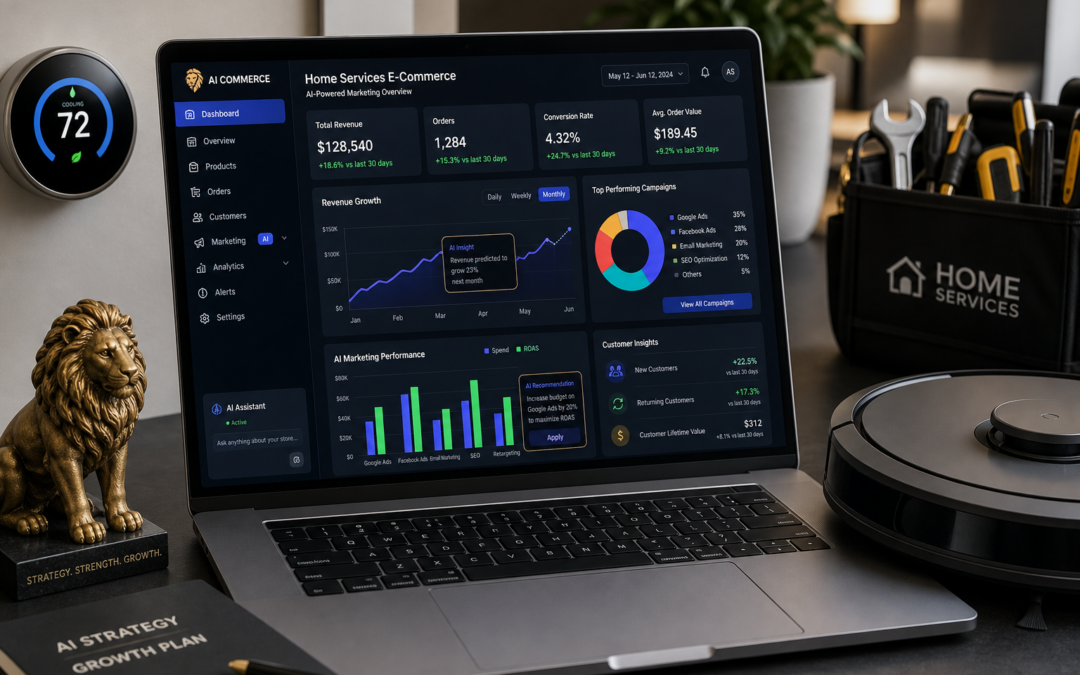
AI e-commerce marketing for home services in 2026 is no longer a “nice-to-have”—it’s a competitive necessity, but most owners underestimate the real choices and potential pitfalls involved. The decision to build in-house AI marketing capabilities or partner with a specialized agency is about more than just budget or control: it’s a test of your ability to keep up with rapid shifts in technology, customer expectations, and the challenge of integrating AI with legacy systems. Too many service brands are caught off guard by the ongoing investment, hidden integration challenges, and the need for real strategic oversight that distinguishes market leaders from the rest.
Key Takeaways
- AI e-commerce marketing is now essential for home services—consumers expect more than a basic website or ad spend, and competitors are raising the bar with smarter, more responsive digital experiences.
- In-house teams offer direct control and tailored strategy, but require significant, ongoing investment in specialized talent, technology, and adapting processes. Agencies deliver speed, deep expertise, and lessons from working with many markets, but you trade off some hands-on oversight.
- The difference in annual cost between a lean in-house team and hiring a full-service agency can be substantial—many businesses see potential gaps in the six-figure range, but the real impact depends on the level of specialization, tool choices, and how much ongoing support is needed. See AI Advantage Agency for a sample breakdown of common cost structures.
- Your decision should depend on your team’s ability to adapt quickly, integrate new tools with existing systems, and commit to ongoing investment—not just the headline costs.
- Most failures happen because businesses underestimate the complexity of AI integration with legacy systems or lack a clear owner for ongoing AI strategy and oversight.
Why AI E-Commerce Marketing Has Become Non-Negotiable for Home Services
By 2026, 83% of homeowners begin their search for service providers online, and nearly a quarter use AI tools like ChatGPT to research or get recommendations. If your business isn’t appearing where AI engines surface options—or if your e-commerce experience feels clunky compared to what consumers now expect—you’re at a disadvantage before the first call.
A common misconception is that a visually appealing website or basic Google Ads campaign is sufficient. In reality, AI-driven e-commerce marketing in home services now includes automated lead intake, dynamic pricing, predictive appointment scheduling, and personalized follow-up sequences—most of which occur before a human ever gets involved. Research by Invoca found that 63% of home services consumers in the US and UK couldn’t reliably tell if they were interacting with AI or a human during their buying journey.
Brands that are moving ahead are embedding AI at every touchpoint—not just to reduce costs, but to create a seamless, responsive customer journey. The “AI gap” is increasingly visible as shrinking lead pipelines and lower conversion rates for those lagging behind. For tactical examples of how HVAC companies are evolving, see the 2026 AI E-Commerce Marketing Playbook for HVAC Companies and this Modern Retail article on AI-enabled customer experience improvements.
In-House vs Agency: What Most Owners Overlook About the Real Costs
When comparing agency vs. in-house marketing, the visible costs are just the starting point. Many owners focus on agency retainers or salary lines, overlooking the deeper costs of building real AI marketing capacity. According to AI Advantage Agency, a sample calculation for a modest five-person in-house marketing team comes to over $520,000 per year fully loaded, while a typical agency retainer averages $180,000. These are illustrative figures and actual costs can vary widely—what matters most is understanding what’s included (like ongoing support, strategy, and integration work) and what’s extra.
However, the bigger drag on in-house ROI isn’t just payroll. There are ongoing expenses for AI tool licenses, integration work, troubleshooting, and keeping up with new features, algorithm changes, and compliance requirements. The opportunity cost can be significant: every week your team spends patching a chatbot or manually segmenting leads is a week not spent on launching campaigns or optimizing for conversions.
Agencies often move faster, bringing specialized expertise and a broader perspective from working across many industries. However, you may have less direct control and might compete for attention if you’re not a top-tier client. The real decision point is your team’s true capacity to keep up with AI’s rapid evolution. Many home service brands overestimate their ability to “DIY” advanced AI marketing after a few early successes, only to hit a wall with integration or talent shortages. For a detailed, sector-specific comparison, see AI E-Commerce Marketing for HVAC Companies: In-House vs Agency and this Forrester report on hidden marketing technology costs.
What Actually Changes When You Add AI to Home Services E-Commerce?
Adding AI isn’t just about “turning on” a new tool—it reshapes your entire marketing and sales workflow. Instead of only generating leads, you’re orchestrating a personalized journey: AI-driven lead scoring, automated appointment reminders, dynamic pricing suggestions, and targeted post-service upsells, all triggered by customer data and behavior.
The most common mistake? Adding AI tools on top of old processes and expecting transformational results. AI has the biggest impact when it’s woven throughout intake, nurture, conversion, and retention. For instance, imagine an HVAC company that implements an AI-powered chatbot for instant quotes and real-time scheduling—response times can drop dramatically and lead capture often rises, allowing staff to focus on higher-value work. For a hands-on guide to optimizing these touchpoints, see the 2026 Conversion-Focused Web Design Playbook for Home Services and McKinsey’s research on AI and customer experience.
That said, integration is rarely plug-and-play. AI models require training on your actual customer data, connections to your CRM (like ServiceTitan or HubSpot), and ongoing monitoring for accuracy and fairness. Skipping these steps leads to “AI in name only”—automation without real results. For practical examples of what integration looks like, see Website Development & Management.
Scenario Deep Dive: When Does In-House Make Sense?
Picture a fast-growing plumbing business with a tech-oriented CEO, a strong IT foundation, and a hands-on approach to every customer interaction. In this scenario, building an in-house AI e-commerce marketing team could be the right call—but only if leadership is committed to treating marketing as part of ongoing R&D, not just a support function, and is prepared for meaningful ongoing investment.
What’s truly required? Beyond marketers, you’ll need to attract and retain AI specialists, data analysts, and UX designers who understand home services. These skills are in high demand and command salaries that can stretch most small and midsize business budgets. Ongoing training and upskilling are essential, as AI platforms and best practices change rapidly. A common pitfall: starting with a basic AI tool, only to face mounting integration issues, rising costs, or team knowledge gaps as your needs get more complex.
In-house works best for those who want complete control, are willing to budget for ongoing trial-and-error, and see marketing as a core differentiator—not just a cost center. For most small-to-midsize home service firms, a hybrid or agency approach is usually more practical. For a decision-tree on when to go in-house vs. hybrid, see AI E-Commerce Marketing for HVAC Companies: In-House vs Agency.
How Agencies Empower Home Services Brands to Move Faster
Specialized AI marketing agencies have a structural advantage: they operate at scale, stay up-to-date on the latest AI tools, and bring proven best practices from multiple industries. This enables quicker onboarding to new platforms, swift pivots when algorithms or compliance rules change, and access to talent that’s hard to recruit in-house.
A less discussed benefit is the cross-pollination of ideas. Agencies that work with dozens of service businesses can spot shifts in lead quality, campaign fatigue, and consumer behavior faster than most in-house teams. They can adapt successful tactics from one vertical to another, saving you from reinventing the wheel. The trade-off? As a smaller client, you might get less tailored attention—so it’s crucial to set clear expectations around metrics and require regular, data-focused check-ins.
For example, say a medium-sized landscaping business wants to test AI-powered video ads, automated review requests, and predictive lead scoring in a single quarter. An agency can roll out, measure, and refine all three at once. An in-house team might still be working through basic integrations. For a comparison of agency capabilities, see Best AI E-Commerce Marketing for HVAC Companies in 2026 and the Gartner guide to selecting AI-powered agencies.
The 2026 Reality: AI Agents, Unified Commerce, and the New Service Funnel
One of the biggest shifts for 2026 is the rise of task-specific AI agents embedded in e-commerce flows. TechRadar reports that 40% of enterprise applications are expected to include these AI agents (up from under 5% in 2025), handling everything from lead qualification to appointment booking and follow-up.
Unified commerce—where customers move smoothly between your website, chat, voice, and social channels with their data and preferences intact—is quickly becoming the norm. Service brands that connect AI across these touchpoints create a frictionless journey; those with patchwork systems risk losing leads and delivering inconsistent experiences. For a deeper look at omnichannel AI in service businesses, see this Accenture analysis.
A frequent trap: treating AI as a “set and forget” install. In reality, someone must own AI orchestration—being accountable for the customer journey, compliance, retraining, and measuring results. Without this, businesses end up with disconnected bots, inconsistent messaging, and data silos.
Framework for Smart AI E-Commerce Marketing Decisions: The S.C.A.L.E. Checklist
To navigate your options, use the S.C.A.L.E. Checklist for evaluating your AI e-commerce marketing approach. Each point leads to a concrete decision—skipping one can undermine your results. Below, each step is illustrated with a real-world scenario or tip:
- Strategy Alignment: Be specific about your goal. For example, say your plumbing business wants to cut manual scheduling calls by half within six months. Write that down, then identify which AI features (like automated online booking) directly support that goal. This makes it easier to select tools or partners that fit, instead of chasing generic automation.
- Capacity Audit: List who on your current team knows how to manage AI-powered tools such as ServiceTitan, Salesforce’s Einstein AI, or HubSpot’s AI modules. Ask: Can anyone troubleshoot, interpret analytics, and run rapid-fire campaigns weekly? If not, consider a hybrid or agency model to avoid delays and costly mistakes. For a practical worksheet, adapt sample team audit templates from Website Development & Management.
- AI Integration Plan: Draw a map of how each AI tool will connect to your CRM, website, and booking systems. List every data handoff. Use tools like Zapier or Make for simple connections, but flag anything that will need a developer or direct API work. For example, integrating an AI live chat with your CRM might seem easy, but often needs manual configuration to avoid duplicate leads or missed follow-ups.
- Lead Quality Monitoring: Set up a dashboard to track not just the number of leads, but call quality, conversion rates, and customer satisfaction. Tools like CallRail or Invoca can help. If you notice a sudden spike in low-quality leads, use feedback loops to fine-tune your AI’s targeting or messaging—don’t just celebrate the volume.
- Evolution & Experimentation: Reserve budget and time each quarter to test new tools or campaign ideas. For instance, you might dedicate one month to A/B testing automated follow-up emails. Regularly prune tools you aren’t using and double down on features that consistently drive results. For more on content-specific AI challenges, see Mastering AI Content Creation: Navigate Google’s 2026 Update.
Assigning a specific owner and deadline for each S.C.A.L.E. step turns a vague intention into actual progress. For those just starting, even a simple shared checklist or project tracker can help clarify roles and keep your team accountable.
Comparison Table: In-House vs Agency vs Hybrid AI E-Commerce Marketing
| Approach | Pros | Cons | Best For |
|---|---|---|---|
| In-House Team | Full control, tailored to brand, direct oversight, integrates with internal systems | High ongoing costs, recruiting challenges, slower to adopt new AI tools, risk of skill gaps | Large, tech-forward firms with deep pockets and long-term vision |
| Agency | Speed to market, access to experts, lower fixed costs, cross-industry insights | Less direct control, potential for less brand-specific nuance, must manage the relationship closely | Small-to-midsize firms, or those needing rapid results and broad expertise |
| Hybrid | Balance of control and speed, mix of internal knowledge with external scale, flexibility as needs change | Complex management, risk of blurred accountability, can be costly if not managed well | Growth-stage businesses, or those with partial internal capacity |
Essential AI E-Commerce Marketing Tools and Services for Home Services
To stay competitive, home service brands in 2026 need a functional stack that covers AI-powered ad campaign management, dynamic website personalization, automated live chat and lead intake, and clear analytics. Major platforms like HubSpot, Salesforce, and ServiceTitan now offer AI modules for things like automated appointment follow-up, predictive lead scoring, and real-time reporting.
But buying tools isn’t enough—the real difference comes from how they’re set up for your unique sales cycle and customer base. For example, integrating an AI live chat tool (like Intercom or Drift) directly with your CRM, then setting it to trigger personalized follow-up, can noticeably shorten response times and improve lead nurturing. For detailed guides on selecting and configuring tools, see AI Live Chat & Lead Intake Assistant and AI Advertising Campaigns, as well as Capterra’s independent review of marketing tools.
Action step: audit your stack every quarter for overlapping features, unused licenses, and integration gaps. Many companies end up with three tools for the same job—or none that truly serve their core needs. For more on optimizing your digital setup, see Website Development & Management and E-Commerce Services.
Trade-Offs and Caveats: What No One Tells You About AI in Home Services Marketing
AI is not a cure-all, and every home service business faces real trade-offs. First, the learning curve can be steep—AI tools only work if the data and strategy behind them are strong. Routine data cleaning, prompt tuning, feedback loops, and ongoing retraining are essential steps that are often overlooked.
Second, AI will amplify both strengths and weaknesses in your processes. If your intake flow is confusing or your service descriptions are unclear, AI will replicate those issues at scale. Third, compliance and privacy risks are growing as AI handles more personal data. Failing to monitor for bias, misleading responses, or regulatory slip-ups can result in lost leads or damage to your reputation. For a practical guide to privacy and compliance, see this independent compliance resource.
The most overlooked caveat: AI can automate, but cannot replace human judgment. Strategic direction, creative messaging, and troubleshooting still require a human touch. The businesses that thrive in 2026 will pair AI with attentive, ongoing oversight—not simply “set and forget” their tech stack.
What’s Next? Adapting to the Ongoing Evolution of AI E-Commerce in Home Services
The pace of AI-driven change in e-commerce marketing is only accelerating. Most consumers now interact with AI-powered touchpoints—often without realizing it—and 80% of retail and CPG companies are piloting or deploying generative AI at scale, with AI-referred traffic to US retail sites up 4,700% year-over-year. The competitive bar keeps rising. Home service brands who treat AI marketing as a one-off project will be outpaced by those who build for ongoing adaptation and learning.
Expect more “invisible” AI—where customers may never realize they’re interacting with a bot or being routed by an algorithm—and more advanced e-commerce techniques, from predictive pricing to highly targeted segmentation. The winners will invest in both technology and the human expertise to guide it. Whether you choose in-house, agency, or hybrid, your playbook should include regular audits, frequent testing, and relentless focus on real lead quality—not just quantity.
For those serious about building a future-proof AI marketing engine, start with a candid assessment of your goals, your in-house capacity, and your willingness to adapt. The future isn’t about picking the “best” tool—it’s about fostering a culture of experimentation and continuous improvement. If you seek outside expertise, a global agency such as Lion Click Media can help accelerate adoption—provided you start with clear expectations and shared performance benchmarks.
References and Further Reading
- Street Fight Mag: Growing Performance Gap in the Home Services Economy (2026)
- Invoca: Home Services Buyer Experience Report 2026
- AI Advantage Agency: In-House vs. Agency Cost Breakdown
- Modern Retail: How Home Services Platforms Are Using AI
- Forrester: The Hidden Costs of Marketing Technology
- McKinsey: How AI Is Revolutionizing Customer Experience
- TechRadar: Why Agentic AI and Unified Commerce Will Define Ecommerce in 2026
- Accenture: Unified Commerce and AI
- Gartner: How Marketers Can Choose the Right AI-Powered Agency
- Presenc.ai: AI in Retail and Ecommerce Statistics 2026
- Capterra: Best Marketing Tools for Small Businesses
- Privacy.org: AI Marketing Compliance Guide
Frequently Asked Questions
Can small home services businesses benefit from AI e-commerce marketing?
Yes, even small businesses can leverage AI tools for lead capture, personalized offers, and automated follow-ups, improving conversion without massive budgets.
Is it better to start AI marketing in-house or with an agency?
Starting with an agency often accelerates learning and results, while building in-house is a longer-term investment best suited for stable businesses.
How does AI improve online booking for home services?
AI personalizes booking flows, predicts service needs, and uses chatbots to answer questions instantly, reducing friction and increasing appointment rates.
What skills should an in-house AI marketing team have?
They need expertise in AI-powered analytics, content automation, paid media AI tools, and CRM integrations tailored to service-based e-commerce.
Are AI marketing agencies more expensive than freelancers?
Agencies typically charge more but offer comprehensive, scalable services and access to proprietary AI technology that freelancers may lack.
Can hybrid models cause confusion between in-house and agency roles?
Yes, without clear role definitions and communication, hybrid approaches risk duplicated efforts or mixed messaging, so strong coordination is essential.
What AI tools are critical for home services e-commerce marketing?
Key tools include AI content creation platforms, live chat lead intake assistants, AI-driven ad bidding systems, and advanced CRM AI modules.
Get Your Free AI Marketing Audit
See exactly where you are leaving leads on the table and how Lion Click Media can help you rank higher, capture more customers, and Make Your Brand ROAR. No cost, no obligation.
Claim My Free Audit →Or chat with our 24/7 AI assistant (bottom-right) for instant answers.